
Catalog production for D2C jewelry brands.
Built for the brands that count stones, prongs and motifs the way buyers do. Marketplace-spec jewelry catalogs — Myntra, Tata CLiQ Luxe, Nykaa Luxe, Amazon India — in 24 hours, with stone count, prong count and metal hue locked to your flat-lay. 50–200 SKUs in a day.
Last verified: 2026-05-22

Built for jewelry-brand operators in India
Jewelry has a cycle-time and fidelity problem.
D2C jewelry brands face a unique catalog-production problem. Each SKU is defined by countable primitives — stone count, prong count, metal alloy hue, facet pattern — that a buyer can verify from the hero image before paying ₹40,000 or more. A studio shoot at fine-jewelry fidelity costs ₹15,000 to ₹40,000 per SKU and ships in four to six weeks. A 200-SKU drop cycle clears between ₹30L and ₹80L pre-amortisation. The catalog cost is structurally the second-largest line on a D2C jewelry P&L after metal and stones.
Compression on this line item is what unlocks every other lever the brand wants to pull — faster drops, more SKUs per season, regional bridal styling, festival calendars, Meta-ads creative refreshes, marketplace cross-listing. Kraftr is built to compress it without giving up the fidelity the category requires.
4–6 wk
Traditional studio production. Pre-references → shoot → retouch → upload.
₹15k–₹40k
Model, photographer, retoucher, studio. Fine-jewelry rates 2026.
₹30L–₹80L
A 200-SKU bridal drop pre-amortisation. Cash trapped before listing.
Built around the category, not retro-fitted to it.
Most AI catalog tools were designed for apparel and tolerate drift the jewelry category does not. Kraftr’s jewelry pipeline runs a higher-fidelity path with a dedicated QA rubric scoring nine jewelry-specific dimensions. Stone count and prong count drift are P0 rejects and are regenerated automatically before they reach the brand. For the full breakdown, see Jewelry Product Photography for Fashion & Catalog Listings.
Seven fidelity primitives, locked
Stone count, prong or claw count, setting type, metal alloy hue, facet pattern, engraving or granulation, finish. Each is verified against the source flat-lay on every render before the image leaves QA.
On-model without booking models
Ring on mehendi hand, necklace on décolletage, jhumka on ear, bridal set on partial-face model. Five regional bridal presets cover Marwari, Punjabi, South Indian, Bengali and Maharashtrian aesthetics.
Every Indian marketplace crop
Myntra 3:4, Tata CLiQ Luxe 4:5, Nykaa Luxe 3:4 with the tighter editorial check, Amazon and Flipkart 1:1, Tanishq.com 1:1. One reference set produces every required crop.
Bridal-season surge planning
The Nov–Feb wedding season compounds with Karva Chauth (late Oct) and Diwali. Kraftr gives bridal-focused brands a priority queue and a 12-week pre-season production calendar.
Five presentation modes
Packshot, mannequin, on-body macro, on-model close-up, lifestyle. Configurable per shoot row. The carousel structure each marketplace expects, built into the picker.
Brand consistency across the drop
The same model identity, hair, makeup and lighting recipe hold across every SKU in a drop. No more re-booking the same model for a week to keep a 200-SKU drop coherent.
From flat-lay to marketplace-ready in three steps.

Upload the SKU and attach the flat-lay
Drop the overhead packshot of the piece. The pipeline reads stone count, prong count, setting type, metal hue, facet pattern, engraving and finish from the image.
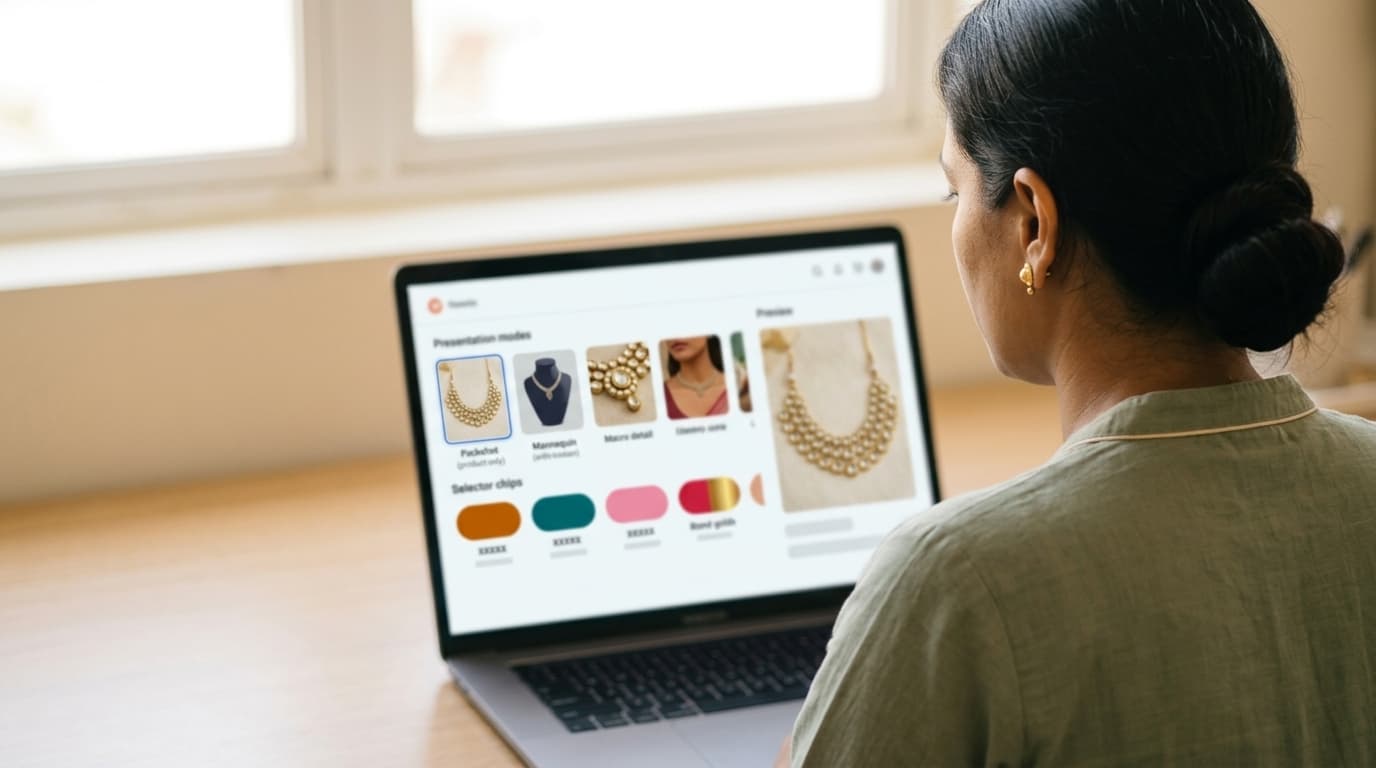
Pick piece type, presentation mode, marketplace
Ring, earring, necklace, bridal set. Packshot, mannequin, on-body macro, on-model close-up, lifestyle. Myntra, CLiQ Luxe, Nykaa Luxe, Amazon, Flipkart. Region for bridal.

Batch-render the carousel
All carousel slots render in parallel at every required crop. Brand consistency locks across SKUs in the drop. Output is marketplace-ready — no retoucher pass.
Where the math changes for jewelry brands.
Three anonymised patterns from the design partner programme. Numbers are illustrative ahead of the jewelry-pipeline launch — directional, not audited. Talk to us to model your own SKU mix.
Per-SKU cost 90% lower, drop time 80% faster
A Bengaluru daily-wear ring brand replaces a four-week studio cycle with a six-day Kraftr cycle. Five-slot carousels — packshot, hero-tilt, on-hand, scale, macro — across a 200-SKU drop. The catalog line moves from a four-figure ₹ per SKU studio rate to a two-figure render rate, and the drop ships before the marketing calendar starts.
Regional bridal styling across one reference set
A Jaipur kundan bridal house renders Marwari, Punjabi, South Indian, Bengali and Maharashtrian styling across the same SKU. Sangeet, wedding and reception editorial registers ship in one batch. The same physical SKU now lists on Tata CLiQ Luxe, Nykaa Luxe and Tanishq.com from one reference — no triple-shoot.
Weekly Myntra + Meesho drops, marketplace cadence
A fashion-jewelry seller scales weekly drops with 3:4 portrait and 1:1 square crops produced from the same flat-lay. The carousel order, slot count and background standard match each marketplace’s house rules. Inventory cash unlocks weeks earlier because the catalog isn’t the long pole anymore.
Wedding season is a 14-week window. Plan for the surge.
Peak Indian wedding bookings run Nov 1 through Feb 15, with Karva Chauth and Diwali compounding demand in late Oct and early Nov. Bridal-jewelry catalogs targeting the season should be live by mid-September. Kraftr renders bridal jewelry for bridal catalog photography with regional styling presets — and gives priority queue access through the surge.
- Pre-references locked by mid-August
- Render production runs through September
- Karva Chauth (late Oct) + Diwali (early Nov) compound demand
- Cross-listed across CLiQ Luxe, Nykaa Luxe, Tanishq.com
- Priority queue access through Nov–Feb
- Bridal QA rubric — stricter than daily-wear
Volume tiers built for jewelry SKU counts.
Per-image rates range ₹120–₹200 for jewelry SKUs depending on resolution and presentation mode. A 5-slot SKU runs ₹600–₹1,000 — a fraction of a studio per-SKU rate. Volume packs scale through 50, 100, 200 and 500 SKU tiers. Bridal-season surge pricing is announced separately each year. See full pricing or Kraftr vs a traditional jewelry photoshoot for the full cost comparison.
What jewelry-brand operators ask first.
- How does Kraftr produce catalogs for D2C jewelry brands specifically?
- Kraftr’s fidelity-first pipeline renders jewelry SKUs across five presentation modes — packshot, mannequin, on-body macro, on-model close-up, and lifestyle — from a single flat-lay reference. Seven jewelry fidelity primitives are locked on every render: stone count, prong or claw count, setting type, metal alloy hue, facet pattern, engraving and finish.
- What’s the cost-per-SKU for jewelry catalog production with Kraftr versus a traditional studio shoot?
- Traditional Indian fine-jewelry studio shoots range from roughly ₹15,000 to ₹40,000 per SKU once model, photographer, retoucher and studio time are included. Kraftr renders at ₹120–₹200 per image, and the per-SKU cost is a small fraction of a studio shoot. Turnaround drops from four to six weeks to one to two days. Pricing scales with monthly SKU volume.
- Does Kraftr cover Tata CLiQ Luxe and Nykaa Luxe for jewelry brands?
- Kraftr renders jewelry SKUs at every Indian marketplace’s required composition — Tata CLiQ Luxe at 4:5 portrait, Nykaa Luxe at 3:4 portrait, Myntra Jewellery at 3:4, Amazon Fashion India at 1:1 square and Flipkart at 1:1. One reference set produces every crop without a re-shoot. Editorial slots — dark velvet on CLiQ Luxe, warm cream on Nykaa Luxe — are configurable per shoot row.
- How does Kraftr handle bridal-jewelry catalogs for the Indian wedding season?
- Kraftr’s bridal jewelry workflow renders kundan, polki, jadau and temple sets on partial-face Indian models in regional styling — Marwari, Punjabi, South Indian, Bengali, Maharashtrian. Sangeet, wedding and reception editorial palettes are configurable presets. The Nov–Feb wedding-season surge is planned for separately with priority queue access.
- What fidelity guarantees does Kraftr give jewelry brands on stone count and prong count?
- Kraftr’s QA rubric scores every jewelry render on nine weighted dimensions, with stone count (weight 16) and prong/setting count (weight 14) as the two highest-leverage fidelity primitives. Drift on either is a P0 reject and the render is regenerated before it ships to the brand. The 90% pass-rate gate ensures rejection-trap defects do not reach the brand.
- Can Kraftr render BIS-hallmarked gold jewelry images for Amazon India compliance?
- Kraftr renders gold jewelry at the metal’s correct alloy hue — 22k saturated warm yellow for Indian-market gold, 18k paler straw, 14k slightly greenish. The BIS hallmark itself cannot be synthesised; the hallmark image required by Amazon.in must be photographed or composited with provenance from the physical SKU and uploaded as a dedicated slot.
- What SKU volumes does Kraftr handle for jewelry brands?
- Kraftr is built to handle jewelry catalog production from 50 SKUs per day for boutique D2C brands to 200 SKUs per day for marketplace-scale sellers. A typical 5-slot carousel — packshot, hero-tilt, on-body, scale, macro detail — renders end-to-end for 100 SKUs in a single day. Brand consistency locks across every angle and every SKU.
- How is Kraftr different for jewelry brands versus apparel-focused tools?
- Jewelry SKUs are defined by countable primitives — stones, prongs, facets, motifs — that apparel-focused tools tolerate drift on. Kraftr’s jewelry pipeline runs a higher-fidelity render path with a dedicated QA rubric scoring nine jewelry-specific dimensions. Drift on stone count or prong count is a category change and is treated as a P0 reject.
Jewelry Product Photography for Fashion & Catalog Listings
Pillar guideThe Kraftr jewelry photography playbook
Festival crossoverBridal catalog photography for jewelry brands
Sibling categorySaree photography for D2C brands
CompareKraftr vs a traditional jewelry photoshoot
Cross-clusterAmazon India apparel & jewelry photo requirements