
The jewelry product photography playbook for D2C brands.
Twelve chapters covering the seven fidelity primitives, the five presentation modes, lighting and camera setup, every Indian marketplace spec, per-piece-type rules for rings, earrings and necklaces, regional bridal aesthetics, rejection traps and the nine-dimension QA rubric. Written for D2C jewelry brand operators shipping catalog at marketplace scale.
Last verified: 2026-05-22
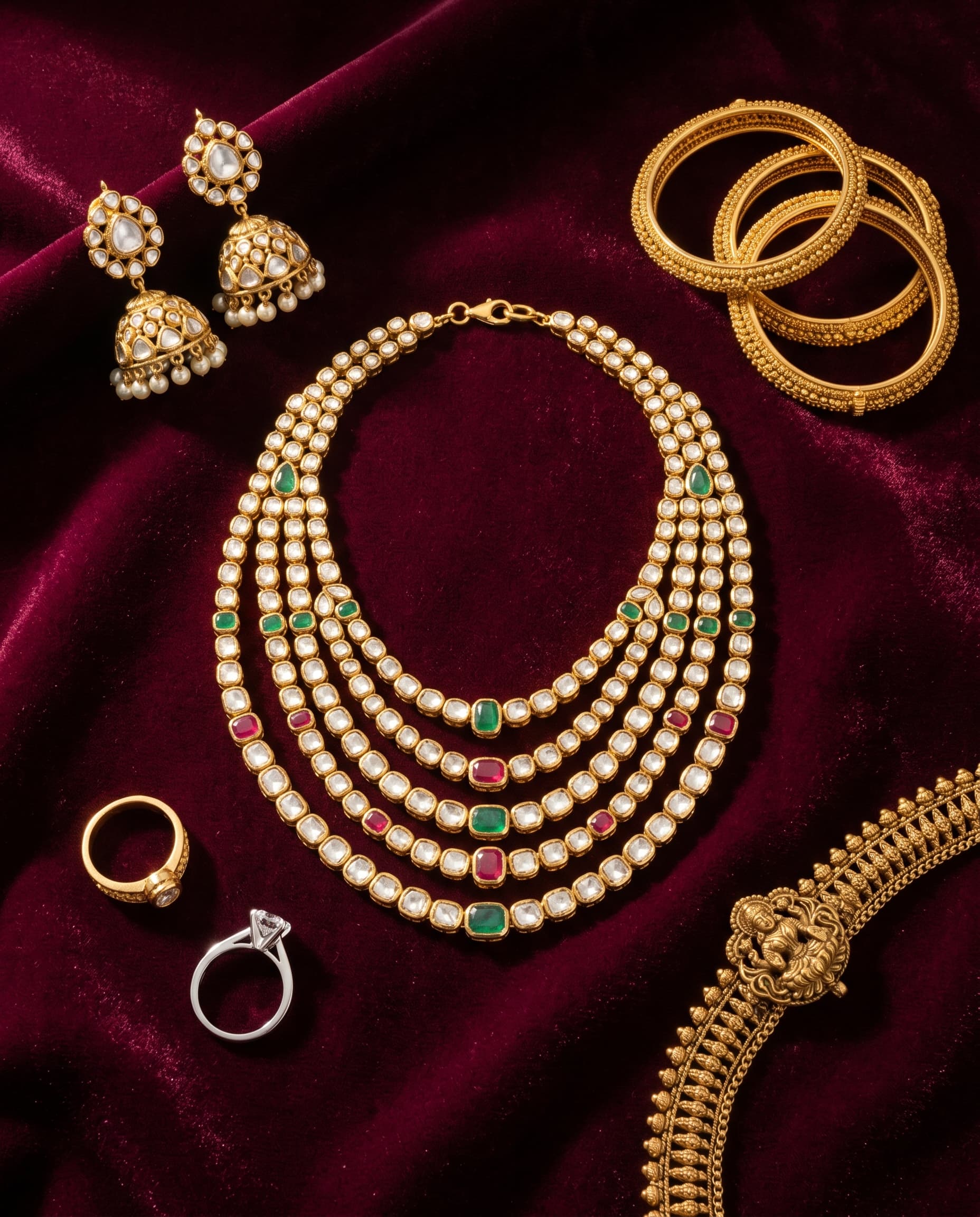
12 chapters · 2026 edition · India
Table of contents.
Foundation chapters (01, 02, 03, 12) are written in full below. Chapters 04–11 are the cluster spokes — each anchored here with a capsule and linked out to the long-form post.
- 01
The seven fidelity primitives
Stone count, prong count, setting, metal hue, facet pattern, engraving, finish.
- 02
The five presentation modes
Packshot, mannequin, on-body macro, on-model close-up, lifestyle.
- 03
Lighting, camera, surfaces
Hard rim for fire, soft diffused for polished metal, side-light for pearls.
- 04
Marketplace specs across India
Myntra 3:4 · CLiQ Luxe 4:5 · Amazon 1:1 · BIS hallmark gate on gold.
- 05
On-model vs flat-lay
Different buyer questions, different shots, different carousel positions.
- 06
Bridal jewelry catalog shoots in India
Marwari, Punjabi, South Indian, Bengali, Maharashtrian — regional fluency required.
- 07
Gold vs lab-grown — what changes
Metal alloy hue, stone provenance, certificate shots, marketplace register.
- 08
Earring product photography rules
Pair packshot, profile, on-ear close-up, scale, hanging-element detail.
- 09
Necklace product photography rules
Front packshot, on-body décolletage, hero-tilt, scale on neck, detail macro.
- 10
Ring product photography rules
Top-down packshot, 30° hero-tilt, on-hand close-up, scale, centre-stone macro.
- 11
Rejection traps across marketplaces
Stone-count drift, metal-hue shift, missing BIS, off-white background, multi-piece.
- 12
QA rubric — 9 dimensions
Stone count (16), prong (14), metal hue (14), facets (12), engraving (10) and four more.
The seven fidelity primitives.
Jewelry product photography is judged against seven fidelity primitives that the buyer can literally count from the hero image: stone count, prong or claw count, setting type, metal alloy hue, facet pattern, engraving or granulation, and finish. Drift on any one of those seven is a category change and grounds for delisting under marketplace misrepresentation clauses.
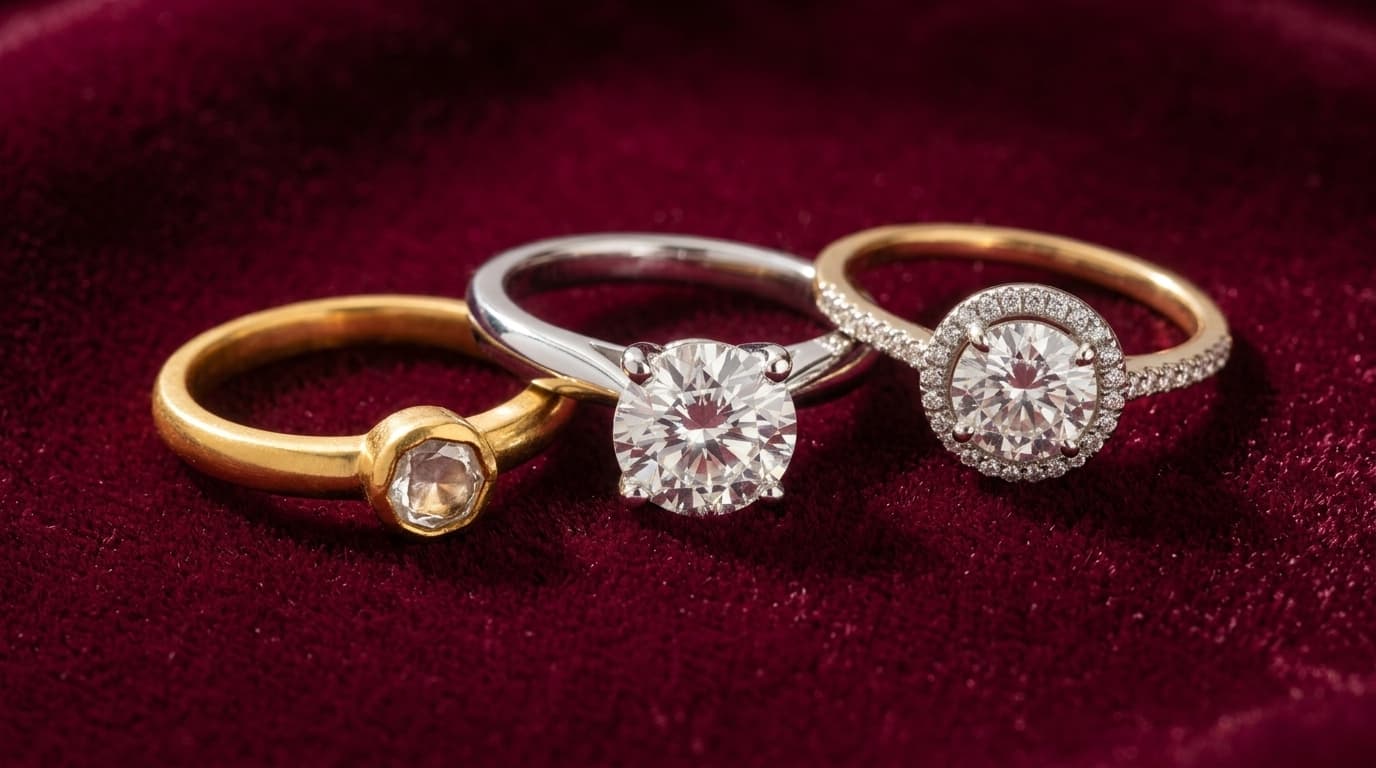
Apparel image pipelines tolerate a 1 ΔE colour drift between reference and render without consequence. Jewelry does not have that latitude. A halo ring rendered with one extra stone reads as a different SKU. A four-prong solitaire rendered as six-prong is a category change. A 22k yellow gold band rendered with the warm bias of a generic AI pipeline reads as 18k rose gold — a perceived ₹10,000+ shift in market value on the same physical piece. The buyer counts. The marketplace QC counts. Bluestone’s ranking system counts. The pipeline must count too.
The seven primitives are not a stylistic preference — they are the schema by which the SKU is identified. Lock them and the catalog becomes shippable. Drift on them and the catalog becomes liability. Kraftr’s jewelry pipeline reinforces each primitive in the prompt and verifies each against the source flat-lay before the render leaves QA. This is the page’s and the pipeline’s info-gain moat over generic jewelry photography tools.
- Stone count. The single highest-leverage primitive. Bluestone auto-flags stone-count drift against its catalog database at intake QC. A pavé band that loses a stone or a halo that gains two is the most common P0 reject in jewelry catalog production.
- Prong / claw count. Four-prong versus six-prong versus bezel-set is a setting category. Mis-rendering the prong count is the same as mis-categorising the SKU.
- Setting type. Prong, bezel, channel, pavé, halo, three-stone, cluster. Each setting type has its own light play and its own buyer search query. Render preserves the source.
- Metal alloy hue. 22k Indian yellow gold is a saturated warm yellow. 18k Western yellow is paler straw. 14k can read slightly greenish. Rose gold sits in the pink-coral band. White gold and platinum diverge subtly under warm vs cool light. The render must reproduce the declared alloy precisely.
- Facet pattern. Round-brilliant, princess, emerald, marquise, pear, oval, asscher. Each cut has a signature facet geometry that resolves at macro distance and is the buyer’s primary verification on a high-AOV solitaire.
- Engraving / granulation. Temple motifs (Lakshmi, peacock, mango), milgrain edges, meenakari panels, Bengali shakha conch motifs, Marwari jadau tracery. Regional motifs must be preserved verbatim — there is no creative latitude here.
- Finish. High-polish, satin, matte, antique, oxidised. Temple jewelry is deliberately antique-finish; modern bridal is high-polish. Rendering the wrong finish puts the piece in the wrong editorial register.
Catalogs that ship without locking these seven primitives leak returns at the upper end of the AOV curve where the buyer is most attentive. Catalogs that lock them open the room to compress everything else — cycle time, per-SKU cost, marketplace cross-listing, regional variation.
The five presentation modes.
Jewelry catalog photography supports five presentation modes: packshot (jewelry on a styled surface, no body); mannequin (on a display form like a velvet bust); on-body macro (body part only, no face); on-model close-up (face and jewelry both in frame); lifestyle (jewelry as one detail in a wider story). Each mode has its own lighting, framing and reference budget.
Different modes answer different buyer questions. Packshot answers “what is this” — stone count, prong count, motif. On-body macro and on-model close-up answer “how does it sit” — drape on the neck, fit on the finger, hang of an earring. Lifestyle answers “who is this for” — what occasion, what dressing register, what story. A jewelry PDP that omits any of the three answer-types leaks add-to-cart at that decision moment.
Packshot
The canonical “what is this” mode. Jewelry laid on a styled surface with no body in frame. Pure white #FFFFFF for catalog primary slots; warm cream paper, dark velvet (#1A1A1A), marble, silk, polished wood and brushed stone for editorial slots. Lighting is top-down soft diffused with a slight directional key — gold needs the directional key to surface zari and granulation; diamond needs hard rim at 30° off-camera-left to surface facet fire.
Mannequin / display form
Velvet bust for necklaces, jewelry tree for earrings, ring stand for rings. The middle ground between packshot and on-body — the buyer sees the piece in context without the model being a styling distraction. Useful for editorial sets where the brand wants neutrality between SKUs.
On-body macro
Body part only — décolletage, ear, hand, wrist — no face. The buyer sees how the piece sits on skin without the cognitive load of evaluating the model. The most under-used mode in Indian D2C jewelry catalogs in 2026 and the highest-leverage conversion lift on the second carousel slot.
On-model close-up
Face and jewelry in frame. Required for bridal sets above the ₹15,000 AOV threshold on Tata CLiQ Luxe. Regional bridal styling — Marwari, Punjabi, South Indian, Bengali, Maharashtrian — registers here. The lighting recipe shifts warmer than packshot to flatter Indian skin tones without losing fidelity on the piece.
Lifestyle
Jewelry as one detail in a wider story — a hand on a teacup, a bride mid-laugh at a sangeet, a stack of bangles on a workdesk. The “who is this for” shot. Tata CLiQ Luxe permits one editorial slot per SKU; Nykaa Luxe rewards lifestyle slots in engagement signals.
Lighting, camera, surfaces.
Jewelry lighting is material-dependent. Diamonds and faceted coloured stones need hard rim at 30° off-camera-left to surface facet fire. Polished gold and platinum need soft diffused key to avoid blown highlights. Matte and oxidised metals tolerate harder light. Pearls need soft diffused side-light to reveal lustre. Surfaces swing the editorial register more than lighting does.
Camera choice is downstream of mode. Packshot needs a macro lens (typically 100mm f/2.8) at f/8–f/11 for depth of field across the piece. On-model close-up typically shoots wider — 50mm to 85mm — at f/2.8–f/4 to keep the model’s eye sharp while keeping the jewelry readable. Lifestyle leans 35mm wider, more negative space.
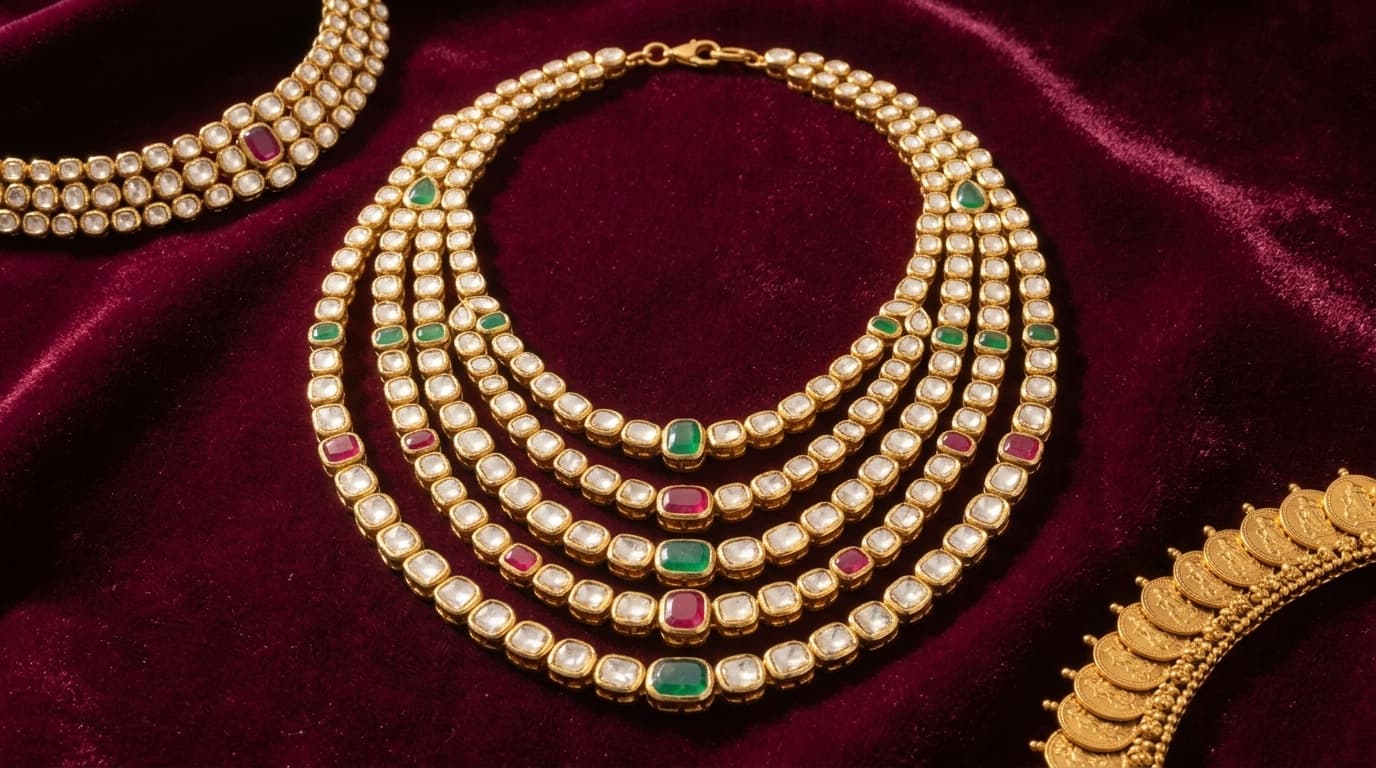
Surfaces carry editorial weight. Pure white #FFFFFF reads as catalog-primary — Myntra, Amazon, Flipkart, Tanishq.com all default here. Warm cream paper reads as Nykaa-Fashion-editorial. Dark velvet at #1A1A1A reads as CLiQ Luxe editorial and is what makes a bridal kundan set photograph as bridal. Marble reads contemporary-luxury — appropriate for solitaires and lab-grown lines. Brushed wood reads everyday and pairs with daily-wear stacking lines. Silk reads ceremonial.
A correctly-chosen surface lets a single SKU list across Myntra, CLiQ Luxe and Tanishq.com without re-shooting — the same piece reads differently in each editorial register. Kraftr’s pipeline configures surface per shoot row, so the master capture produces all marketplace registers from one reference.
Jewelry image specs across Indian marketplaces.
Indian jewelry marketplaces split into three aspect-ratio tiers in 2026: Myntra Jewellery and Nykaa Fashion at 3:4 portrait (1,080×1,440 px minimum), Tata CLiQ Luxe at 4:5 portrait (1,200×1,500 px), and Amazon Fashion India at 1:1 square (1,000 px minimum long edge). BIS hallmark is mandatory on Amazon for gold SKUs.
Each marketplace also runs its own intake QC checks beyond the spec sheet — Myntra enforces sRGB colour profile and rejects warm-toned whites; Amazon enforces ≥85% frame fill; Bluestone auto-flags stone-count drift against its catalog database; Tata CLiQ Luxe permits exactly one dark-velvet editorial slot per SKU. For the full per-platform breakdown with rejection patterns and BIS hallmark gates, read jewelry photography specs across Indian marketplaces.
On-model vs flat-lay jewelry photography.
On-model and flat-lay jewelry photography answer different buyer questions. Flat-lay packshot is the canonical “what is this” shot — stone count, prong count, motif verification. On-model is the “how does it sit” shot — drape on the neck, fit on the finger, hang of an earring. Indian jewelry PDPs with at least one on-model shot in the first three carousel slots see materially higher add-to-cart.
The decision of which mode to lead with depends on AOV and category. Bridal sets and solitaires above ₹40,000 lead with on-model; daily-wear stacking lines and fashion-tier earrings lead with flat-lay or mannequin. Carousels mix both. For the full carousel architecture across categories, read on-model vs flat-lay jewelry photography in 2026.
Bridal jewelry catalog shoots in India.
Bridal jewelry catalog shoots in India require regional fluency. Marwari sets lean kundan with polki centres, Punjabi sets feature heavy 22k yellow gold and meenakari work, South Indian temple jewellery uses antique-finish 22k gold with Lakshmi and peacock motifs, Bengali sets favour 22k gold and conch motifs, Maharashtrian sets centre on the nath. Sangeet, wedding and reception register different palettes.
Bridal SKUs sit at the top of the jewelry AOV curve — ₹40,000 to ₹4,00,000+ per piece — and the buyer counts every stone, prong and motif before paying. A drifted prong count or hallucinated meenakari panel on a daily-wear ring is a return; on a bridal set it is a category change. Bridal also bridges to the festival cluster — see bridal catalog photography for the festival-window catalog production playbook. For the full bridal jewelry checklist, read the bridal jewelry catalog shoot checklist.
Gold vs lab-grown — what changes for the shoot.
Gold and lab-grown jewelry shoot considerations differ on three axes: metal alloy hue (22k Indian gold is saturated warm yellow versus 18k Western paler straw), stone provenance (natural diamond versus IGI-certified lab-grown — both require certificate shots on Bluestone), and target marketplace (Tata CLiQ Luxe permits both with different editorial registers). Drift on metal hue is a category change.
Full breakdown: gold vs lab-grown jewelry shoot considerations.
Earring product photography rules.
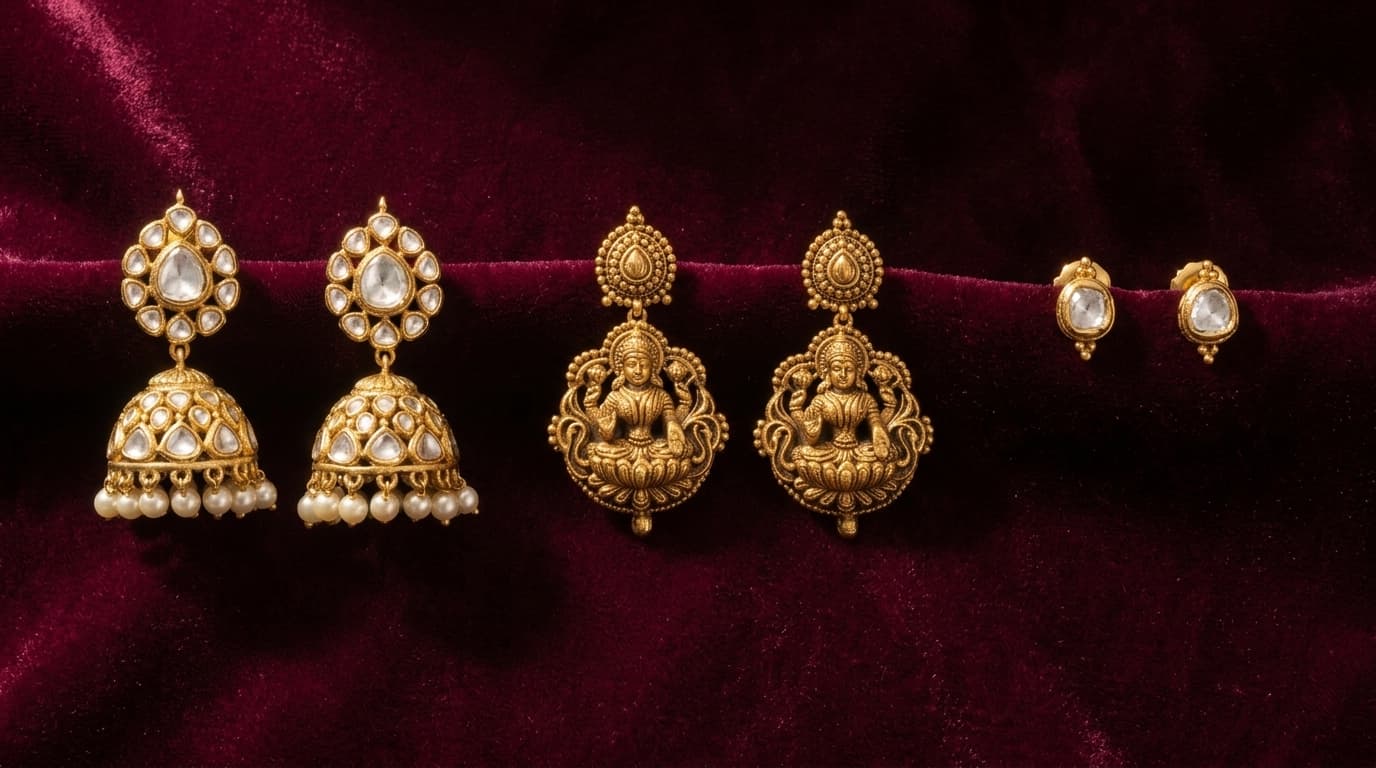
Earrings require a mandatory shot list: pair packshot, profile, on-ear close-up, scale reference and hanging-element detail. The on-ear shot is the highest-leverage slot — it answers whether the earring sits flush or hangs, and how the hanging element rests against the jaw.
Full per-marketplace breakdown: earring product photography — marketplace rules.
Necklace product photography rules.
Necklaces require front packshot on velvet or paper, on-body décolletage, hero-tilt of the centrepiece, scale on neck, and a detail macro on the central motif. The on-body shot is mandatory for any necklace above ₹15,000 AOV on Tata CLiQ Luxe.
Full per-marketplace breakdown: necklace product photography — marketplace rules.
Ring product photography rules.
Rings require top-down packshot, 30° hero-tilt, on-hand close-up, scale reference and centre-stone macro. The macro is the buyer’s primary fidelity check on solitaires and engagement rings — facet pattern, prong count and setting type all resolve at that distance.
Full per-marketplace breakdown: ring product photography — marketplace rules.
Rejection traps across Myntra, CLiQ Luxe, Nykaa Luxe.
Indian jewelry marketplaces reject catalog listings primarily for five reasons in 2026: stone-count drift between image and SKU title, metal-hue shift, missing BIS hallmark on gold SKUs (Amazon India), off-white backgrounds reading as cream on Amazon and Bluestone QC, and multi-piece composition when the SKU is a single piece. Each trap has a specific marketplace enforcement signature.
Bluestone enforces stone-count drift strictest because its ranking system depends on stone count being a verifiable spec. Amazon enforces BIS hallmark visibility on gold at intake. Myntra rejects warm-toned whites under its sRGB colour profile check. Tata CLiQ Luxe permits exactly one editorial dark-velvet slot per SKU and rejects warm cream on the primary slot. For the full per-marketplace rejection-code decoder, read jewelry catalog rejection traps across marketplaces.
QA rubric — the nine dimensions of jewelry render quality.
The Kraftr jewelry QA rubric scores every render on nine weighted dimensions on a 100-point scale: stone count fidelity (weight 16), prong setting count fidelity (14), metal alloy hue fidelity (14), facet pattern preservation (12), engraving and motif preservation (10), shadow plausibility (8), reflection plausibility (8), on-body anatomy (10, on-model modes only), lifestyle scene scale (8, lifestyle only). Pass-rate gate is 90%.
| Dimension | Weight | P0? |
|---|---|---|
| Stone count fidelity | 16 | Yes — auto-regenerate |
| Prong / setting count fidelity | 14 | Yes — auto-regenerate |
| Metal alloy hue fidelity | 14 | Yes — auto-regenerate |
| Facet pattern preservation | 12 | Yes — auto-regenerate |
| Engraving / motif preservation | 10 | P1 — flag for review |
| Shadow plausibility | 8 | P2 — manual review |
| Reflection plausibility | 8 | P2 — manual review |
| On-body anatomy (on-model modes) | 10 | P1 — flag for review |
| Lifestyle scene scale (lifestyle only) | 8 | P2 — manual review |
The rubric runs against the source flat-lay and the declared SKU metadata. The 90% pass-rate gate ensures rejection-trap defects do not reach the brand. Renders that fall below 90 on any of the four P0 dimensions are automatically regenerated with a tightened prompt that names the specific drift; renders that pass P0 but fall below 80 overall are flagged for human review. This is the closing fidelity gate the rest of the playbook is engineered to satisfy.
The five modes across every piece type.


The pillar questions, answered.
- What does jewelry product photography require that apparel photography does not?
- Jewelry product photography requires preservation of seven countable fidelity primitives that apparel does not enforce: stone count, prong or claw count, setting type, metal alloy hue, facet pattern, engraving or granulation, and finish. Drift on any one is a category change. Apparel tolerates 1 ΔE colour drift; jewelry yellow-gold-to-rose-gold drift is a SKU change.
- How many presentation modes does jewelry catalog photography support?
- Jewelry catalog photography supports five presentation modes: packshot (jewelry on a styled surface, no body); mannequin (on a display form like a velvet bust); on-body macro (body part only, no face); on-model close-up (face and jewelry both in frame); and lifestyle (jewelry as one detail in a wider story). Each mode has its own lighting, framing and reference budget.
- What are the marketplace specs for jewelry photography in India in 2026?
- Indian jewelry marketplace specs in 2026 split into three aspect-ratio tiers: Myntra Jewellery and Nykaa Fashion at 3:4 portrait (1,080×1,440 px minimum), Tata CLiQ Luxe at 4:5 portrait (1,200×1,500 px minimum) and Amazon Fashion India, Tanishq.com, Caratlane, Bluestone at 1:1 square (1,000–2,000 px minimum). Pure white #FFFFFF is the standard catalog background.
- Which lighting setup is right for jewelry product photography?
- Jewelry product photography lighting depends on material. Gemstones with fire — diamond, ruby, sapphire — require hard rim light at 30° off-camera-left to surface facet brilliance. Polished metals — gold, platinum — require soft diffused key to avoid blown highlights. Matte and oxidised metals tolerate harder light. Pearls require soft diffused side-light to reveal lustre without blowing the surface.
- What is the QA rubric for jewelry renders before they ship to a catalog?
- The Kraftr jewelry QA rubric scores every render on nine weighted dimensions on a 100-point scale, with stone count (weight 16) and prong/setting count (14) as the two highest-leverage primitives. The pass-rate gate is 90% across a five-item sample covering all five presentation modes. Drift on a P0 dimension triggers automatic regeneration before the render ships.
- What are the most common rejection traps for jewelry listings on Indian marketplaces?
- Jewelry listing rejection traps cluster around five issues in 2026: stone-count drift, metal-hue shift, missing BIS hallmark on Amazon Fashion India gold SKUs, off-white backgrounds reading as cream, and multi-piece composition when the SKU is a single piece. Bluestone and Tanishq.com enforce these strictest; Myntra and Nykaa Fashion are slightly more permissive on background tint.
- How is bridal jewelry photography for India different from generic jewelry photography?
- Bridal jewelry photography for India requires regional fluency across Marwari, Punjabi, South Indian, Bengali and Maharashtrian aesthetics. Each region has signature pieces — Marwari kundan-polki, South Indian temple, Bengali shakha-pola — and signature metals and stones. Sangeet, wedding and reception register different palettes. Generic jewelry photography that ignores regional cues reads catalog-flat to the Indian buyer.
Catalog 200 jewelry SKUs in a day at marketplace spec.
Kraftr renders rings, earrings, necklaces and bridal sets at every marketplace’s required composition — on-model and on a styled surface — with fidelity locked to the actual piece. No retoucher. No studio rental. Stone count, prong count and metal hue verified before the render ships.
Live citations behind this playbook.
- Tata CLiQ Seller Central — Catalog guidelines (luxury.tatacliq.com)
- Amazon.in Seller Central — Product image requirements
- BIS Hallmarking — Bureau of Indian Standards (bis.gov.in)
- Myntra Partner Portal — Image specifications (partner.myntra.com)
- Nykaa Fashion Seller Portal (nykaafashion.com/sell-on-nykaa-fashion)
- Flipkart Seller Hub — Lifestyle vertical image specs
- Internal: Kraftr jewelry photography playbook chapters 01–12 — first principles, presentation modes, lighting, surfaces, on-body anatomy, regional bridal aesthetics, platform guidelines, QA rubric.
Jewelry Product Photography for Fashion & Catalog Listings
IndustryCatalog Production for D2C Jewelry Brands
Cross-clusterThe full marketplace image spec matrix
Cross-clusterAmazon India apparel & jewelry photo requirements
Festival crossoverBridal catalog photography — jewelry meets festival
PricingJewelry render pricing