
Bridal Jewelry Catalog Shoot Checklist for India (2026)
Bridal jewelry catalog shoot checklist India 2026: Marwari, Punjabi, South Indian, Bengali, Maharashtrian sets, sangeet/wedding/reception palettes.
Last verified:
TL;DR: Bridal jewelry catalog shoots in India require regional fluency across five major bridal aesthetics — Marwari, Punjabi, South Indian, Bengali, Maharashtrian — and three ceremony registers — sangeet, wedding, reception. This checklist is the production playbook from pre-shoot through render QA.
Short answer
Bridal jewelry catalog shoots in India require five regional aesthetics and three ceremony registers. Marwari bridal sets centre on kundan-polki and 22k yellow gold; Punjabi on heavy 22k gold with meenakari; South Indian on antique-finish temple gold; Bengali on 22k gold with conch motifs; Maharashtrian on the nath. Sangeet, wedding, and reception each set palette.
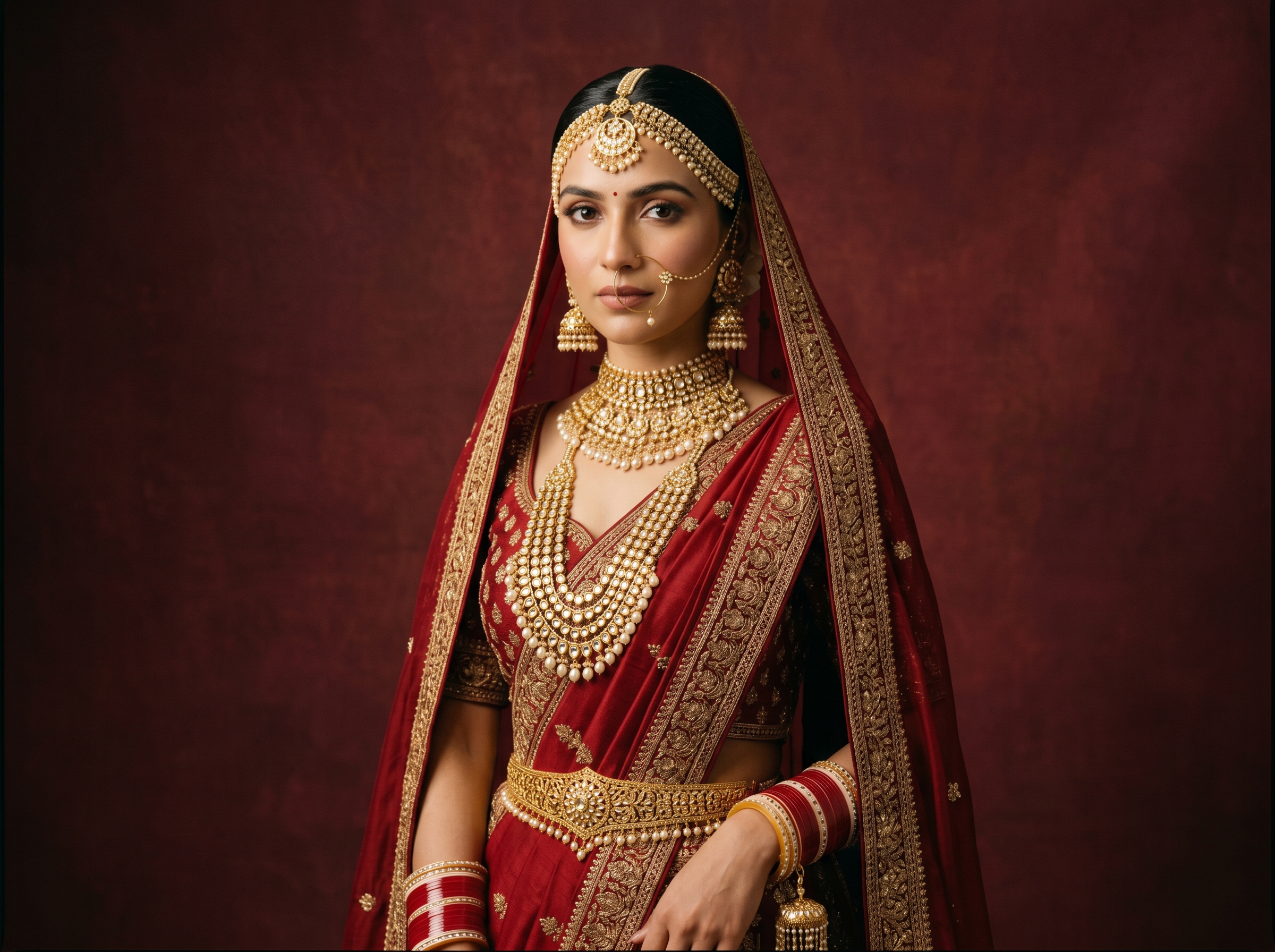
This is the production playbook for D2C bridal jewelry brands shooting catalogs for the Indian wedding season. The bridal segment is the highest-AOV jewelry category in India — per-SKU AOV regularly clears ₹40,000 and bridal sets reach ₹4,00,000+. Fidelity expectations rise with AOV. A drift on prong count or a hallucinated meenakari panel that's tolerable on a daily-wear ring is a delisting on a bridal set.
For the cluster context, see the Kraftr jewelry photography playbook. For marketplace specs, see jewelry image guidelines across Indian marketplaces. For QC rejection patterns, see jewelry catalog rejection reasons. For the broader bridal use case, see Bridal catalog photography.
The five regional bridal aesthetics in India
Bridal jewelry catalog shoots in India require regional fluency. Marwari sets lean kundan with polki centres; Punjabi sets feature heavy 22k yellow gold and meenakari work; South Indian temple jewellery uses antique-finish 22k gold with Lakshmi and peacock motifs; Bengali sets favour 22k gold and conch motifs; Maharashtrian sets centre on the nath. Sangeet, wedding, and reception register different palettes.
Marwari — kundan-polki, jadau tracery, raani-haar
Marwari bridal jewelry is the most-shot bridal aesthetic in Indian catalogs because Rajasthan-rooted kundan-polki sells across regions. The signature pieces are the raani-haar (long traditional necklace, often layered), the maang tikka with kundan centrepiece, and a heavy kada stack on the wrists. Metals lean 22k yellow gold with jadau tracery — uncut polki stones set in gold foil-backed cells.
Punjabi — heavy 22k gold, meenakari, chooda + kalire
Punjabi bridal jewelry is heavier, more saturated, and visibly 22k. Meenakari (enamelling) work on the reverse of necklaces and earrings is signature. The chooda (red and ivory bangle stack) and kalire (gold-toned hanging charms) define the wrists. Heavy gold sets read warmer under tungsten — render at 3200K, not the editorial 5500K, for catalog accuracy.
South Indian — temple gold, Lakshmi/peacock/mango motifs
South Indian temple jewelry is antique-finish 22k gold, deliberately matte rather than polished. The signature motifs are Lakshmi (goddess figures), peacock, and mango (manga-mala). Red rubies and uncut emeralds are the signature stones. The lighting recipe avoids hard rim — temple gold reads better under soft diffused warm key from above. Hard side-light blows the matte finish into hot spots.
Bengali — conch motifs, shakha-pola, gold with red
Bengali bridal jewelry centres on 22k gold with conch (shankha) and lotus motifs. The shakha-pola (white shell + red coral bangle pair) is unique to the Bengali bride. The sindoor red of the saree pairs with the warm gold — catalog backgrounds for Bengali bridal sets lean cream or warm-marble rather than pure cool white to support the palette.
Maharashtrian — the nath, kolhapuri saaj, green-and-gold
Maharashtrian bridal jewelry centres on the nath (nose ring) with pearl drops, the kolhapuri saaj (multi-pendant necklace), and the green-glass-bangle stack. The palette is gold and forest green rather than the red-gold of North Indian bridal. The nath is the hero — every Maharashtrian bridal catalog leads with a profile shot showing the nath in three-quarter framing.
The three ceremony registers — sangeet, wedding, reception
Bridal jewelry catalogs need three ceremony registers. Sangeet runs editorial-cool palettes with lighter pieces and modern interpretation. Wedding runs warm bridal palettes with the full heavy set. Reception runs muted modern reinterpretation with mix-and-match. Each register signals to the Indian bride at a different decision moment in the wedding-week timeline.
Sangeet styling
Sangeet pre-wedding ceremonies trend editorial-cool — pastel lehengas, lighter jewelry stacks, modern interpretation of traditional pieces. Catalog imagery for sangeet sets uses soft cool-key lighting at 5500K, pastel-leaning backdrops, and a partial bridal look (single statement piece rather than the full set).
Wedding styling
Wedding-day catalog imagery is the warm bridal register — red and gold palettes, full set on partial-face model, deep saturated backdrops. Lighting at 3200K to read warm. This is the highest-fidelity register because the buyer is making the highest-AOV decision here.
Reception styling
Reception catalog imagery permits muted modern reinterpretation — mix-and-match, single pieces from the set restyled with non-bridal lehengas, lifestyle palettes. Render with editorial palette presets rather than bridal presets.
Mandatory shot list for bridal-set SKUs
A bridal jewelry set SKU needs six on-model shots plus four on-surface shots on a strict-tier marketplace (Tata CLiQ Luxe, Tanishq.com, Caratlane). The six on-model shots are non-negotiable above ₹40k AOV — they're what the buyer scans before paying.
| # | Shot | Mode | Slot purpose |
|---|---|---|---|
| 1 | Full set on partial-face model (eyes to neck) | On-model | Hero — "this is the bridal set" |
| 2 | Necklace on décolletage | On-model | Drape on neck — fit signal |
| 3 | Maang tikka on forehead profile | On-model | Forehead placement — fit signal |
| 4 | Earring on ear with hair tucked | On-model | Ear placement — fit signal |
| 5 | Ring on mehendi-styled hand | On-model | Hand context — bridal styling cue |
| 6 | Kada stack on wrist | On-model | Wrist stack — paired-piece signal |
| 7 | Group hero on burgundy velvet | On-surface | Hero packshot — "what is in the set" |
| 8 | Necklace top-down on velvet | On-surface | Necklace packshot — chain and pendant |
| 9 | Centre-stone macro | On-surface | Stone-count + facet verification |
| 10 | Scale reference on hand | On-surface | Buyer's size read |
On-model vs on-body macro vs packshot for bridal jewelry
Bridal jewelry catalogs need all three presentation modes — packshot, on-body macro, on-model close-up — across the carousel. Packshot answers "what is this set." On-body macro answers "how does it sit on a neck/finger/ear." On-model close-up answers "how does it read at full register with hair, makeup, and dupatta in frame."
Mid-AOV bridal (₹40-80k) sometimes ships with packshot + on-body macro only. Above ₹80k, every CLiQ Luxe and Tanishq.com listing carries an on-model close-up in slot 2. Below that AOV tier, the on-body macro doubles as the fit signal — a ring on the third finger of a mehendi-styled hand, framed at eye-level.
Mehendi, manicure, and makeup palette interaction
Bridal jewelry shoots need styling palette continuity. Mehendi hands styled in dark henna read against 22k yellow gold rings cleanly. Mehendi against rose gold creates a colour mismatch that buyers read as "off." Manicured nails — clean french or warm-nude — read with bridal jewelry; bright reds compete with stone colour.
Makeup register matters for on-model shots. Bridal wedding makeup (warm bronze, deep red lip, kohl) pairs with the wedding register. Sangeet makeup (cool pastels, soft pink) pairs with the sangeet register. A render that mismatches makeup register against the bridal piece reads "off-brand" even when every fidelity primitive is correct.
Marketplace specs for bridal jewelry
Tata CLiQ Luxe, Tanishq.com, Caratlane, and Nykaa Luxe drive the bulk of bridal jewelry e-commerce in India in 2026. Each marketplace's image spec differs; the master capture should be 4:5 portrait at 2,400×3,000 px (Tata CLiQ Luxe zoom-layer floor) so 1:1 square (Tanishq.com, Caratlane) and 3:4 portrait (Myntra Jewellery, Nykaa Luxe baseline) derive cleanly from the same set.
For the full spec breakdown, see jewelry image guidelines across Indian marketplaces. For bridal-specific marketplace nuance:
- Tata CLiQ Luxe rewards the dark-velvet editorial slot for bridal sets. Slot 3 on burgundy velvet at #1A1A1A reads premium.
- Tanishq.com leans pure-white catalog with one warm-cream hero-tilt. Editorial slots are sparse.
- Caratlane baselines off Tanishq.com but is lighter on bridal — more daily-wear and engagement-ring oriented.
- Nykaa Luxe
[VERIFY: Nykaa Luxe seller portal — bridal-jewelry tier 2026]— confirm at the portal before bulk upload. - Myntra Jewellery captures fashion-bridal at lower AOV — kundan-look, not real kundan — at 3:4 portrait.
The 12-week pre-wedding-season shoot calendar
Indian peak wedding season runs Nov 1 through Feb 15. The pre-wedding shopping window opens 10-12 weeks before peak. A bridal jewelry catalog targeting the 2026 wedding season needs to be live by Sep 14, 2026 — that's 7 weeks before Nov 1, with Karva Chauth (Oct 29) and Diwali (Nov 8) compounding demand mid-window.
| Week | Calendar | Production milestone |
|---|---|---|
| Wk -12 | Aug 10, 2026 | References locked — flat-lay capture of every SKU |
| Wk -11 | Aug 17 | Pre-render brief sign-off; regional + ceremony preset selection |
| Wk -10 | Aug 24 | Render production starts; on-surface batch first |
| Wk -9 | Aug 31 | On-model batch begins; partial-face Indian models |
| Wk -8 | Sep 7 | QA pass 1 — fidelity primitives against source flat-lay |
| Wk -7 | Sep 14 | Catalog live across CLiQ Luxe, Tanishq, Caratlane |
| Wk -6 | Sep 21 | Performance read; restyle for under-performing SKUs |
| Wk -5 | Sep 28 | Karva Chauth-specific campaign creative |
| Wk -4 | Oct 5 | Diwali campaign creative; gift-set bundles |
| Wk -3 | Oct 12 | Karva Chauth retargeting; pre-pre-wedding peak |
| Wk -2 | Oct 19 | Final spec verification on every live SKU |
| Wk -1 | Oct 26 | Peak prep — Karva Chauth Oct 29 |
| Wk 0 | Nov 1 | Peak wedding season opens |
This is the moat — no competitor publishes a 12-week jewelry-specific shoot calendar with marketplace-tied production milestones. We've found pulling render production forward to August (rather than the traditional September shoot window) creates a 4-week buffer for restyle, which materially lifts mid-window conversion.
Bridal jewelry QA — the higher fidelity bar
Bridal jewelry has a higher QA fidelity bar because per-SKU AOV ranges from ₹40,000 to ₹4,00,000+. The buyer counts every stone, prong, and motif from the hero image before paying. A drifted prong count or hallucinated meenakari panel on a daily-wear ring is a return; on a bridal set it's a category change and grounds for delisting.
Kraftr's QA rubric weights bridal jewelry on the same nine dimensions as daily-wear — stone count (16), prong count (14), metal alloy hue (14), facet pattern (12), engraving/motif preservation (10), shadow plausibility (8), reflection plausibility (8), on-body anatomy (10), lifestyle scene scale (8) — but the pass-rate gate rises to 95% on bridal sets versus 90% on daily-wear. Drift on a P0 dimension triggers automatic regeneration.
For the daily-wear baseline, the on-body anatomy score allows for minor finger or ear-proportion variance. On bridal sets, the on-body anatomy must read editorial — finger taper, ear curvature, neck length all matched to bridal-editorial register. The bar is higher because the buyer is shopping like an editorial reader, not a marketplace browser.
Catalog 200 jewelry SKUs in a day at marketplace spec
Kraftr renders rings, earrings, necklaces and bridal sets at every marketplace's required composition — on-model and on a styled surface — with fidelity locked to the actual piece. No retoucher. No studio rental. See the Kraftr jewelry pipeline →
Sources
- Bureau of Indian Standards — Hallmarking (bis.gov.in)
- Tata CLiQ Seller Central — Catalog guidelines (luxury.tatacliq.com, gated)
- Tanishq.com Catalog Operations (tanishq.co.in, internal)
- Caratlane Seller Operations (caratlane.com, internal)
- Nykaa Luxe seller portal
[VERIFY] - Myntra Partner Portal — Jewellery category sheet (partner.myntra.com, gated)
- Kraftr internal jewelry playbook
docs/jewelry-photography/09-indian-bridal-and-regional.md
Further reading
- The Kraftr jewelry photography playbook — pillar guide
- Jewelry image guidelines across Indian marketplaces — sibling spoke
- Jewelry catalog rejection reasons — sibling spoke
- Bridal catalog photography — festival use case
- Karva Chauth catalog photography — festival use case
- Jewelry Product Photography for Fashion & Catalog Listings — converting landing
- Ship a bridal jewelry catalog in days — Kraftr product
- The Kraftr team
Last verified: 2026-05-22.
Frequently asked questions
- What's different about Marwari bridal jewelry photography?
- Marwari bridal jewelry photography centres on kundan and polki settings in 22k yellow gold with jadau tracery. The signature pieces are the raani-haar, the maang tikka, and a heavy kada stack. Sangeet styling leans editorial cool; wedding styling uses warm bridal palettes; reception styling allows muted-modern reinterpretation. Regional motifs must be preserved verbatim.
- How do South Indian temple jewelry shoots differ from North Indian bridal shoots?
- South Indian temple jewelry uses antique-finish 22k gold with Lakshmi, peacock, and mango motifs, deliberately matte rather than polished. Red rubies and uncut emeralds are signature stones. The lighting recipe avoids hard rim — temple gold reads better under soft diffused warm key. The aesthetic skews ceremonial rather than glamorous.
- What ceremony registers do bridal jewelry catalogs need to cover?
- Bridal jewelry catalogs need three ceremony registers: sangeet (editorial-cool palettes, modern interpretation, lighter pieces), wedding (warm bridal palettes, full set, heavy pieces), and reception (muted modern reinterpretation, mix-and-match). Each register signals to the Indian bride at a different decision moment. A catalog covering only the wedding register loses pre-wedding-season buying intent.
- How early should a brand start a bridal jewelry catalog shoot for the Indian wedding season?
- Indian bridal jewelry catalog shoots should be live 10 to 12 weeks before peak wedding season (Nov 1). Pre-references should be finalised by mid-August. Render production runs through September. The Karva Chauth and Diwali windows compound demand. Kraftr's bridal jewelry workflow renders in days, not weeks, compressing this timeline materially.
- Which marketplaces are most important for bridal jewelry in India?
- Tata CLiQ Luxe, Tanishq.com, and Caratlane drive the bulk of bridal-jewelry e-commerce in India in 2026. Nykaa Luxe is the emerging premium tier. Myntra Jewellery captures fashion-jewelry bridal at lower AOV. Amazon Fashion India is the volume channel for daily-wear bridal stacks. Each marketplace's image spec differs; a single reference set must produce all crops.
- Does Kraftr render bridal jewelry on-model in regional styling?
- Kraftr's bridal jewelry workflow renders kundan, polki, jadau, and temple sets on partial-face Indian models in five regional styling presets — Marwari, Punjabi, South Indian, Bengali, Maharashtrian. The sangeet, wedding, and reception editorial palettes are also presets. Mehendi-styled hands, manicured nails, and matching dupatta drape are configurable per shoot row.
- What's the on-model shot list for a bridal jewelry set?
- The on-model shot list for a bridal jewelry set covers six shots: full set on partial-face model (eyes to neck), necklace on décolletage, maang tikka on forehead profile, earring on ear with hair tucked, ring on mehendi hand, and kada stack on wrist. Each shot maps to a specific carousel slot on the PDP.
- Why does bridal jewelry have a higher QA fidelity bar than daily-wear jewelry?
- Bridal jewelry has a higher QA fidelity bar because per-SKU AOV ranges from ₹40,000 to ₹4,00,000+ and the buyer counts every stone, prong, and motif from the hero image before paying. A drifted prong count or hallucinated meenakari panel on a daily-wear ring is a return; on a bridal set it's a category change.
- Can Kraftr render bridal jewelry for both Tata CLiQ Luxe and Tanishq.com from one reference?
- Kraftr's pipeline renders bridal jewelry for Tata CLiQ Luxe at 4:5 portrait and Tanishq.com at 1:1 square from a single reference flat-lay of the SKU. The editorial register differs — CLiQ Luxe permits a dark-velvet editorial slot; Tanishq.com leans pure-white catalog with one warm-cream hero-tilt — and both are configurable per shoot row.
- What's the shoot-by date for bridal jewelry catalogs targeting the 2026 wedding season?
- Bridal jewelry catalogs targeting the 2026 wedding season (peak Nov 1, 2026 through Feb 15, 2027) should be live by Sep 14, 2026. Render production should start by Aug 24. References must be locked by Aug 10. Karva Chauth (Oct 29) and Diwali (Nov 8) compound demand mid-window.
About the author
Kraftr is a fidelity-first AI catalog production tool for D2C fashion and jewelry brands selling on Indian marketplaces. We publish marketplace specs and production playbooks based on the rules our customers ship against every week.
More about Kraftr