
Jewelry Photography Specs: Myntra, Flipkart, Amazon, CLiQ (2026)
Jewelry image specs for Indian marketplaces 2026: Myntra 3:4 portrait, Tata CLiQ Luxe 4:5, Amazon India 1:1, BIS hallmark rules, rejection traps.
Last verified:
TL;DR: Indian jewelry marketplaces in 2026 use three aspect ratios — Myntra 3:4 portrait, Tata CLiQ Luxe 4:5 portrait, Amazon Fashion India 1:1 square. BIS hallmark is mandatory on Amazon for gold SKUs. This post breaks every spec down per platform with the rejection traps that block listings.
Short answer
Jewelry catalog images for Indian marketplaces in 2026 must meet three aspect-ratio standards: Myntra Jewellery requires 3:4 portrait at 1,080×1,440 px minimum, Tata CLiQ Luxe requires 4:5 portrait at 1,200×1,500 px, and Amazon Fashion India requires 1:1 square at 1,000 px long edge. Gold SKUs require a visible BIS hallmark on Amazon.in.
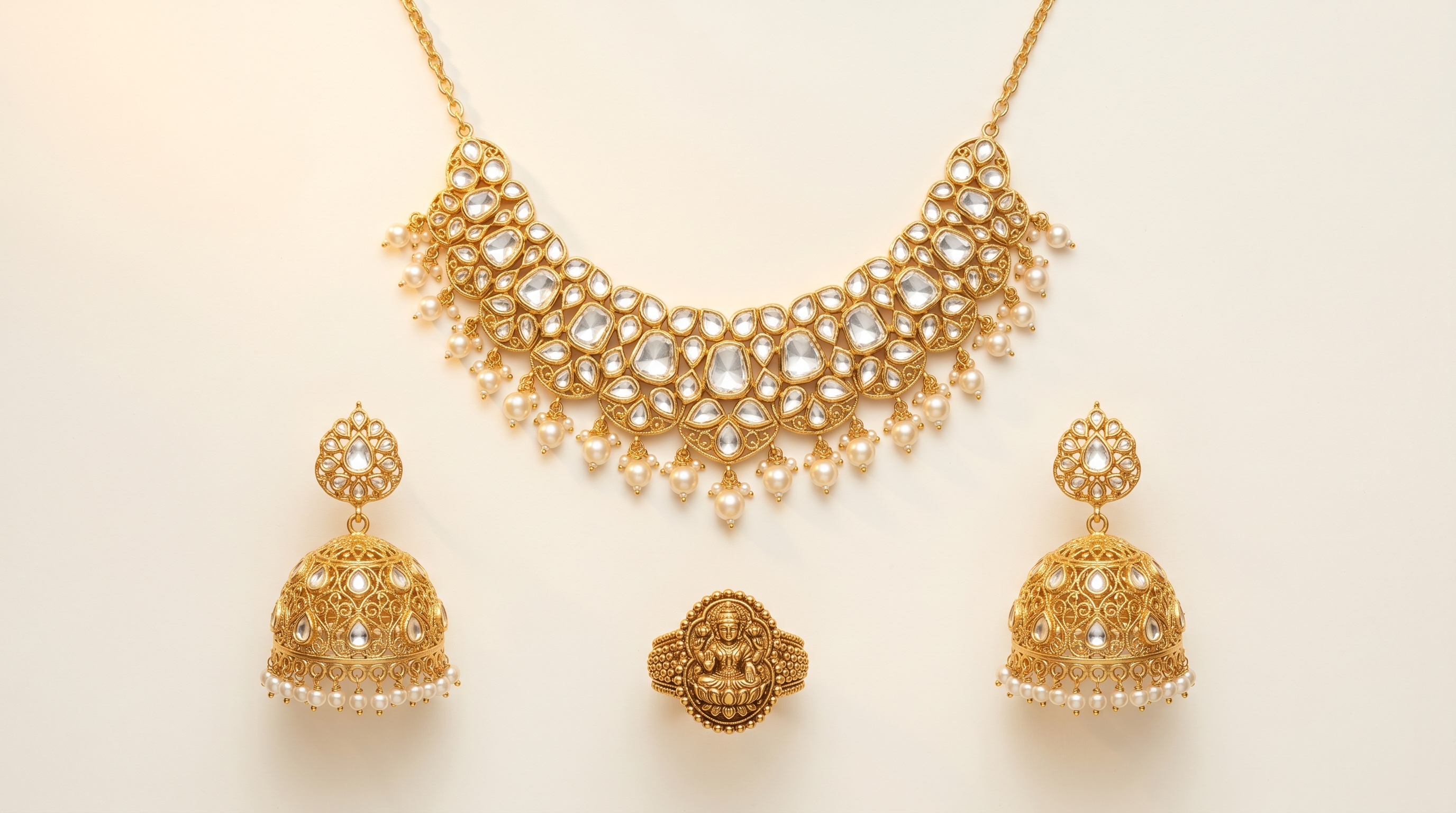
This is the verified spec sheet for jewelry sellers — Myntra Jewellery, Flipkart, Amazon Fashion India, Tata CLiQ Luxe, Nykaa Luxe, plus Tanishq.com, Caratlane, and Bluestone for completeness. Every spec is cited inline. Two marketplace rows are flagged [VERIFY] because their seller portals are gated; do not bulk-upload against an unverified line item.
For the cross-category view across apparel + jewelry, see the full marketplace image spec matrix. For Amazon-specific jewelry rules, see Amazon India apparel & jewelry photo requirements 2026. For the Myntra-specific apparel companion, see Myntra image guidelines 2026.
The cross-platform jewelry spec matrix
Indian jewelry marketplaces split into three image-spec tiers. Myntra Jewellery and Nykaa Fashion run 3:4 portrait at 1,080×1,440 px minimum. Tata CLiQ Luxe runs 4:5 portrait at 1,200×1,500 px. Amazon Fashion India and Tanishq.com run 1:1 square at 1,000 px minimum long edge. Tata CLiQ Luxe is the strictest master capture.
| Platform | Min resolution | Aspect ratio | Background | On-body required | Hallmark shot |
|---|---|---|---|---|---|
| Myntra Jewellery | 1,080 × 1,440 px (2,400 × 3,200 recommended) | 3:4 portrait (mandatory) | Pure white #FFFFFF (lifestyle in slots 4-7) | Yes — for earrings, necklaces, rings | Optional |
| Flipkart Lifestyle (Jewelry) | 1,000 × 1,000 px min; 2,000 × 2,000 recommended [VERIFY: Flipkart Seller Hub — jewelry vertical 2026] | 1:1 square primary (portrait alt accepted in some sub-cats) [VERIFY] | Pure white | Optional [VERIFY] | Recommended for gold [VERIFY] |
| Amazon Fashion India (Jewelry) | 1,000 px long edge min; 2,560 px recommended | 1:1 square | RGB #FFFFFF; product fills ≥85% of frame | Optional; ghost-mannequin / hand-form accepted on main | Required for gold (BIS hallmark visible — Amazon enforces at intake) |
| Tata CLiQ Luxe | 1,200 × 1,500 px (2,400 × 3,000 px for zoom layer) | 4:5 portrait mandatory primary; 1:1 accepted slots 5-7 | Pure white catalog; one editorial slot per SKU may use dark velvet #1A1A1A or marble | Yes — required above ₹15k AOV | Recommended |
| Nykaa Luxe | [VERIFY: Nykaa Luxe seller portal — luxury jewelry tier 2026] — Nykaa Fashion baseline is 1,500 × 2,000 px, 3:4 portrait | [VERIFY] — Nykaa Fashion is 3:4; Luxe tier likely 4:5 | Pure white catalog; one warm-cream or marble slot permitted (Nykaa Fashion baseline) | Yes (Nykaa Fashion baseline; Luxe tier rewards lifestyle slot) | Optional |
| Tanishq.com | 1,200 × 1,200 px min; 2,000 × 2,000 recommended | 1:1 square | Pure white catalog | Yes — featured on most PDPs | Required for hallmarked SKUs |
| Caratlane | 1,000 × 1,000 px min | 1:1 square | Pure white catalog | Optional | Required for hallmarked SKUs |
| Bluestone | 1,200 × 1,200 px min | 1:1 square | Pure white #FFFFFF (zero shadow tint tolerance) | Optional | Required for hallmarked SKUs |
If you list across Myntra + Amazon + Tata CLiQ Luxe in the same drop, you need three masters per SKU. Render once at 4:5 portrait (CLiQ Luxe is strictest), then derive 3:4 and 1:1 crops from the same reference set. We've found re-cropping a portrait master to square below 85% frame fill is the single most common cause of an Amazon rejection that looked compliant in QA.
Myntra Jewellery — 3:4 portrait, pure white primary
Myntra Jewellery mandates a 3:4 portrait aspect ratio at 1,080×1,440 px minimum (2,400×3,200 px recommended). Background on the primary slot is pure white #FFFFFF. On-body imagery is required for earrings, neckpieces, and rings. Lifestyle and styled shots are permitted in slots four through seven.
What this means for ring SKUs
Rings on Myntra Jewellery list with the on-body shot as the conversion driver. The primary slot is the top-down packshot on pure white, but the second slot — on-hand at eye-level distance — is where the buyer reads scale. Skip slot 2 and add-to-cart drops materially on the mobile PDP.
What this means for earring and necklace SKUs
Earrings and necklaces both demand the on-model close-up by slot 2 on Myntra. A jhumka on ear with hair tucked, or a polki rivière on décolletage, signals fit and drape in a way no packshot can. The 3:4 portrait crop is built for this — square crops cut off the hang or the chain.
Flipkart Jewelry — 1:1 square baseline
Flipkart Jewelry catalog slots baseline on the broader Flipkart Lifestyle image contract: 1:1 square primary at 1,000×1,000 px minimum and 2,000×2,000 px recommended for HD zoom. [VERIFY: Flipkart Seller Hub — jewelry vertical 2026] for portrait alternates in specific sub-categories; rules differ from the apparel vertical.
Flipkart's intake QC is lighter than Myntra's on jewelry — fewer auto-rejections, more soft-flag corrections. That's not a quality license. The PDP ranks listings with HD-zoom-capable masters above non-zoom masters, so the 2,000×2,000 px recommended floor is the effective minimum if you want search visibility.
The sub-category portrait carve-out flag matters for traditional/bridal sub-categories where Flipkart historically accepted Myntra-style portrait crops. We don't have a verified 2026 seller-hub doc to cite — treat it as "shoot square primary, render portrait alt for the lifestyle slots."
Amazon Fashion India — 1:1 square + BIS hallmark gate
Amazon Fashion India requires 1:1 square images at 1,000 px minimum long edge (2,560 px recommended), pure white background RGB #FFFFFF, and product fill of at least 85% of the frame. Gold SKUs require a visible BIS hallmark in at least one image — Amazon enforces this at intake.
The BIS hallmark gate is the Amazon-specific trap that consistently catches first-time gold sellers. Bureau of Indian Standards regulation since June 2021 makes hallmarking mandatory on gold jewellery sold in India. Amazon's catalog QC reads the hallmark image at intake. No hallmark image, no listing — the SKU sits in "incomplete listing" status until the seller uploads a hallmark photo from the physical piece.
The hallmark itself cannot be synthesised. A pure-render workflow cannot create a verifiable BIS mark. The hallmark image must be photographed from the physical piece or composited with provenance from a real hallmark capture. Every other angle, including the on-body and packshot, can come from the render pipeline.
Tata CLiQ Luxe — 4:5 portrait + zoom layer
Tata CLiQ Luxe enforces 4:5 portrait at 1,200×1,500 px minimum for the primary slot and recommends 2,400×3,000 px for the zoom layer. Sub-2,400 px masters disable the PDP's 1.6× zoom and the listing loses an internal premium-listing badge that compounds into search ranking.
The editorial slot rule
CLiQ Luxe permits one editorial slot per SKU — typically slot 3 or 4 — using dark velvet at #1A1A1A or marble surface as the background. This is unique among Indian jewelry marketplaces. Slots 1 and 2 remain pure-white catalog. The editorial slot is where the buyer reads the piece in context — a polki rivière on burgundy velvet reads at a different price tier than the same piece on flat white.
The ₹15k AOV on-body trigger
Tata CLiQ Luxe requires on-body imagery for SKUs above the ₹15,000 AOV threshold. Below that, on-surface alone is accepted. Above, listings without an on-body slot get visibility-throttled in the Luxe discovery feed. The threshold is a tier signal — Luxe expects luxury treatment above ₹15k.
Nykaa Luxe — Fashion baseline + tighter editorial check
Nykaa Luxe baselines off Nykaa Fashion's 1,500×2,000 px 3:4 portrait spec, with a tighter editorial check on the luxury tier. The Luxe seller portal's exact 2026 specs require verification — confirm at the Nykaa Luxe seller portal before bulk uploads. Lifestyle slots are rewarded in engagement signals.
[VERIFY: Nykaa Luxe seller portal — luxury jewelry tier 2026]. Nykaa Fashion's baseline is documented in the public seller-portal collateral, but the Luxe tier portal is gated and we cannot confirm spec parity for 2026. Treat Nykaa Fashion's 3:4 portrait at 1,500×2,000 px as the floor and expect a tighter editorial bar on the Luxe tier — on-body slot quality, lifestyle palette, and editorial direction are scored higher than Fashion.
The BIS hallmark image requirement
BIS hallmarking has been mandatory for gold jewellery sold in India since June 2021 under the Bureau of Indian Standards regulation. Amazon.in enforces a visible hallmark in at least one catalog image at intake. The hallmark cannot be synthesised by a render — it must be photographed or composited with provenance.
The 2021 mandate (which the Bureau of Indian Standards documents at bis.gov.in) covers 14k, 18k, and 22k gold. The hallmark itself is a six-digit alphanumeric — the HUID (Hallmark Unique Identification) — plus the BIS logo, purity grade, and assaying-centre mark. All four elements must be legible in the hallmark image.
In our experience, the cleanest workflow is a single 1:1 macro of the hallmark on the inner band or clasp, shot at 100mm macro at f/8 with diffused side-light, then dropped into slot 5 or 6 of every gold SKU on Amazon. The render pipeline handles every other angle.
Rejection traps unique to jewelry listings
Jewelry listings on strict marketplaces are suppressed for five recurring traps: off-white backgrounds reading as cream on Amazon and Bluestone; stone-count drift between image and SKU title; metal-hue shift (yellow gold rendered as rose); missing BIS hallmark on gold SKUs; and multi-piece composition when the SKU is a single piece.
The five-trap matrix
| # | Trap | Marketplace that enforces it strictest | Fix |
|---|---|---|---|
| 1 | Stone-count drift (halo gains 2 stones, pavé drops one) | Bluestone (auto-flags against catalog DB), Tanishq.com | Lock exact stone count in render brief; QA against source flat-lay |
| 2 | Metal-hue shift (22k yellow → rose; white gold → silver) | Tata CLiQ Luxe, Bluestone, Tanishq.com | Specify alloy hex in render brief; QA against declared metal field |
| 3 | Missing BIS hallmark on gold | Amazon Fashion India (intake gate) | Shoot hallmark macro from physical SKU; insert at slot 5 |
| 4 | Off-white background (warm cream reads as cream) | Amazon Fashion India, Bluestone | Render at pure #FFFFFF sRGB; sample 3 points before upload |
| 5 | Multi-piece composition on single-piece SKU | Amazon Fashion India (main slot policy) | Render single-piece on main; paired styling on alt slots only |
For the deep breakdown with marketplace-by-marketplace enforcement signatures, see jewelry catalog rejection reasons across marketplaces.
Why stone-count drift is the highest-leverage trap
Stone-count drift is the rejection trap that scales fastest with catalog size. A renderer that hallucinates one extra stone on a 5-stone halo creates a category-change defect — the SKU title says "5-stone halo," the image shows 7 stones, and Bluestone's intake QC reads them as different SKUs. At 100 SKUs/drop, even a 3% drift rate suppresses three listings.
Kraftr's QA rubric weights stone count at 16 out of 100. Drift triggers automatic regeneration before the render leaves QA — no human in the loop, no end-of-day batch checks.
AI-generated jewelry imagery — marketplace policy in 2026
AI-generated jewelry imagery is accepted across Myntra, Nykaa, Amazon India, and Tata CLiQ Luxe under non-misrepresentation rules in 2026. The render must accurately depict stone count, prong count, metal hue, facet pattern, and motif against the physical SKU. BIS hallmark on Amazon gold listings cannot be synthesised.
The non-misrepresentation principle is the operative rule on every Indian marketplace. There is no "AI disclosure" mandate as of mid-2026, but there is a fidelity bar — the render has to match the physical SKU on the seven jewelry fidelity primitives (stone count, prong or claw count, setting type, metal alloy hue, facet pattern, engraving/granulation, finish). Drift on any of these is grounds for delisting under marketplace misrepresentation clauses.
Provenance is increasingly relevant. Frontier image-generation pipelines embed SynthID watermarks for audit-ready proof of AI generation — useful when a marketplace requests provenance during a QC dispute.
Catalog 200 jewelry SKUs in a day at marketplace spec
Kraftr renders rings, earrings, necklaces and bridal sets at every marketplace's required composition — on-model and on a styled surface — with fidelity locked to the actual piece. No retoucher. No studio rental. See the Kraftr jewelry pipeline →
Pre-flight checklist for jewelry catalog uploads
[ ] Master capture at 4:5 portrait (CLiQ Luxe), 2,400 × 3,000 px+
[ ] Derive 3:4 portrait crop for Myntra Jewellery + Nykaa
[ ] Derive 1:1 square crop for Amazon + Flipkart + Tanishq + Caratlane + Bluestone
[ ] Pure white #FFFFFF sRGB on every primary slot
[ ] On-body slot rendered for earrings, necklaces, rings on Myntra
[ ] On-body slot rendered for all SKUs above ₹15k AOV on CLiQ Luxe
[ ] BIS hallmark macro shot from physical SKU for gold (Amazon)
[ ] Stone count, prong count, metal hue verified against SKU title
[ ] No multi-piece composition on main slot for single-piece SKUs
[ ] Frame fill ≥85% on Amazon main; ≥60% on every other marketplace
Sources
- Bureau of Indian Standards — Hallmarking (bis.gov.in)
- Tata CLiQ Seller Central — Catalog guidelines (luxury.tatacliq.com, gated)
- Amazon.in Seller Central — Product image requirements (sellercentral.amazon.in)
- Myntra Partner Portal — Image specifications (partner.myntra.com, gated)
- Nykaa Fashion Seller Portal (nykaafashion.com/sell-on-nykaa-fashion); Nykaa Luxe portal
[VERIFY] - Flipkart Seller Hub
[VERIFY] - Fynd documentation on Myntra image guidelines
- SynthID watermarks — provenance for AI-rendered imagery
Further reading
- Jewelry Product Photography for Fashion & Catalog Listings — converting landing with renders
- Catalog Production for D2C Jewelry Brands — persona-keyed deep dive
- The Kraftr jewelry product photography playbook — pillar guide
- The bridal jewelry catalog shoot checklist — sibling spoke
- Jewelry catalog rejection reasons across marketplaces — sibling spoke
- The full marketplace image spec matrix — cross-cluster
- Ship a jewelry catalog at marketplace spec — Kraftr product
- The Kraftr team
Last verified: 2026-05-22.
Frequently asked questions
- What is the Myntra Jewellery image size requirement in 2026?
- Myntra Jewellery requires 1,080×1,440 px minimum at a 3:4 portrait aspect ratio. 2,400×3,200 px is recommended for hero slots. The primary image background must be pure white #FFFFFF in sRGB colour profile. Warm-toned whites are rejected at intake on the colour-profile check.
- What aspect ratio does Tata CLiQ Luxe require for jewelry images?
- Tata CLiQ Luxe requires 4:5 portrait as the mandatory primary aspect ratio. 1:1 square is accepted only for slots five through seven. Catalog slots use pure white; CLiQ Luxe permits one editorial slot per SKU using dark velvet at #1A1A1A or marble for the primary set.
- Is a BIS hallmark required in Amazon India jewelry images?
- BIS hallmark is required on Amazon.in for gold jewellery listings under the Bureau of Indian Standards mandate effective June 2021. Amazon enforces a visible hallmark in at least one image at intake. The hallmark cannot be AI-generated; it must be photographed or composited with provenance from the physical SKU.
- What is the minimum resolution for Nykaa Luxe jewelry photos?
- Nykaa Luxe baselines off the Nykaa Fashion specification of 1,500×2,000 px at 3:4 portrait, with a tighter editorial check on the luxury tier. The Luxe seller portal's exact 2026 minimums require verification before bulk uploads. Confirm at the Nykaa Luxe seller portal.
- Can I use AI-generated jewelry images on Indian marketplaces?
- AI-generated jewelry images are accepted on Myntra Jewellery, Nykaa Fashion and Luxe, Amazon Fashion India, and Tata CLiQ Luxe in 2026 under non-misrepresentation rules. The render must accurately depict stone count, prong count, metal hue, facet pattern, and motif. Drift on any of these is grounds for delisting.
- What's the difference between Tata CLiQ Luxe and Tata CLiQ Fashion image specs?
- Tata CLiQ Luxe and Tata CLiQ Fashion share a 4:5 portrait primary aspect ratio at 1,200×1,500 px minimum. CLiQ Luxe adds an editorial check on the imagery, permits a dark-velvet or marble editorial slot, and requires on-body imagery above the ₹15k AOV threshold. CLiQ Fashion is more permissive on background.
- Why does Flipkart jewelry use 1:1 square when Myntra uses 3:4 portrait?
- Flipkart Lifestyle's product detail page is built mobile-first around a 1:1 square hero, matching Amazon India's apparel grid. Myntra's PDP uses a 3:4 portrait grid optimised for full-length apparel imagery, which carried into the Jewellery vertical. A jewelry seller listing on both must produce both crops from one master capture.
- What are the most common jewelry image rejection reasons in 2026?
- The five most common jewelry image rejection reasons across Indian marketplaces are off-white backgrounds reading as cream on Amazon and Bluestone QC, stone-count drift between image and SKU title, metal-hue shift, missing BIS hallmark on gold, and multi-piece composition when the SKU is a single piece. Each has a specific marketplace enforcement signature.
- Does Tanishq.com or Caratlane accept AI-generated images?
- Tanishq.com and Caratlane have no public AI-disclosure policy as of mid-2026; the operative rule is non-misrepresentation. The rendered jewelry must accurately depict the physical SKU on every fidelity-critical dimension. A render that drifts on stone count, prong count, metal hue, facet pattern, or motif against the source is grounds for delisting.
- How does Kraftr produce jewelry images at every marketplace spec from one reference?
- Kraftr's fidelity-first pipeline produces every marketplace's required aspect ratio — 1:1, 4:5, 3:4 — from one reference flat-lay of the SKU. Seven jewelry fidelity primitives are locked on every render: stone count, prong count, setting type, metal alloy hue, facet pattern, engraving, finish. One reference set produces every crop without a re-shoot.
About the author
Kraftr is a fidelity-first AI catalog production tool for D2C fashion and jewelry brands selling on Indian marketplaces. We publish marketplace specs and production playbooks based on the rules our customers ship against every week.
More about Kraftr