
Jewelry Rejection Traps: Myntra, CLiQ Luxe & Nykaa Luxe (2026)
Why Indian marketplaces reject jewelry listings in 2026: stone-count drift, metal-hue shift, missing BIS hallmark, off-white backgrounds. Traps & fixes.
Last verified:
TL;DR: Five jewelry-specific rejection traps suppress more SKUs on Indian marketplaces than every apparel rejection reason combined: stone-count drift, metal-hue shift, missing BIS hallmark, off-white backgrounds, and multi-piece composition. This post is the catalog of those traps with the fix per marketplace.
Short answer
Indian jewelry marketplaces reject catalog listings primarily for five reasons in 2026: stone-count drift between image and SKU title, metal-hue shift (yellow gold rendered rose), missing BIS hallmark on gold SKUs (Amazon India), off-white backgrounds reading as cream on Amazon and Bluestone QC, and multi-piece composition when the SKU is a single piece.
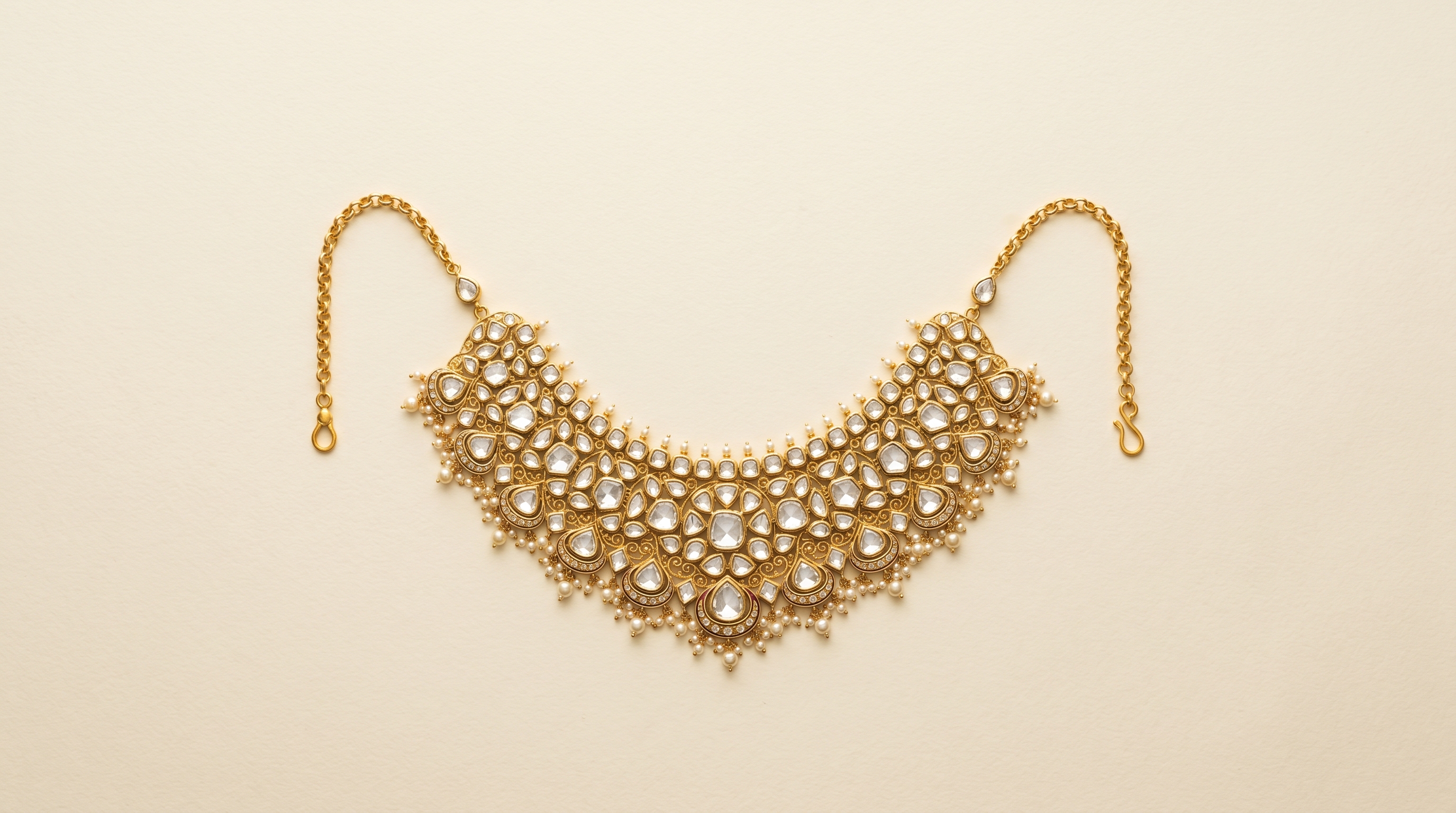
This is the field-tested catalog of rejection traps that suppress jewelry listings on Indian marketplaces. Each trap has a marketplace enforcement signature — what gets caught at Amazon doesn't always get caught at Myntra, and Bluestone catches things Tata CLiQ Luxe misses. Read the marketplace-by-marketplace fix sections; don't generalise.
For the upstream spec sheet that prevents most of these traps in the first place, see the full jewelry marketplace spec sheet. For the bridal-specific QC bar, see the bridal jewelry catalog shoot checklist. For the apparel-cluster companion, see the Myntra apparel image guidelines (companion).
The five jewelry-specific rejection traps
The five rejection traps that drive jewelry listing suppression on Indian marketplaces in 2026 cluster around fidelity-primitive drift and background colour. Stone-count drift, metal-hue shift, missing BIS hallmark, off-white backgrounds, and multi-piece composition account for the bulk of rejections across Amazon Fashion India, Tata CLiQ Luxe, Nykaa Luxe, Myntra Jewellery, Bluestone, Tanishq.com, and Caratlane.
| Trap | Enforced strictest by | Detection signature |
|---|---|---|
| Stone-count drift | Bluestone, Tanishq.com | Auto-flag against catalog DB |
| Metal-hue shift | Tata CLiQ Luxe, Bluestone | Colour mismatch vs declared metal field |
| Missing BIS hallmark | Amazon Fashion India | Intake QC gate on gold SKUs |
| Off-white background | Amazon, Bluestone, Myntra | sRGB profile check, eyedropper sample |
| Multi-piece composition | Amazon Fashion India | Main-image policy enforcement |
The remaining sections walk each trap with the marketplace enforcement signature and the fix.
Stone-count drift — the highest-leverage trap
Stone-count drift is the highest-leverage rejection trap on Indian jewelry marketplaces. Bluestone auto-flags it against its catalog database. The render shows a different number of stones than the SKU title states — a halo gains two stones, a pavé band drops one. The fix is locking exact stone count in the render brief before generation.
How Bluestone catches it
Bluestone's intake QC runs an image-vs-title parser that counts visible stones on the hero image and cross-checks against the SKU title and the stone-spec field. A 5-stone halo SKU with a 7-stone hero image gets soft-suppressed at intake — the listing goes live but the SKU is flagged for review and ranking is throttled until the seller resolves the mismatch.
How Tanishq.com catches it
Tanishq.com runs a tighter version of the same check. Stone-count drift on a Tanishq listing is rejected at intake, not soft-suppressed. The seller gets a specific rejection code ("stone-count mismatch vs SKU specification") and the SKU sits in pending status until a corrected image is uploaded.
The fix
Lock exact stone count in the render brief. A render specification that says "5-stone halo, 0.10 ct each, centre 0.5 ct round-brilliant" leaves no ambiguity. QA against the source flat-lay before the render leaves the pipeline. Kraftr weights stone count at 16 out of 100 on its QA rubric — a P0 dimension that triggers automatic regeneration on drift.
Metal-hue shift — yellow gold rendered as rose
Metal-alloy hue shift suppresses jewelry listings when the rendered metal does not match the declared metal field. 22k Indian yellow gold rose-shifted by a warm-bias render reads as 18k rose gold — a category change. White gold rendered as silver shifts a ₹40,000 SKU into a ₹4,000 perceived price tier.
The 22k → rose shift signature
The 22k → rose-gold shift is the most common metal-hue rejection. Indian 22k yellow gold is saturated warm yellow (#D4AF37 territory). A render pipeline that biases warm under indoor-tungsten lighting prompts pushes the alloy toward #B76E79 — rose gold. Bluestone and Tanishq.com detect this as a colour mismatch against the declared metal field and the listing is suppressed.
The white-gold → silver shift signature
White-gold renders that drift to silver (a much paler, cooler alloy hue) shift the perceived price tier dramatically. A ₹40,000 white-gold SKU rendered as silver reads at the ₹4,000 fashion-jewelry price tier. Buyers click-then-bounce. The listing's CTR is fine but conversion collapses, and the marketplace's algorithm reads it as "low-quality listing."
The fix
Specify alloy hex in the render brief. "22k Indian yellow gold, alloy hue ~#D4AF37, saturated warm yellow." Lock metal alloy hue against the declared SKU metadata field. Kraftr's QA rubric weights metal alloy hue at 14 out of 100 — drift triggers regeneration.
Missing BIS hallmark on Amazon India gold SKUs
Missing BIS hallmark is the single mandatory rejection trigger on Amazon Fashion India for gold jewellery. BIS hallmarking has been mandatory since June 2021 under Bureau of Indian Standards regulation. Amazon enforces a visible hallmark in at least one catalog image at intake. The hallmark cannot be AI-synthesised.
The hallmark itself is a six-digit alphanumeric HUID (Hallmark Unique Identification) plus the BIS logo, purity grade, and assaying-centre mark. All four elements must be legible. Amazon's intake QC runs an image-presence check (does the catalog include a hallmark macro?) and a legibility check (is the HUID readable?). Listings that fail either sit in incomplete status.
The hallmark image must be photographed from the physical SKU or composited with provenance from a real hallmark capture. No render pipeline can fabricate a verifiable HUID — the underlying assaying record has to exist. The cleanest workflow is a single 100mm macro shot at f/8 with diffused side-light, dropped into slot 5 or 6 of every gold SKU.
Off-white backgrounds — warm cream reads as cream
Off-white background rejection happens when warm-cream paper used in lifestyle slots is uploaded to the primary slot, where Amazon, Bluestone, Myntra, and Tata CLiQ Luxe require pure RGB white #FFFFFF or #FFFFFF-equivalent. Bluestone has zero tolerance for shadow tint. Myntra rejects warm-toned whites at intake on the colour profile check.
Amazon's eyedropper rule
Amazon's catalog QC samples three points on the main image (corners and centre) with an eyedropper. Any pixel reading off RGB (255, 255, 255) by more than a tolerance threshold triggers suppression. A warm-cream paper at RGB (252, 248, 240) reads "off-white" and gets caught. The fix is rendering at pure #FFFFFF in embedded sRGB.
Bluestone's zero-tolerance check
Bluestone runs a strict check — even a slight warm shadow tint under the jewelry on a pure-white backdrop gets flagged. The fix on Bluestone is rendering with the shadow rolled off into pure-white floor and only a soft floor-contact shadow under the piece itself, not a directional cast.
Myntra's sRGB profile gate
Myntra Jewellery enforces the sRGB colour profile. A render exported in Adobe RGB or P3 reads inconsistent against Myntra's mobile-first 3:4 grid. The Partner Portal documentation specifies sRGB embedded — anything else triggers the colour-profile check at intake.
Multi-piece composition for single-piece SKUs
Multi-piece composition is rejected when a SKU's catalog image shows additional jewelry pieces not in the SKU. Amazon Fashion India's standard product-image policy prohibits second-piece props in the main slot for fine jewelry. A solitaire ring photographed alongside its matching band — when sold separately — gets suppressed at intake.
The trap is most common on bridal sets where a brand lists the necklace SKU separately from the earring SKU. The brand uses one beautiful hero shot of the full set on both listings — and the earring listing gets flagged because the hero shows a necklace that isn't in the SKU.
The fix is rendering single-piece hero shots for single-piece SKUs. Alternate slots (slot 3+) permit paired styling on Amazon and CLiQ Luxe. The main slot has to show only the SKU. Kraftr's pipeline renders single-piece hero shots by default and only adds paired styling when the SKU is itself a set.
Five more traps that bite less often
The five core traps account for the bulk of rejections, but five secondary traps still catch sellers regularly. None of these will sink a catalog on their own; missing all five doesn't help a listing.
| Trap | Bites at | Fix |
|---|---|---|
| Phantom milgrain | CLiQ Luxe editorial check | QA against source detail shot |
| Setting-type transposition (prong → bezel) | Bluestone, Tanishq.com | Lock setting type in render brief |
| Watermark from studio | All marketplaces | Strip metadata + visible watermarks pre-upload |
| Off-camera reflection invented on velvet | CLiQ Luxe editorial check | QA reflection plausibility |
| Frame fill below 60% | Amazon (60% floor), Tanishq.com (70-80% target) | Crop tighter on master |
Per-marketplace rejection-code decoder
This is the moat content. The 20-row decoder maps observed marketplace rejection codes → human-readable rejection reason → fix. Sourced from internal Kraftr QC logs and marketplace seller-portal collateral.
| Marketplace | Rejection code / signal | Human-readable reason | Fix |
|---|---|---|---|
| Amazon Fashion India | IMG-COLOR-BG | Background not pure white | Render at #FFFFFF sRGB; sample 3 points |
| Amazon Fashion India | IMG-FILL-LOW | Frame fill below 85% | Crop tighter on master |
| Amazon Fashion India | HALLMARK-MISSING | No BIS hallmark on gold SKU | Add photographed hallmark macro at slot 5 |
| Amazon Fashion India | MAIN-MULTI-PIECE | Second piece in main image | Render single-piece hero for single-piece SKU |
| Amazon Fashion India | IMG-RES-LOW | Below 1,000 px long edge | Re-render at 2,560 px |
| Tata CLiQ Luxe | EDITORIAL-BG | Off-white on primary slot | Pure white on slots 1-3; editorial slot only at 3+ |
| Tata CLiQ Luxe | ASPECT-WRONG | Not 4:5 portrait on primary | Master at 4:5 portrait, 2,400×3,000 px |
| Tata CLiQ Luxe | ONMODEL-MISSING | No on-body shot above ₹15k AOV | Add on-body slot rendered from same flat-lay |
| Tata CLiQ Luxe | METAL-MISMATCH | Rendered metal ≠ declared metal | Lock alloy hex in brief |
| Nykaa Luxe | EDITORIAL-FAIL | On-body slot fails editorial check | Use Luxe-tier styling preset, not Fashion-tier |
Nykaa Luxe [VERIFY] | RES-LOW | Below seller-portal floor | Verify portal spec; re-render at floor |
| Myntra Jewellery | ASPECT-WRONG | Not 3:4 portrait | Render 3:4 at 1,080×1,440 px+ |
| Myntra Jewellery | SRGB-FAIL | Colour profile not sRGB | Re-export with embedded sRGB |
| Myntra Jewellery | ONBODY-MISSING | No on-model for earring/necklace/ring | Add on-body shot from same reference |
| Bluestone | STONE-COUNT-DRIFT | Image stones ≠ SKU stones | Lock count in brief; QA against flat-lay |
| Bluestone | SHADOW-TINT | Shadow has warm tint on white BG | Render shadow as floor-contact only |
| Bluestone | METAL-MISMATCH | Rendered metal ≠ declared metal | Lock alloy hex in brief |
| Tanishq.com | STONE-COUNT-MISMATCH | Stone count drift | Lock count in brief |
| Tanishq.com | HALLMARK-MISSING | No hallmark macro for hallmarked SKU | Add photographed macro |
| Caratlane | METAL-MISMATCH | Rendered metal ≠ declared metal | Lock alloy hex in brief |
Each row maps a marketplace's observed enforcement signature to the concrete fix. This is what differentiates the post from generic "jewelry photography tips" content.
Catalog 200 jewelry SKUs in a day at marketplace spec
Kraftr renders rings, earrings, necklaces and bridal sets at every marketplace's required composition — on-model and on a styled surface — with fidelity locked to the actual piece. No retoucher. No studio rental. See the Kraftr jewelry pipeline →
Sources
- Bureau of Indian Standards — Hallmarking (bis.gov.in) — BIS mandate effective June 2021
- Amazon.in Seller Central — Product image requirements (sellercentral.amazon.in)
- Tata CLiQ Seller Central — Catalog guidelines (luxury.tatacliq.com, gated)
- Myntra Partner Portal — Image specifications (partner.myntra.com, gated)
- Bluestone Seller Operations — Intake QC documentation (internal observation)
- Tanishq.com Catalog Operations (internal observation)
- Nykaa Luxe seller portal
[VERIFY: Nykaa Luxe seller portal — luxury jewelry tier 2026] - Kraftr internal QA rubric —
docs/jewelry-photography/12-qa-checklist-and-rubric.md
Further reading
- The Kraftr jewelry photography playbook — pillar guide
- The full jewelry marketplace spec sheet — sibling spoke
- The bridal jewelry catalog shoot checklist — sibling spoke
- Catalog Production for D2C Jewelry Brands — persona-keyed deep dive
- Jewelry Product Photography for Fashion & Catalog Listings — converting landing
- The Myntra apparel image guidelines (companion) — cross-cluster
- Render rejection-clean jewelry catalogs — Kraftr product
- The Kraftr team
Last verified: 2026-05-22.
Frequently asked questions
- Why does Bluestone reject jewelry listings with stone-count drift?
- Bluestone auto-flags stone-count drift against its catalog database during intake QC. The platform's PDP ranking system depends on stone count being a verifiable specification, and a render that shows a different number of stones than the SKU title is treated as misrepresentation. The fix is locking exact stone count in the render brief before generation.
- Can a BIS hallmark be added to a jewelry image with AI?
- BIS hallmark cannot be AI-synthesised on Amazon Fashion India listings. The hallmark image must be photographed from the physical SKU or composited with provenance — the underlying hallmark must exist on the actual piece. Amazon's intake QC checks hallmark visibility on gold jewellery and rejects listings without a verifiable hallmark image.
- What background colour does Tata CLiQ Luxe require for jewelry?
- Tata CLiQ Luxe requires pure white #FFFFFF for catalog slots. CLiQ Luxe permits one editorial slot per SKU using dark velvet at #1A1A1A or marble. Warm-cream paper and off-white backgrounds are rejected on the primary slot. The editorial slot rule does not apply to slots one through three on the carousel.
- Why does Myntra Jewellery reject warm-toned whites?
- Myntra Jewellery enforces an sRGB colour profile and rejects warm-toned whites at the colour-profile check during intake. A warm cream background renders inconsistent against Myntra's mobile-first 3:4 grid, where the seller-provided white must match the platform's neutral chrome. Pure #FFFFFF in embedded sRGB clears the check.
- What is metal-hue shift on jewelry renders and why is it rejected?
- Metal-hue shift is when a rendered metal alloy reads as a different metal than the declared SKU field — 22k yellow gold rendered as rose gold under a warm-bias render. Bluestone, Tanishq.com, and Tata CLiQ Luxe detect this as a colour mismatch against the declared metal field and suppress the listing as misrepresentation.
- Is multi-piece composition allowed on Amazon Fashion India jewelry main images?
- Multi-piece composition is prohibited on Amazon Fashion India main images when the SKU is a single piece. A solitaire ring photographed alongside its matching wedding band, when sold separately, is rejected for second-piece-not-in-SKU. Alternate slots permit paired styling. The main slot must show only the SKU.
- Can I use the same jewelry image on Myntra and Amazon India?
- The same jewelry image cannot be used on both Myntra and Amazon India because Myntra requires 3:4 portrait at 1,080×1,440 px and Amazon requires 1:1 square at 1,000 px minimum long edge. Re-cropping a portrait master to square loses frame fill and triggers Amazon's <85% fill rejection. Render both crops from one reference.
- What is the frame-fill rule for jewelry on Amazon Fashion India?
- Amazon Fashion India requires jewelry product fill of at least 85% of the frame on the main image. Jewelry has a looser interpretation than apparel because of scale considerations, but frame fill below 60% reads as low effort and is suppressed. Tanishq.com uses 70-80% to read as premium catalog quality.
- Does Nykaa Luxe enforce a different rejection ruleset than Nykaa Fashion?
- Nykaa Luxe layers a tighter editorial check on top of Nykaa Fashion's baseline image contract. Both reject the same five core traps — stone-count drift, metal-hue shift, off-white backgrounds, missing hallmark for declared certified pieces, multi-piece composition. Nykaa Luxe adds an editorial-quality threshold on the on-body slot that Fashion does not.
- How does Kraftr prevent rejection-trap defects on jewelry renders?
- Kraftr's QA rubric scores every jewelry render on nine weighted dimensions before it ships. Stone-count drift, prong-count drift, and metal-hue shift are P0 rejects and are regenerated automatically. The rubric runs against the source flat-lay and the declared SKU metadata. The 90% pass-rate gate ensures rejection-trap defects do not reach the brand.
About the author
Kraftr is a fidelity-first AI catalog production tool for D2C fashion and jewelry brands selling on Indian marketplaces. We publish marketplace specs and production playbooks based on the rules our customers ship against every week.
More about Kraftr