
Diwali Fashion Photography Guide 2026: Shoot Calendar, Specs & Lookbook
Diwali 2026 (Nov 8) catalog shoot-by date is Sep 27. Full calendar, garment palette, Myntra/Flipkart EORS specs, and the 8 rejection traps for festive fashion.
Last verified:
TL;DR: Diwali 2026 falls on Nov 8. The shoot-by date is Sep 27. This guide gives you the week-by-week shoot calendar, the Diwali palette and garment mix, every marketplace's EORS spec, and the eight rejection traps that block festive-wear catalogs.
Short answer
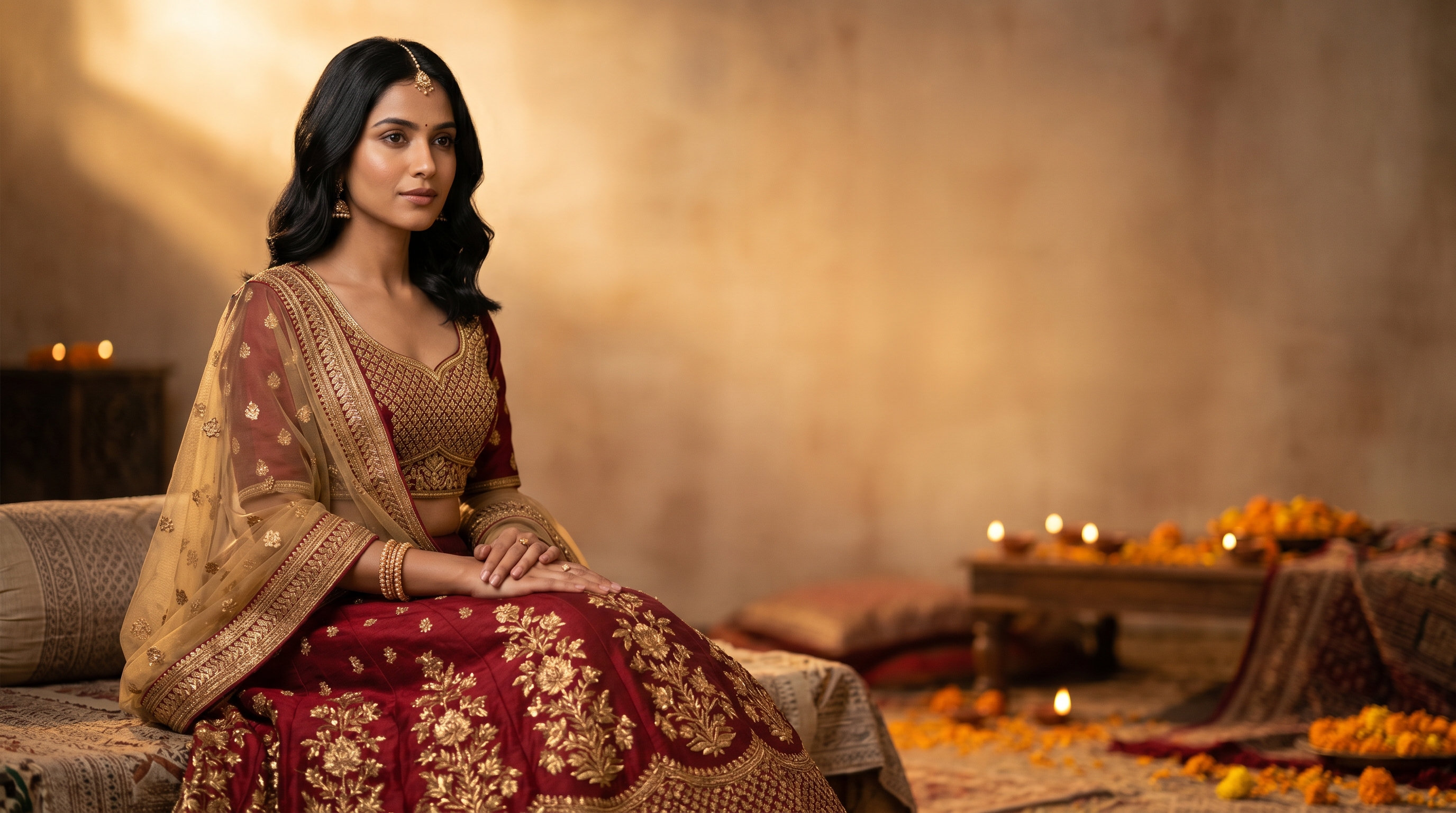
Diwali fashion photography for 2026 follows a 13-week ramp: concept lock by Aug 9, references by Aug 30, hero render by Sep 6, full catalog by Sep 20, marketplace upload by Sep 27, catalog live four weeks before the Nov 8 festival. The Diwali palette leads with red, maroon, gold and cream; garment mix skews lehenga, saree, anarkali and sherwani.
For the date-of-truth, we cross-check apps/web/src/content/festivals.ts against Drik Panchang's 2026 festival list. For the broader seasonal frame around Diwali, see the Indian fashion seasonal drop calendar.
When is Diwali 2026, and why does the date drive everything?
Diwali 2026 falls on Friday, November 8 — verified against Drik Panchang's 2026 festival list and apps/web/src/content/festivals.ts. That single date sets the entire D2C fashion calendar's Q4 spine, because Indian marketplaces ramp algorithmic boosts roughly 30 days before each peak festival.
Brands shipping Diwali catalogs late lose the pre-festival paid-ad ramp window, the EORS placement window on Myntra, and the Great Indian Festival ranking pass on Amazon India. Each of those windows compounds; missing one cascades into missing the next. The shoot-by date is Sep 27.
Bhai Dooj follows on Nov 11, three days after Diwali, and most Diwali SKUs continue selling through that secondary peak. The MOFU catalog window effectively runs Oct 9 (T-30) through Nov 22 (T+14) — the validFrom and validThrough window we emit in JSON-LD for this post and the matching Diwali landing.
The Diwali shoot calendar — exact week-by-week ship-by dates
Diwali campaigns ramp 13 weeks before Nov 8, with concept lock at T-13w (Aug 9), references at T-10w, hero render at T-9w, full catalog rendered by T-7w (Sep 20), and marketplace upload by T-6w (Sep 27). The pre-festival ramp window then runs four weeks before peak, which is when Myntra EORS and Flipkart Big Billion Days placements typically soft-launch. This is the post's info-gain moat — every other festival blog publishes generic "shoot four weeks ahead" advice.
| Phase | Recommended date (counts back from Nov 8) | What to lock |
|---|---|---|
| T-13w | Aug 9 | Festival creative concept; SKU shortlist |
| T-10w | Aug 30 | Flat-lay references; model selection |
| T-9w | Sep 6 | Hero render approved (anchor for chapter) |
| T-7w | Sep 20 | Full catalog rendered (50–200 SKUs) |
| T-6w | Sep 27 | Catalog uploaded to marketplaces (shoot-by date) |
| T-4w | Oct 11 | Catalog live; paid-ad creative testing begins |
| T-30d | Oct 9 | Sitemap bumps changeFreq=weekly; AI engines re-crawl |
| T-2w | Oct 25 | EORS Diwali Sale soft-launches [VERIFY: Myntra Partner Portal EORS-2026] |
| T-day | Nov 8 | Festival peak |
Recovery path for brands starting late
What if it's already mid-September? You compress. Kraftr's fidelity-first pipeline renders a full 50–200 SKU Diwali catalog in one to three days from a single flat-lay reference set, which is the recovery option for brands that locked concept late. The catch is the paid-ad ramp window — a brand going live Oct 18 captures only the final three weeks of pre-festival CPM efficiency, not the full six. Cheaper than missing Diwali entirely, but plan ahead next year.
Year-over-year refresh pattern
After the first Diwali catalog ships through Kraftr (kraftr.studio), the annual refresh is roughly 25% of a fresh shoot's cost. The brand's reference-set anchor — model identity, brand aesthetic, color discipline — persists across years. Only the SKU set and scene styling change. That's the compounding return on a fidelity-first pipeline: each year's catalog is faster and cheaper than the last.
What garments dominate a Diwali catalog?
Diwali catalogs lead with red, maroon and gold lehenga, anarkali, saree, and sherwani SKUs — typically 60–70% ethnic wear, 20–25% indo-western fusion, 5–15% accessories. Premium brands skew bridal-leaning; mass brands skew festive-ready-to-wear. Multi-occasion silhouettes that carry through Bhai Dooj (Nov 11) extend each SKU's working window, which is why most brands plan Diwali and Bhai Dooj as a single 7-week sales arc rather than two campaigns.
Lehenga — 35–45% of SKUs
Lehengas are the volume garment for Diwali D2C catalogs. The bridal-leaning silhouettes — deep red zardosi, maroon brocade with gold zari, cream-and-gold contrast — anchor the hero slot. Full-length 3:4 portrait framing is non-negotiable on Myntra; submitting head-to-knee crops loses the flare and triggers re-uploads at QC. Render at 2K minimum on the long edge for marketplace EORS placements.
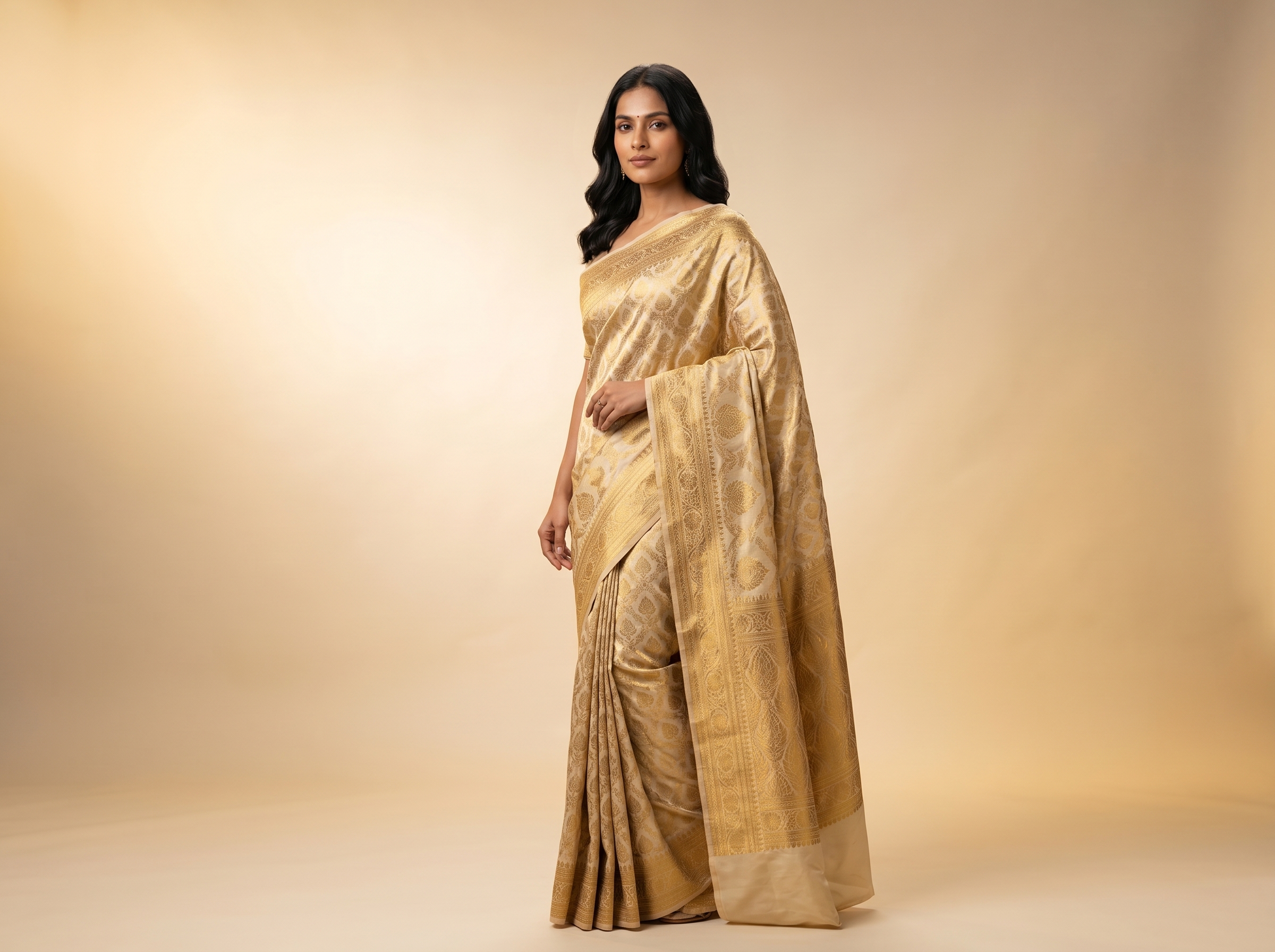
Saree — 20–25% of SKUs
Banarasi, kanjivaram and heavy-zari silk sarees dominate the Diwali saree mix. The pallu drape is the styling signature — render the model with the pallu over one shoulder showing the full border weave. Heavy zardosi at the border needs careful exposure on Flipkart, where QC can mis-read dark embroidery on dark skin as "blurry / under-lit". A 0.3 EV lift on hero renders solves it.
Anarkali — 15–20% of SKUs
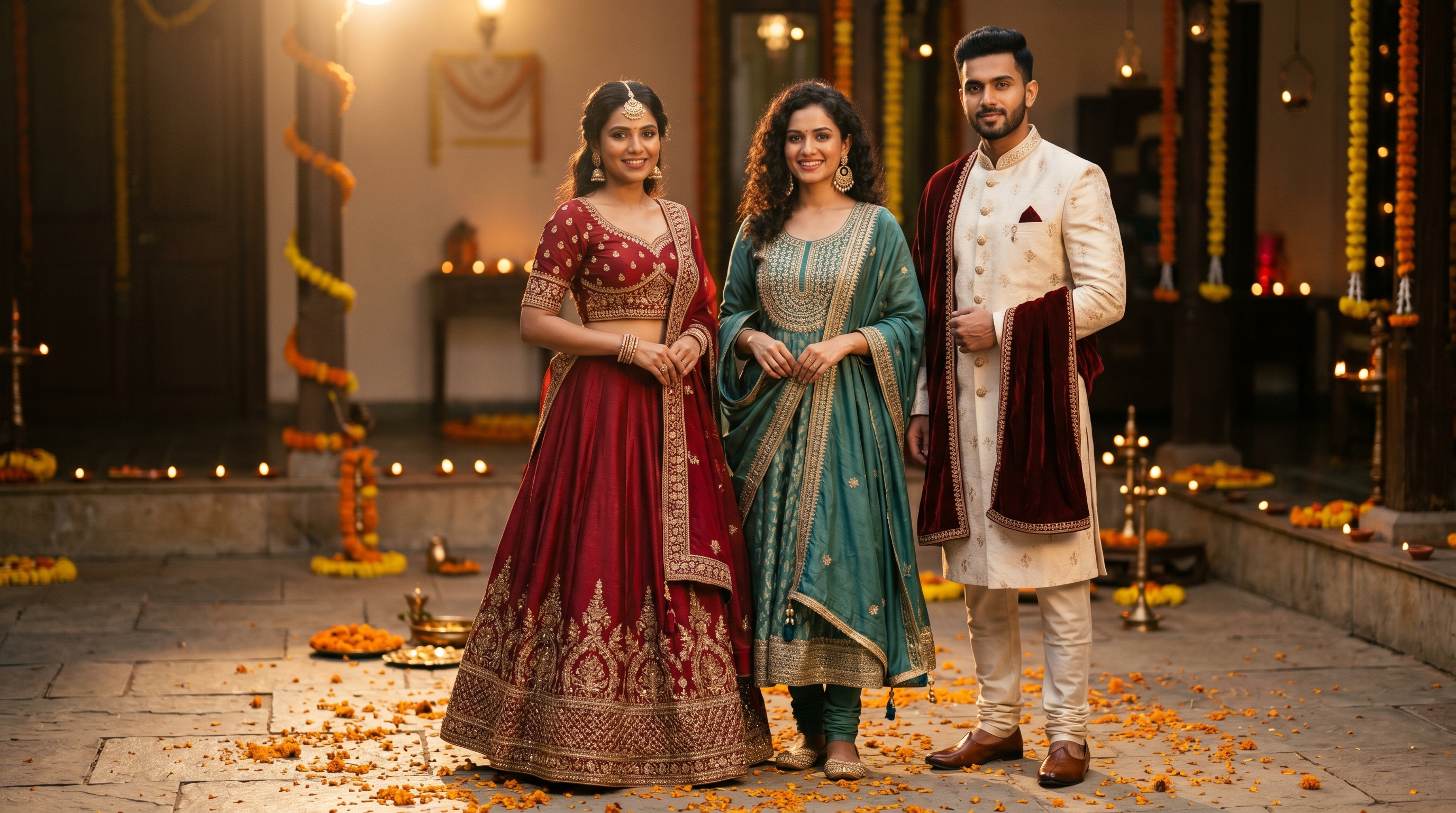
Anarkalis split between traditional floor-length and contemporary calf-length. Both work for Diwali. Group lookbook shots — three models in anarkali / lehenga / sherwani arrangements — fill EORS-style "festival lifestyle" slots that rank higher when filled. See the lehenga photography for fashion catalogs page for the underlying garment-cluster specs.
Sherwani — 5–10% of SKUs
The men's side of Diwali is smaller in SKU count but higher in AOV. Cream, ivory and gold sherwanis with subtle embroidery dominate; bridal-couple shoots pair the male sherwani with a female lehenga at matched palette. Kraftr's anchor → fan-out pipeline runs male and female chapters in parallel with shared backdrop and palette continuity.
Indo-western fusion — 5–15% of SKUs
Indo-western fusion — drape skirts, cape-style anarkalis, structured kurta-saree hybrids — captures the cocktail / pre-Diwali-party occasion. Mass-market brands skew higher here; premium brands skew lower. Multi-occasion silhouettes that read both Diwali festive and December cocktail extend the SKU's selling window into the wedding season.
The Diwali palette and styling rules
Diwali's editorial palette runs deep — red, maroon, gold, cream, deep emerald, royal blue — with restrained festive styling rather than gaudy stage-set lighting. The single biggest creative mistake on Indian D2C Diwali catalogs is over-styling: heavy diya props in slot 1, marigold strings draped over the model, candles in the foreground that pull focus off the SKU. Marketplace QC treats off-SKU props in the primary slot as a rejection trigger.
Color, hair and makeup
Hair leans festive — half-up, soft waves, or a low chignon with a small maang tikka for the bridal-leaning hero. Makeup runs smoky-warm, never over-baked or shimmer-heavy. Skin tone in render renders luminous, never flat. Jewelry stays restrained on the hero (small jhumkas, a single maang tikka) and goes heavier only on slot 4 (detail) and slot 5 (look-shot).
Backdrop hierarchy
The primary slot (slot 1) is pure white #FFFFFF — Myntra spec. The secondary slots (slots 2–4) use Myntra's house-standard light grey with a soft shadow. The look-shot (slot 5) is where festival styling lives — diya backdrop, warm-tone gradient, festive group composition. Off-SKU props belong only in slot 5, never slot 1.
Off-SKU props rule
Diyas, lamps, marigold strings and decorative trays are off-SKU. They cannot appear in slot 1. They can appear in slots 4–5 only when the SKU is still the visual subject of the frame. Submitting a diya-heavy slot 1 is the single most common Diwali-catalog rejection on Myntra; see the rejection-traps section below.
What are the marketplace ad specs for Diwali EORS?
Diwali EORS placements weight HD imagery — Myntra hero renders at 2,000 × 2,000 px or larger on the long edge over the year-round 1,500 × 2,000 px minimum, per the Myntra image guidelines guide. The 3:4 portrait aspect ratio, white #FFFFFF primary-slot background, and gender-matched full-length model rules apply unchanged. EORS adds an editorial festival lifestyle slot that ranks higher when filled.
| Marketplace | Slot 1 (hero) | Aspect ratio | Min dimensions | EORS / festival-specific |
|---|---|---|---|---|
| Myntra | Full-length on-model, white BG | 3:4 portrait | 1,500 × 2,000 px (hero); 2,000 × 2,000+ for EORS | Extra "festival lifestyle" slot weighted in ranking [VERIFY: Myntra Partner Portal] |
| Flipkart Fashion | 1:1 white BG + 4:5 portrait alternates | 1:1 + portrait alternates | 1,000 × 1,000 (zoom threshold); 2,000+ for HD | Big Billion Days HD-bias [VERIFY: Flipkart Seller Hub] |
| Amazon India | 1:1 white BG, full product visible | 1:1 | 1,000 × 1,000 (min); 1,600 × 1,600 (recommended) | Great Indian Festival — main image white BG required |
| Meesho | 1:1, garment fills 80%+ frame | 1:1 | 1,200 × 1,200 (min) | Mega Blockbuster — price emphasis over render fidelity |
| Nykaa Fashion | 3:4 portrait on-model | 3:4 portrait | 1,500 × 2,000 (hero) | Pink Friday — premium-look bias |
| AJIO | 1:1 + 4:5 alternates | 1:1 + 4:5 | 1,200 × 1,200 (min) | Big Bold Sale [VERIFY: AJIO seller portal] |
For the year-round cross-platform comparison, see marketplace product photo specs 2026.
What are the rejection traps for festive-wear catalogs?
Diwali catalogs get rejected most often for predictable, festival-specific reasons. We've seen each of these block uploads at Myntra and Flipkart QC during the EORS window. Mark each trap on your pre-flight checklist before the shoot-by date.
- Diya or candle props in slot 1. Myntra rejects primary-slot props that aren't part of the SKU. Use diyas in slots 4–5 (look-shot) only.
- Lehenga skirt cropped at hem. Bridal lehengas need full-length 3:4 portrait — head-to-knee crops lose the skirt detail and trigger re-uploads.
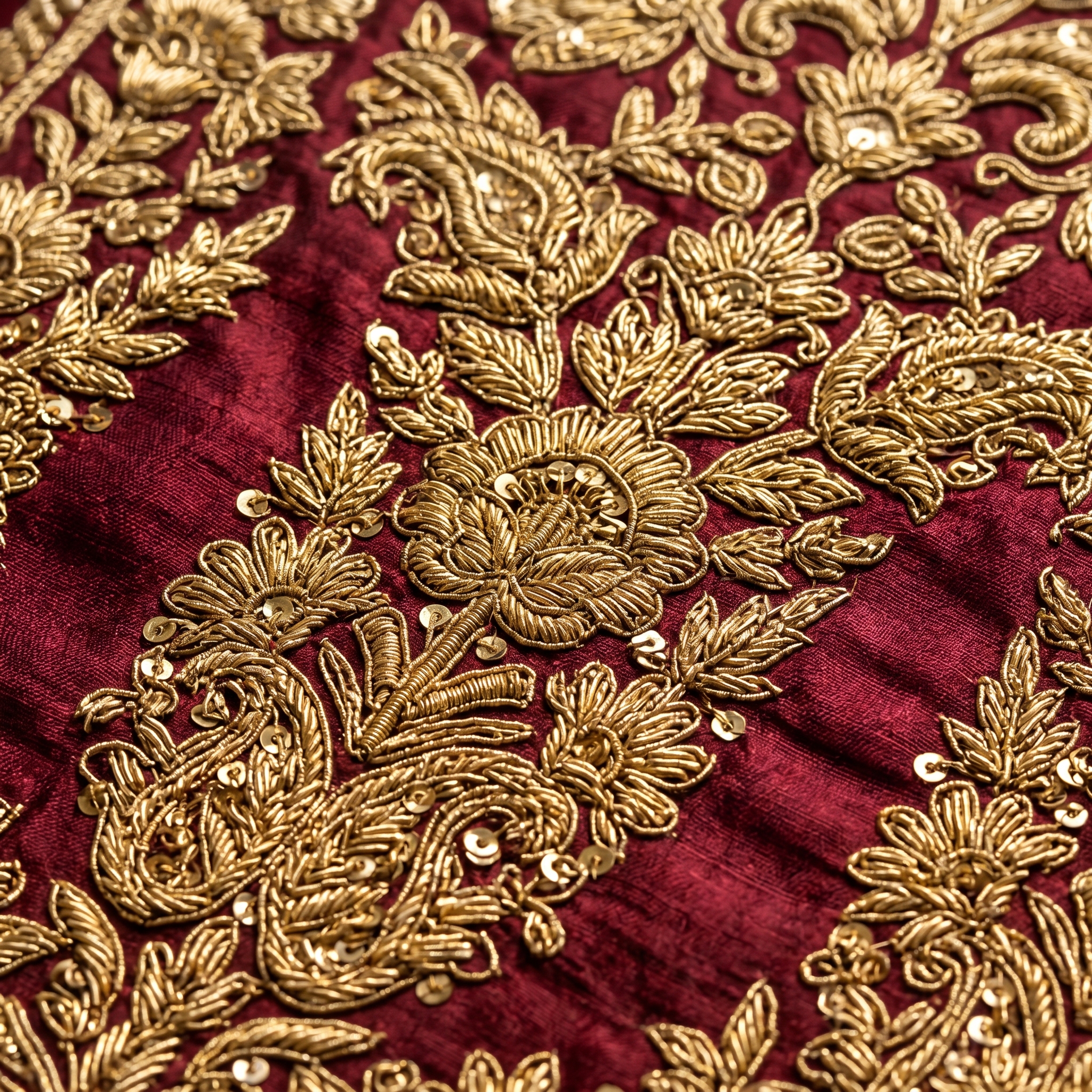
- Heavy zardosi mis-read as blurry on Flipkart QC. Flipkart's QC can mis-read dark embroidery on dark skin as "blurry / under-lit". Lift exposure 0.3 EV on hero renders.
- "Diwali" or year in the SKU title. Myntra deprioritizes time-bound SKU titles after the festival window. Use evergreen titles and let festival creative live in the catalog slots.
- Multi-look styled together as a single SKU. Each lehenga variant is its own SKU — uploading a group shot as one listing collapses ranking. Use the lifestyle slot for groups.
- Hero on heavy-print backdrop. Patterned backdrops lose garment contrast. Stay on white #FFFFFF in slot 1; reserve patterned scenes for slot 5.
- Footwear or jewelry visible in slot 1. Off-SKU accessories trigger QC flags. Crop tighter or restyle the hero.
- Low-light hero on dark skin tone. Exposure lift required at render time; submitting under-lit primary shots invites Flipkart QC bouncing the upload.
How do brands compress the shoot-to-catalog cycle from four weeks to one to three days?
Traditional Diwali catalogs take three to four weeks of studio production: garment sourcing, model day rates, stylist + hair-and-makeup, three to five shoot days, retouching, and color match against physical samples. Kraftr's fidelity-first pipeline replaces the studio-day portion with deterministic prompt rendering from a single flat-lay reference. The remaining time is creative concept lock (still T-13w), reference prep (T-10w), and marketplace QC + upload (T-6w).
The total catalog cycle compresses from 28–35 days to one to three days of active render time. The downstream effect on the calendar is that brands can start concept-lock later — early September for a Nov 8 Diwali — and still ship the catalog on a fixed Sep 27 shoot-by date. The risk margin around marketplace QC, paid-ad creative testing, and pre-festival ramp doesn't move; only the production bottleneck collapses.
Frequently asked questions
When should D2C brands shoot their Diwali 2026 campaign?
Diwali campaigns shoot by Sep 27, 2026 — six weeks before the Nov 8 festival peak — to ship the catalog live before marketplaces ramp algorithmic boosts at T-30 days. Brands using Kraftr's fidelity-first pipeline compress the shoot window from four weeks to one to three days; lock dates can slide to mid-October without missing the peak.
What are the Myntra EORS image specs for Diwali 2026?
Diwali EORS placements on Myntra weight hero renders at 2,000 × 2,000 px or larger on the long edge over the year-round 1,500 × 2,000 px minimum. The 3:4 portrait aspect ratio, white #FFFFFF primary-slot background, and gender-matched full-length model rules apply unchanged. EORS adds an editorial festival lifestyle slot that ranks higher when filled.
What garments dominate a Diwali catalog?
Diwali catalogs lead with red, maroon and gold lehenga, anarkali, saree, and sherwani SKUs — typically 60–70% ethnic wear, 20–25% indo-western fusion, 5–15% accessories. Premium brands skew bridal-leaning; mass brands skew festive-ready-to-wear. Multi-occasion silhouettes that carry through Bhai Dooj (Nov 11) extend each SKU's working window.
How do brands plan a multi-marketplace Diwali drop?
Diwali multi-marketplace drops lock concept 12 weeks out, render the catalog at every marketplace's spec from one reference set (Myntra 3:4, Flipkart 1:1, Amazon 1:1, Meesho 1:1, Nykaa Fashion 3:4, AJIO 1:1), and upload six weeks before Nov 8. Kraftr produces all aspect ratios from a single shoot.
What's the typical Diwali shoot budget for a 100-SKU brand?
Diwali shoots for 100 SKUs in traditional studios run ₹1,000–₹6,000 per image (₹1,00,000–₹6,00,000 total) plus studio rental, model fees, stylist, and hair-and-makeup — typically ₹3.5–8 lakh end-to-end for festive lookbooks. Kraftr's per-SKU credit cost runs a fraction of that; see Kraftr pricing for the live INR rates.
What are the most common Diwali catalog rejection reasons?
Diwali catalogs get rejected most often for off-SKU diya or candle props in slot 1, lehenga skirts cropped at hem (head-to-knee instead of full-length), heavy zardosi prints mis-read as 'blurry' on Flipkart QC, and SKU titles containing the year — which Myntra deprioritizes after the festival. Use diyas in slots 4–5 only; render full-length 3:4 portrait hero.
How does Kraftr handle the Diwali festival palette?
Diwali catalog rendering preserves the flat-lay reference's actual fabric color, then adds festival-appropriate scene styling — warm-tone secondary backgrounds, festive hair and jewelry, diya backdrop on the look-shot slot. The Diwali palette applies to scene-styling parameters, not garment color; brand fidelity to the actual SKU is locked across every slot.
Can a single render set drive both organic listings and paid Diwali ad creative?
Diwali render sets produced through Kraftr cover both organic and paid use cases — marketplace-spec hero and slot renders (3:4 / 1:1) plus 4:5 portrait and 16:9 landscape variants used by Meta and Google ads, from a single reference set. One Diwali shoot, every channel, plus brand-consistent ad creative across Instagram, Facebook, Google Shopping and YouTube.
Is it too late to shoot Diwali if a brand starts in October?
Diwali shoots that start in October miss the six-week ramp window — paid-ad CPMs run 2–3× higher during the festival peak. Kraftr's one-to-three-day shoot-to-catalog cycle is the recovery path: a brand starting Oct 15 can be live by Oct 18, capturing the final three-week pre-festival window. Recovery, not replacement for planning.
How do brands refresh a Diwali catalog year-over-year?
Diwali catalog refreshes run annually, 12 weeks before the new year's festival date — updating creative palette, model selection, and styling. Year-over-year, Kraftr brands reuse the brand's reference-set anchor (model identity + brand aesthetic) and refresh only the scene styling and SKU set. Typical refresh runs ~25% of a fresh shoot's cost.
Ship your Diwali drop by September 27
Kraftr's fidelity-first pipeline produces full Diwali lookbooks — lehengas, sherwanis, sarees, anarkali sets — on gender-matched models, in the Diwali editorial palette, at marketplace + D2C specs — in days, not weeks. Plan your Diwali drop with Kraftr →
Sources
- Drik Panchang — 2026 festivals list — Diwali 2026 date verified Nov 8.
- Myntra image size & guidelines (2026) — EORS-tier render specs and Myntra-spec primary-slot rules.
- Marketplace product photo specs 2026 — cross-platform spec table for Myntra, Flipkart, Amazon India, Meesho.
- AI vs traditional fashion photoshoot cost — per-image production cost benchmarks behind the budget estimates.
- Indian fashion seasonal drop calendar — the full 2026 drop calendar with shoot-by dates for every Indian festival.
- Diwali catalog photography landing — production walk-through with render gallery.
- Myntra Partner Portal (gated) — EORS-Diwali-2026 specific dates
[VERIFY]. - Flipkart Seller Hub (gated) — Big Billion Days 2026 specific dates
[VERIFY].
About the author: the Kraftr team ships fidelity-first catalog production for D2C fashion brands selling on Indian marketplaces.
Last verified: 2026-05-22.
Frequently asked questions
- When should D2C brands shoot their Diwali 2026 campaign?
- Diwali campaigns shoot by Sep 27, 2026 — six weeks before the Nov 8 festival peak — to ship the catalog live before marketplaces ramp algorithmic boosts at T-30 days. Brands using Kraftr's fidelity-first pipeline compress the shoot window from four weeks to one to three days; lock dates can slide to mid-October without missing the peak.
- What are the Myntra EORS image specs for Diwali 2026?
- Diwali EORS placements on Myntra weight hero renders at 2,000 × 2,000 px or larger on the long edge over the year-round 1,500 × 2,000 px minimum. The 3:4 portrait aspect ratio, white #FFFFFF primary-slot background, and gender-matched full-length model rules apply unchanged. EORS adds an editorial festival lifestyle slot that ranks higher when filled.
- What garments dominate a Diwali catalog?
- Diwali catalogs lead with red, maroon and gold lehenga, anarkali, saree, and sherwani SKUs — typically 60–70% ethnic wear, 20–25% indo-western fusion, 5–15% accessories. Premium brands skew bridal-leaning; mass brands skew festive-ready-to-wear. Multi-occasion silhouettes that carry through Bhai Dooj (Nov 11) extend each SKU's working window.
- How do brands plan a multi-marketplace Diwali drop?
- Diwali multi-marketplace drops lock concept 12 weeks out, render the catalog at every marketplace's spec from one reference set (Myntra 3:4, Flipkart 1:1, Amazon 1:1, Meesho 1:1, Nykaa Fashion 3:4, AJIO 1:1), and upload six weeks before Nov 8. Kraftr produces all aspect ratios from a single shoot.
- What's the typical Diwali shoot budget for a 100-SKU brand?
- Diwali shoots for 100 SKUs in traditional studios run ₹1,000–₹6,000 per image (₹1,00,000–₹6,00,000 total) plus studio rental, model fees, stylist, and hair-and-makeup — typically ₹3.5–8 lakh end-to-end for festive lookbooks. Kraftr's per-SKU credit cost runs a fraction of that; see /pricing for the live INR rates.
- What are the most common Diwali catalog rejection reasons?
- Diwali catalogs get rejected most often for off-SKU diya or candle props in slot 1, lehenga skirts cropped at hem (head-to-knee instead of full-length), heavy zardosi prints mis-read as 'blurry' on Flipkart QC, and SKU titles containing the year — which Myntra deprioritizes after the festival. Use diyas in slots 4–5 only; render full-length 3:4 portrait hero.
- How does Kraftr handle the Diwali festival palette?
- Diwali catalog rendering preserves the flat-lay reference's actual fabric color, then adds festival-appropriate scene styling — warm-tone secondary backgrounds, festive hair and jewelry, diya backdrop on the look-shot slot. The Diwali palette applies to scene-styling parameters, not garment color; brand fidelity to the actual SKU is locked across every slot.
- Can a single render set drive both organic listings and paid Diwali ad creative?
- Diwali render sets produced through Kraftr cover both organic and paid use cases — marketplace-spec hero and slot renders (3:4 / 1:1) plus 4:5 portrait and 16:9 landscape variants used by Meta and Google ads, from a single reference set. One Diwali shoot, every channel, plus brand-consistent ad creative across Instagram, Facebook, Google Shopping and YouTube.
- Is it too late to shoot Diwali if a brand starts in October?
- Diwali shoots that start in October miss the six-week ramp window — paid-ad CPMs run 2–3× higher during the festival peak. Kraftr's one-to-three-day shoot-to-catalog cycle is the recovery path: a brand starting Oct 15 can be live by Oct 18, capturing the final three-week pre-festival window. Recovery, not replacement for planning.
- How do brands refresh a Diwali catalog year-over-year?
- Diwali catalog refreshes run annually, 12 weeks before the new year's festival date — updating creative palette, model selection, and styling. Year-over-year, Kraftr brands reuse the brand's reference-set anchor (model identity + brand aesthetic) and refresh only the scene styling and SKU set. Typical refresh runs ~25% of a fresh shoot's cost.
About the author
Kraftr is a fidelity-first AI catalog production tool for D2C fashion and jewelry brands selling on Indian marketplaces. We publish marketplace specs and production playbooks based on the rules our customers ship against every week.
More about Kraftr