
Meesho Image Size & Product Photo Guidelines (2026)
Meesho image size: 1:1 square, 1200×1200 px+, JPEG, white background, AI imagery allowed if accurate. The 2026 spec sheet for Tier-2/3 fashion sellers.
Last verified:
Short answer: Meesho recommends a 1:1 square aspect ratio, a minimum of around 1,200 × 1,200 px (2,000 × 2,000 px preferred for hero placements), JPEG format, and a clean white or very-light background for the primary image. The platform is more permissive than Myntra on model policy — on-model, ghost mannequin, and flat-lay all clear QC for most apparel categories — and explicitly tolerates AI-generated imagery as long as it accurately represents the garment. Image quality is a search-ranking input, so sub-HD uploads quietly lose to sharper competitors even at the same price.
This is the working spec sheet for Meesho sellers in 2026 — the Tier-2/3 fashion brands and resellers who treat image quality as a margin lever, not an afterthought. Wherever the Supplier Panel docs are gated, claims are flagged as unverified.
For the Myntra-first sibling guide, see Myntra Product Photography 2026 Guidelines. For a cross-channel matrix covering Amazon and Flipkart, see Marketplace Product Photo Specs 2026.
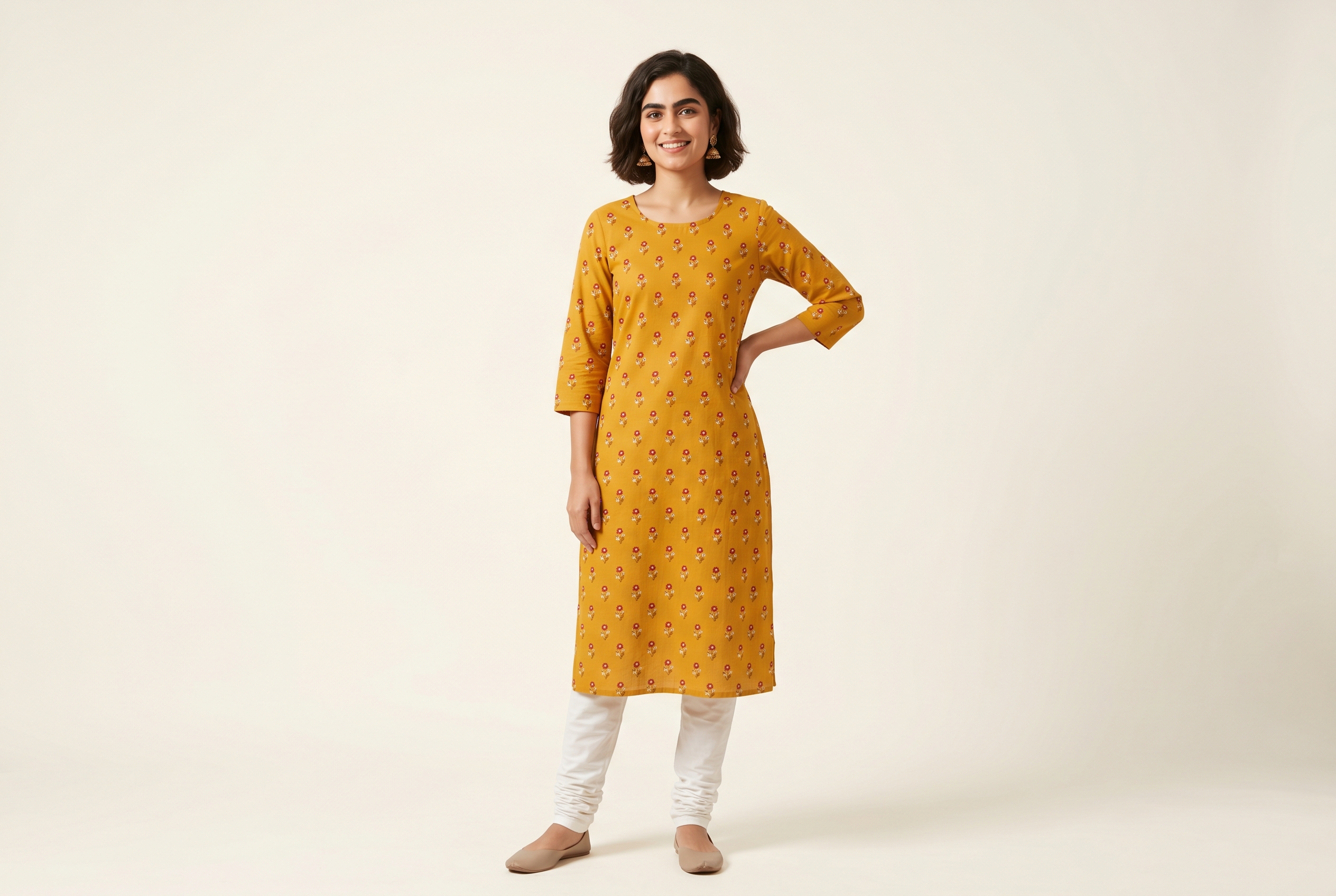
Why Meesho specifically (and why the guidelines are less documented)
Meesho is India's underdog marketplace for Tier-2 and Tier-3 sellers — the platform powering ₹100–₹500 kurtis, ₹300 sarees, and the long tail of independent resellers who can't carry Myntra's production overhead. The Supplier Panel docs sit behind a seller login, and Meesho publishes far less spec-sheet material than Myntra or Amazon, which is precisely why the search term is under-owned. The image rules are real; they're just buried.
The other thing to understand about Meesho is the economics. A Myntra seller can absorb a ₹400 photoshoot cost across a SKU with a ₹1,500 selling price. A Meesho seller running a ₹250 kurti can't. That gap is why Meesho catalogs historically skewed toward whatever the manufacturer's flat-lay or distributor's mannequin shot looked like — and why image quality has become the cheap, fast lever that separates a converting SKU from a dead one.
Where Meesho's guidelines actually live
- Supplier Panel at supplier.meesho.com — gated; spec sheets live inside the catalog-upload flow per category.
- Meesho Help & Support — buyer-side help, occasionally references image policy.
- Third-party seller-tool docs — listing-management platforms (Unicommerce, Browntape, Shiprocket-style integrators) often mirror the spec into their own documentation, which is the most accessible public source.
- Seller communities — Telegram groups and YouTube tutorials carry working knowledge of QC behavior in practice.
Where the Supplier Panel can't be cited directly, this guide flags the claim as (unverified — confirm in the Meesho Supplier Panel before bulk uploads).
Core technical specs
| Field | Spec |
|---|---|
| Min dimensions | ~1,200 × 1,200 px (1:1) (verified 2026-05-21 — via published seller-help articles) |
| Recommended | 2,000 × 2,000 px for hero |
| Aspect ratio | 1:1 square preferred; portrait gets center-cropped |
| File format | JPEG (PNG accepted; re-compressed downstream) |
| Max file size | ~5 MB per image (unverified) |
| Practical target | 300 KB – 1 MB per image |
| Color space | sRGB |
| Background | White or very-light solid for primary |
| Image count | 4 minimum recommended; up to 7+ per SKU (unverified) |
| Model policy | On-model, ghost mannequin, or flat-lay — all accepted |
| AI imagery | Permitted if accurate to the physical garment |
Sources: Meesho Supplier Panel (gated). Cross-referenced from third-party listing-tool documentation and seller-community guidance current to early 2026. Verify any borderline call inside the panel for your specific category before a bulk upload.
Image spec at a glance
Meesho is the only major marketplace that defaults to 4:5 — shoot 4:5 if Meesho is your primary platform.
- Aspect ratio
- 4:5 portrait
- Min size
- 1080×1350 px
- Recommended
- 1200×1500 px
- Background
- White or off-white
- Model
- Optional — recommended for ethnic wear
- Max images
- 6 per listing
- Max file size
- Under 5 MB
- No promotional text — “Sale”, “50% off”, or price stamps reject at QC
- No competitor branding or logos visible in frame
- Product must fill at least 70% of the frame
- Consistent background treatment across every image in a listing
- Image-mismatch returns can trigger account-level penalties
Why 1:1 (and why portrait crops awkwardly)
Meesho's buyer-side product page is built mobile-first around a square hero crop. A 3:4 portrait submission — the kind of frame a Myntra-first seller already has — gets center-cropped on display, which usually clips the bottom of a long kurti or the top of a saree's pallu. That's not a rejection; it's worse. The listing goes live looking subtly wrong, and conversion drops without an obvious cause.
Plan your master capture at 1:1 from the start, or shoot 3:4 wide enough that a square center-crop still shows the full garment silhouette. Anything else costs you a re-export per SKU.
The slot-by-slot apparel sequence
Meesho doesn't enforce a rigid five-slot template the way Myntra does, but converting catalogs all follow a similar pattern. Four to seven images per SKU, sequenced so the buyer can answer "what is this, does it fit, what does the fabric look like" in three scrolls.
Slot 1 — Front (primary)
- Background: Clean white or very-light grey.
- Subject: Garment shown front-on. On-model, ghost mannequin, or a well-lit flat-lay all work.
- Framing: Garment fills at least 75–85% of the frame.
- The most common mistake: Submitting a dark, phone-shot manufacturer image. It clears upload but quietly underperforms in search.
Slot 2 — Back or full-length
- Subject: Show the back of the garment, or a full-length view if the primary was a tighter crop.
- Why it matters: Returns drop measurably when the buyer has seen the back before purchase — neckline closures, dupatta length, kurti hem, saree border.
Slot 3 — Side or styled shot
- Subject: Three-quarter angle, drape, or styled context.
- For sarees: This is typically where the draped on-model shot goes if the primary was a flat-lay.
Slot 4 — Fabric or detail close-up
- Subject: Weave, print at scale, embroidery, hardware closures.
- Why it matters: This is the trust slot. Meesho buyers in price-sensitive categories rely heavily on fabric close-ups to decide if the SKU is worth the ₹250–₹500 they're spending. Missing or low-quality slot 4 is the silent return-rate killer.
Slots 5–7 — Variant, styled, or size-chart
- Subject: Color variants on the same model, a styled look-shot, or a size-chart graphic if the category supports it.
Saree, kurti, and jewelry categories diverge from this. Sarees often expect a draped shot AND a full pallu flat-lay. Jewelry expects on-bust or on-hand scale references. Verify the category-specific template inside the Supplier Panel before shooting at scale.
Model policy — what Meesho accepts that Myntra doesn't
This is where Meesho's image rules diverge most sharply from Myntra's, and where the cost difference between the two platforms becomes structural.
- On-model is welcome but not mandatory. A clean flat-lay or ghost-mannequin shot clears the primary slot for most apparel categories.
- Ghost mannequin is fully accepted. No "visible mannequin" prohibition the way Myntra enforces.
- No strict gender-match requirement at the platform level — though category-specific QC and buyer expectations still favor an appropriately-modeled image (a women's kurti shown on a woman, etc.). Don't read this as a license to ship mismatched models; read it as a missing automated check.
- Headless and cropped framing are more tolerated than on Myntra, particularly for budget categories where the manufacturer's source image is the only available asset.
- Real model vs. synthetic model — Meesho does not differentiate as long as the render is accurate.
The practical implication: a Meesho-only seller can ship a converting catalog with flat-lays and well-lit mannequin shots and never book a model day. A Myntra seller can't. This is the single biggest production-cost gap between the two platforms.
AI imagery on Meesho — the 2024–2026 shift
Meesho has been notably permissive on AI-generated product imagery, and the policy crystallized through 2024–2025 as fidelity-first image generation matured enough to render accurately at the print and weave level.
The working rules, current to 2026:
- AI-generated imagery is allowed as long as it accurately represents the physical garment the buyer will receive.
- QC flags distortion the same way it flags blur — melted hardware, drifting print scale, hallucinated trim, or weave that doesn't match the source garment all trigger rejection.
- No required AI-disclosure label at the product-page level (unverified — confirm in Supplier Panel terms). Frontier image models that embed SynthID watermarks provide audit-ready proof of AI generation if it ever becomes required.
- Image-quality search ranking applies equally to AI and traditionally-shot imagery. A sharp, faithful AI render beats a blurry phone photo of the actual garment in Meesho's ranking signals.
In practice, this is why Meesho has become the easiest large Indian marketplace to staff with an AI photoshoot pipeline. The platform's combination of permissive model policy, 1:1 aspect ratio, and image-quality-weighted ranking rewards exactly the workflow that AI-generated imagery is good at: rendering a clean, sharp, on-model or flat-lay primary from a single garment reference, fast.
Older first-generation diffusion tools still struggle on knit weave and small-scale print — and those failures show up in Meesho QC the same way they show up everywhere else.
Image quality as a ranking input — the Meesho economics angle
Meesho's Fashion search blends multiple signals — price competitiveness, conversion rate, return rate, and image quality. In a category where ₹50 price gaps move conversion meaningfully, an image-quality penalty quietly costs sellers placement they can't easily diagnose.
The signals Meesho's ranking appears to weight:
- Resolution. Sub-HD (under ~1,000 × 1,000 px) listings rarely surface above HD competitors at comparable prices.
- Sharpness. Motion blur and softness from low-quality manufacturer source images suppress placement.
- White-balance neutrality. Off-white or yellow-cast backgrounds get caught at QC and suppressed in ranking even when they clear upload.
- Frame fill. Sub-75% frame fill in the primary slot reads as "stock image" to both buyers and the ranking model.
- Slot completeness. Listings with only 1–2 images underperform 4+ image listings on identical SKUs.
This is the part most Meesho sellers underestimate. The platform's reputation for "any image works" is half-true at the upload layer and untrue at the ranking layer. A ₹299 kurti with sharp 1,500 × 1,500 px imagery beats a ₹279 kurti with a 600-px-wide phone shot on most queries. The image-quality lever is worth roughly the same as a 7% price cut, in our reading of category data — and it's a one-time fix instead of a permanent margin hit.
Common rejection reasons and quality-suppression triggers
In rough order of how often they hurt Meesho catalogs:
- Sub-HD resolution. Under 1,000 × 1,000 px gets visibly outranked even when it clears upload.
- Wrong aspect ratio. 3:4 portrait cross-listed from Myntra without a 1:1 re-crop clips the garment on display.
- Off-white or yellow-cast background. Caught at QC; suppressed in ranking even after clearing.
- Wrinkled garment. Steaming is the single cheapest fidelity upgrade and most sellers skip it.
- Heavy compression artifacts. Re-uploading WhatsApp-forwarded manufacturer images is the most common cause.
- Watermarks, text overlays, borders. Manufacturer logos in the corner of the primary image suppress placement.
- Missing slot 4 (fabric detail). Returns spike; ranking adjusts down over a few weeks.
- AI render with print drift. Print scale that doesn't match the source garment gets flagged at QC.
- Visible price tags, hangers, or studio clutter. Trims down at QC for primary slot.
- Mismatched lighting between slots. Slot 1 shot at noon, slot 4 shot under tungsten — reads as multi-source manufacturer collage.
Most of these are fixable in post or with a single re-render. They're not platform-rejection traps; they're quality-suppression traps. The listing goes live, the seller waits a month, the SKU never picks up, and nobody traces it back to the image.
What changed in 2024–2026
Three shifts matter for sellers planning catalogs in 2026.
AI imagery acceptance crystallized
Through 2024, Meesho's posture on AI-generated imagery moved from informal tolerance to active acceptance — provided the render is faithful to the physical garment. The marketplace re-confirmed during 2025 that fidelity-first AI renders are treated identically to traditional photography at QC and ranking, (unverified — based on seller-community and integrator reporting; not a formal published policy statement).
Image-quality ranking weight increased
Meesho's Fashion ranking model is widely reported to have shifted weight toward image-quality signals during 2024–2025 as the platform pushed for higher conversion on mobile detail pages. The practical effect: a sharper image outranks a marginally cheaper SKU in more queries than it did in 2022–2023.
Category-specific guideline updates
Saree, kurti, and ethnic-wear categories saw the most movement, with category-specific slot templates that now expect a draped or styled shot alongside the flat-lay. Jewelry expects a clean white-background close-up plus a scale reference (on-bust, on-hand, or on-ear). Verify the current category template in the Supplier Panel for any category that's part of the recent ethnic-wear push.
Cross-listing Meesho and Myntra — the practical workflow
Most fashion sellers in India who are on Meesho are either already on Myntra or planning to be. The cross-listing workflow is straightforward if you start from the stricter spec and adapt down.
If you're already shooting for Myntra
Start with the Myntra spec — it's the binding constraint. Shoot or render at:
- 3:4 portrait at 1,500 × 2,000 px or larger (Myntra's hero recommendation).
- Gender-matched real or synthetic model, full-length, on pure white #FFFFFF.
- Five slots: front on-model, back, side or three-quarter, fabric detail, styled look-shot.
For Meesho:
- Re-crop the primary to a center-cropped 1:1 at 1,500 × 1,500 px (or 2,000 × 2,000 px if your source supports it). Verify the garment isn't clipped at top or bottom — long kurtis and sarees frequently are.
- Drop the gender-match constraint if you want to consolidate models across the Meesho catalog. The platform doesn't enforce it.
- Compress to a 1 MB target on JPEG quality 85–90. Heavier files don't render better on Meesho's CDN.
- Use 4–7 images per SKU instead of Myntra's strict 5.
For a deeper Myntra-side reference, see the Myntra Image Size & Guidelines 2026 guide.
If you're Meesho-first
Start with a 1:1 capture at 2,000 × 2,000 px or higher. If you later want to expand to Myntra, you'll need to either re-shoot (the framing doesn't translate cleanly) or render the same SKU into Myntra's 3:4 portrait crop via an AI pipeline that can re-frame from a single garment reference. The single-platform cost saving is real; the cross-listing cost when you later add Myntra is also real.
MOFU — what this looks like at production scale
Brands building Meesho catalogs at scale increasingly use tools like Kraftr to render on-model images from flat-lays — pay-as-you-go, no subscription, suitable for ₹100-per-unit-margin selling brands that can't carry a fixed monthly fee. The same garment reference renders into a Meesho 1:1 primary, a Myntra 3:4 hero, and an Amazon 1:1 main from one source. See the Myntra listings use case for a worked example of how the slot sequence renders out of a single garment input — the same pipeline produces the Meesho-compliant 1:1 set.
Pre-flight checklist
[ ] Aspect ratio = 1:1 square (or 3:4 master with safe square crop)
[ ] Resolution ≥ 1,500 × 1,500 px (hero) or ≥ 1,200 × 1,200 px (minimum)
[ ] JPEG, quality 85–92
[ ] sRGB color profile embedded
[ ] File size ≤ 1 MB target, hard cap ~5 MB
[ ] Slot 1: white or very-light background, garment fills ≥ 75% of frame
[ ] Slots 2–4: back, side or styled, fabric detail
[ ] No watermarks, text overlays, manufacturer logos, or price tags
[ ] Garment steamed; no visible wrinkles
[ ] White balance neutral across all slots
[ ] No motion blur or compression artifacts from forwarded source files
[ ] If using AI imagery: print scale matches the physical garment
What to do this week
- Audit your three top-selling Meesho SKUs against the checklist above. If your primary is under 1,200 × 1,200 px or has a visible manufacturer watermark, fix those two things first. They're the highest-impact, lowest-effort wins on Meesho.
- Re-export your Myntra catalog as 1:1 center-crops at 1,500 × 1,500 px for the Meesho-shared SKUs. Verify no clipping on long-silhouette garments (anarkali kurtis, sarees, gowns).
- Standardize white balance and background across every slot in a listing. Mismatched lighting between slots is the most common cause of listings that "look off" without an obvious flaw.
- Decide your master spec. For dual-listing sellers, the Myntra 3:4 master at 1,500 × 2,000 px with a 1:1 export workflow is the cheapest long-run plan. Single-platform Meesho sellers can master at 1:1 directly.
- If your catalog is large, plan re-renders not re-shoots. A fidelity-first AI photoshoot pipeline collapses the cost of producing Meesho-compliant 1:1 primaries from existing flat-lays to cents per image. For multi-channel sellers, see the cross-channel breakdown in Marketplace Product Photo Specs 2026, and for the Amazon side, Amazon Apparel & Jewelry Photo Requirements 2026.
For pay-as-you-go pricing on per-image renders sized for Indian fashion margins, see Kraftr pricing.
Further reading
- Myntra Product Photography: 2026 Image Guidelines — the strictest channel; the binding constraint for dual-listing sellers
- Marketplace Product Photo Specs 2026 — Amazon, Myntra, Flipkart, Shopify at a glance
- Amazon Apparel & Jewelry Photo Requirements 2026 — for sellers expanding from Meesho to Amazon
Frequently asked questions
- What is the Meesho image size requirement?
- Meesho recommends a 1:1 square at a minimum of 1,200 × 1,200 px for primary images, with 2,000 × 2,000 px preferred for hero placements and category pages. Submissions below 800 × 800 px tend to get flagged at QC or quality-suppressed in search *(verified 2026-05-21 — via published seller-help articles)*.
- What aspect ratio does Meesho require for product photos?
- Meesho leans 1:1 square for the primary listing image — the Supplier Panel and the buyer-app product page both render in square crops. Portrait images get center-cropped, which often clips kurti hems and saree pallus. Plan your master capture at 1:1 from the start, or shoot 3:4 wide enough to safely crop down.
- What file format does Meesho accept for product images?
- JPEG is the primary recommended format on the Meesho Supplier Panel. PNG uploads are accepted in most flows but get re-compressed to JPEG on the buyer-facing CDN, which can reintroduce artifacts on flat solids. Stick with JPEG quality 85–92 to avoid double-compression banding.
- What is the maximum file size for Meesho product images?
- The Supplier Panel caps individual image uploads at approximately 5 MB *(unverified — confirm in the panel before bulk uploads)*. Practical target is 300 KB to 1 MB per image. Anything heavier slows the panel and rarely improves on-page rendering, since Meesho's CDN re-encodes aggressively for mobile-first delivery.
- Does Meesho allow AI-generated product images?
- Yes — Meesho's posture is permissive on AI imagery as long as the render accurately represents the physical garment. QC flags distorted prints, melted hardware, and pattern drift the same way it flags blurry photos. Sellers using fidelity-first AI photoshoot pipelines clear QC reliably; older first-generation tools regularly fail on knits and prints.
- How is Meesho different from Myntra on image rules?
- Meesho leans 1:1 square at 1,200 px+, accepts on-model OR ghost-mannequin OR flat-lay, and is permissive on AI imagery. Myntra mandates 3:4 portrait at 1,500 × 2,000 px, requires gender-matched real models, prohibits visible mannequins, and runs stricter QC. Myntra's bar is higher; Meesho's bar is more about image quality than rigid format.
- Can poor image quality suppress a Meesho listing in search?
- Yes. Meesho's Fashion ranking combines price competitiveness with image quality signals — sharpness, resolution, white-balance neutrality, and frame fill. Sub-800 px uploads or off-white backgrounds rarely surface above HD competitors. In a category where ₹50 price gaps move conversion, an image-quality penalty can quietly kill an otherwise viable SKU.
- Can I cross-list the same images on Meesho and Myntra?
- Not without re-cropping. Myntra demands 3:4 portrait; Meesho leans 1:1 square. Shoot or render your master at 3:4 portrait (Myntra's spec) at 1,500 × 2,000 px or larger, then export a center-cropped 1:1 at 1,500 × 1,500 px for Meesho. Most sellers also restage the model framing — a Myntra full-length crops awkwardly to square.
- How many product images does Meesho require per SKU?
- Meesho recommends at least 4 images per apparel SKU and accepts up to 7 or more depending on the category *(unverified — confirm exact slot caps in the Supplier Panel)*. Typical apparel sequence: front on-model or flat-lay, back, side or detail, fabric close-up. Saree and kurti categories often expect an additional drape or styled shot.
- Are there category-specific image rules for sarees, kurtis, and jewelry on Meesho?
- Yes. Sarees typically require a draped on-model or on-mannequin shot plus a full-length flat-lay so buyers can see the pallu, border, and body. Kurtis need a front-on view with the neckline clearly visible. Jewelry expects a clean white-background close-up plus an on-model or on-bust shot for scale. Category sheets diverge — verify in the panel.
About the author
Kraftr is a fidelity-first AI catalog production tool for D2C fashion and jewelry brands selling on Indian marketplaces. We publish marketplace specs and production playbooks based on the rules our customers ship against every week.
More about Kraftr