
Bridal & Wedding Season Catalog Playbook India (2026–27)
Bridal catalog production for the 2026–27 Indian wedding season (Nov 15 – Feb 28). Lehenga + sherwani + jewelry specs, AOV tiers, and the rolling-refresh playbook.
Last verified:
TL;DR: The Indian wedding season runs Nov 15, 2026 – Feb 28, 2027. Season-opener catalogs ship by Sep 30. This playbook gives you the rolling-refresh calendar, bridal lehenga + sherwani + jewelry specs across Myntra / Nykaa Fashion / Tata Cliq Luxe / AJIO Luxe / Meesho, the bridal-jewelry crossover production cycle, and the AOV-tier mapping per marketplace.
Short answer
Bridal catalog production for the 2026–27 Indian wedding season follows a rolling 8–12-week refresh cadence: season-opener by Sep 30, mid-season Dec 1, late-season Jan 15. Garment mix skews bridal lehenga (30–35%), sherwani (15–20%), reception saree (15–20%). The bridal-jewelry crossover integrates the jewelry production line into bridal apparel shoots — two catalogs, one production cycle.
For the date-of-truth, we cross-check apps/web/src/content/festivals.ts against Drik Panchang's 2026 festival list. For the broader seasonal frame, see the Indian fashion seasonal drop calendar.
When does the Indian bridal / wedding season run in 2026–27?
The 2026–27 Indian bridal / wedding season runs November 15, 2026 through February 28, 2027 — verified against Drik Panchang's 2026 festival list and apps/web/src/content/festivals.ts. The peak wedding muhurat dates cluster across these 15 weeks [VERIFY: Drik Panchang wedding-muhurat windows], with Karva Chauth (Oct 29) acting as a bridal-adjacent crossover window in late October.
Unlike single-day festivals, the bridal season is a 4–5 month commerce window. That changes catalog production: a wedding-season catalog isn't shipped once and forgotten. It refreshes on a rolling 8–12-week cadence — season-opener at the end of September, mid-season refresh in early December, late-season refresh in mid-January, end-season closer at the end of February. Each refresh updates hero creative and SKU set; the underlying brand aesthetic stays locked across the season.
The validFrom and validThrough window we emit in JSON-LD on this post runs Oct 15, 2026 through Mar 14, 2027 — that's T-30 from the season opener to T+14 after the season closes. Brands shipping the bridal landing page carry the same window.
What is the rolling-refresh playbook for the wedding season?
Bridal catalogs refresh on a rolling 8–12-week cadence: season-opener by Sep 30, mid-season refresh Dec 1, late-season refresh Jan 15, end-season closer Feb 28. Each refresh updates hero creative and adds new SKUs while anchor → fan-out chaining preserves model identity and brand aesthetic from the season-opener. Brand recognition compounds across the 4–5-month season — buyers who see the same face on the brand's Myntra hero in November and January associate the catalog with the brand, not the campaign.
| Phase | Recommended date | What to lock |
|---|---|---|
| Pre-season T-12w | Aug 23 | Concept lock; bridal SKU shortlist |
| T-10w | Sep 6 | Flat-lay references; bridal lehenga + sherwani |
| T-9w | Sep 13 | Hero render approved (anchor) |
| T-7w | Sep 27 | Full season-opener catalog rendered |
| T-6w | Sep 30 | Marketplace upload (opener) |
| Season opens | Nov 15 | Wedding season begins |
| Mid-season refresh | Dec 1 | Refresh hero creative; reuse anchor; new SKUs |
| Late-season refresh | Jan 15 | Final refresh; valentine + holi tie-in |
| End-of-season | Feb 28 | validThrough window closes |
The rolling-refresh playbook is the bridal catalog's structural advantage over single-festival catalogs. Diwali ships once; bridal ships four times. Each refresh costs less than the previous one because the anchor model and brand aesthetic carry forward.
What are the bridal AOV tiers by marketplace?
Bridal AOV tiers segment by marketplace: Tata Cliq Luxe at couture (₹1,00,000+), Nykaa Fashion at premium (₹30,000–₹1,00,000), Myntra at premium-mid (₹15,000–₹50,000), AJIO Luxe at mid-premium (₹8,000–₹25,000), Flipkart Fashion at mid (₹3,000–₹10,000), and Meesho at mass-market (₹500–₹3,000). This is the post's info-gain moat — most bridal photography content treats "bridal" as a single tier; Kraftr publishes the marketplace-by-AOV mapping that lets D2C brands segment correctly.
| Marketplace | AOV tier | Bridal SKU type | Render tier |
|---|---|---|---|
| Tata Cliq Luxe | Couture (₹1,00,000+) | Heavy-zardosi bridal lehenga, couture sherwani | 4K, editorial |
| Nykaa Fashion | Premium (₹30,000–₹1,00,000) | Bridal lehenga, premium sherwani | 4K, editorial |
| Myntra | Premium (₹15,000–₹50,000) | Bridal lehenga, reception saree | 2K hero, 4K detail |
| AJIO Luxe | Mid-premium (₹8,000–₹25,000) | Mid-tier bridal, sangeet-look | 2K |
| Flipkart Fashion | Mid (₹3,000–₹10,000) | Wedding-guest lehenga, saree | 2K |
| AJIO | Mass-mid (₹2,000–₹8,000) | Wedding-guest fusion | 1K – 2K |
| Meesho | Mass (₹500–₹3,000) | Wedding-guest saree, anarkali | 1K |
Brands typically ship 3–5 SKU tiers across this matrix per wedding-season catalog rather than the same SKUs to all marketplaces. Tata Cliq Luxe gets the heavy-zardosi couture pieces; Meesho gets the wedding-guest saree volume; Myntra and Nykaa Fashion capture the premium bridal lehenga. Single-tier bridal catalogs miss the AOV mapping and leave margin on the table.
What garments lead a wedding-season catalog?
Bridal wedding-season catalogs lead with bridal lehenga (30–35% of SKUs), sherwani for groom (15–20%), reception saree (15–20%), sangeet-look fusion (10–15%), wedding-guest anarkali / saree (10–15%), and mehendi-ceremony casual ethnic (5–10%). Premium brands skew bridal lehenga; mass-market brands skew wedding-guest saree volume. Bridal-jewelry crossover SKUs amortize the production cycle across two parallel catalogs.
Bridal lehenga — 30–35% of SKUs
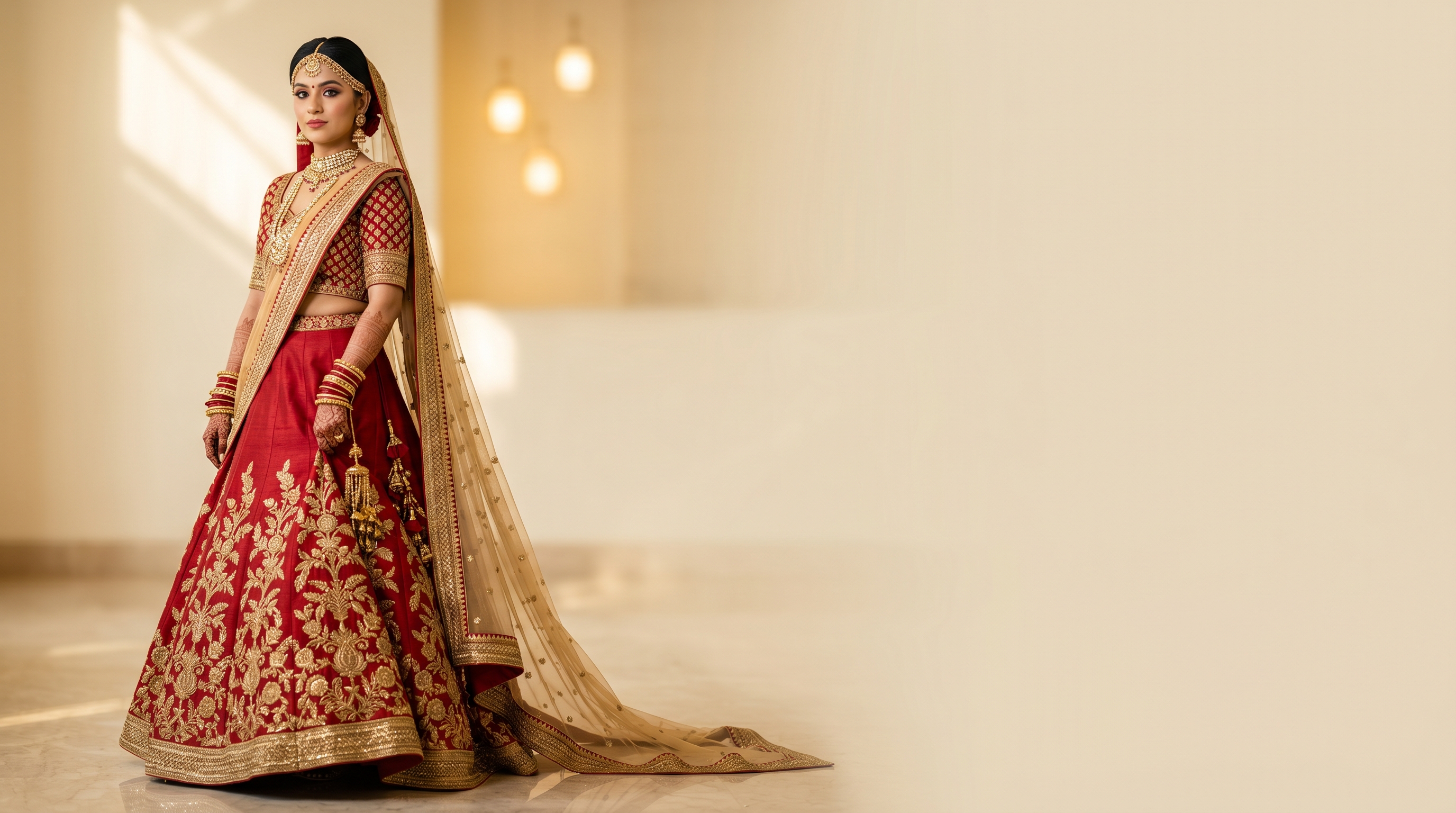
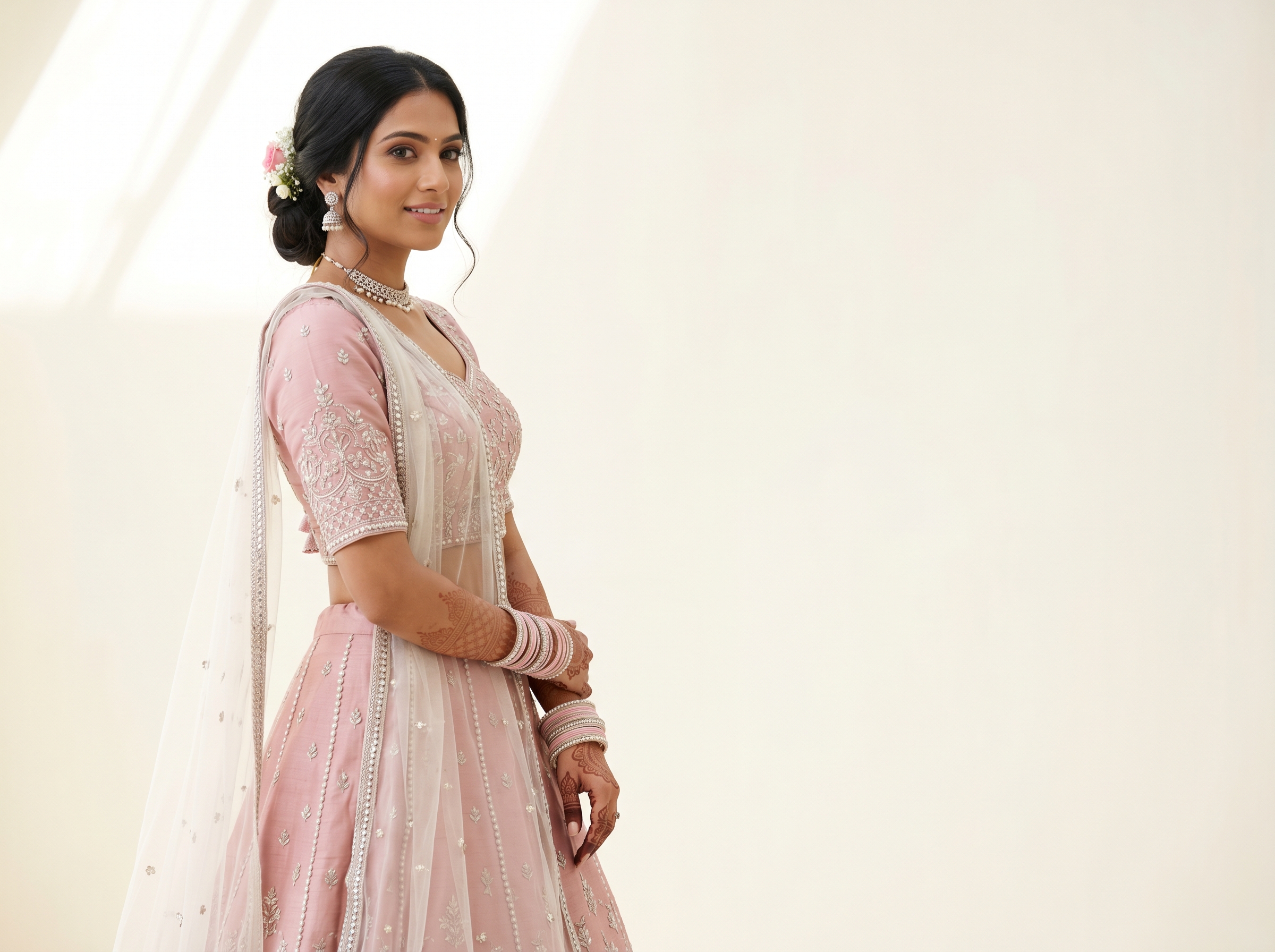
The bridal lehenga is the wedding-season hero garment. Deep red, maroon, and gold-and-red heavy-zardosi silhouettes anchor the premium catalog; pastel pink, sage and ivory contemporary bridal serves the modern-bride angle. Render at 4K hero on the long edge to surface the zardosi thread density and gold zari at marketplace QC resolution. Full-length 3:4 portrait, dupatta drape over head for the bridal-signature styling.
Sherwani — 15–20% of SKUs
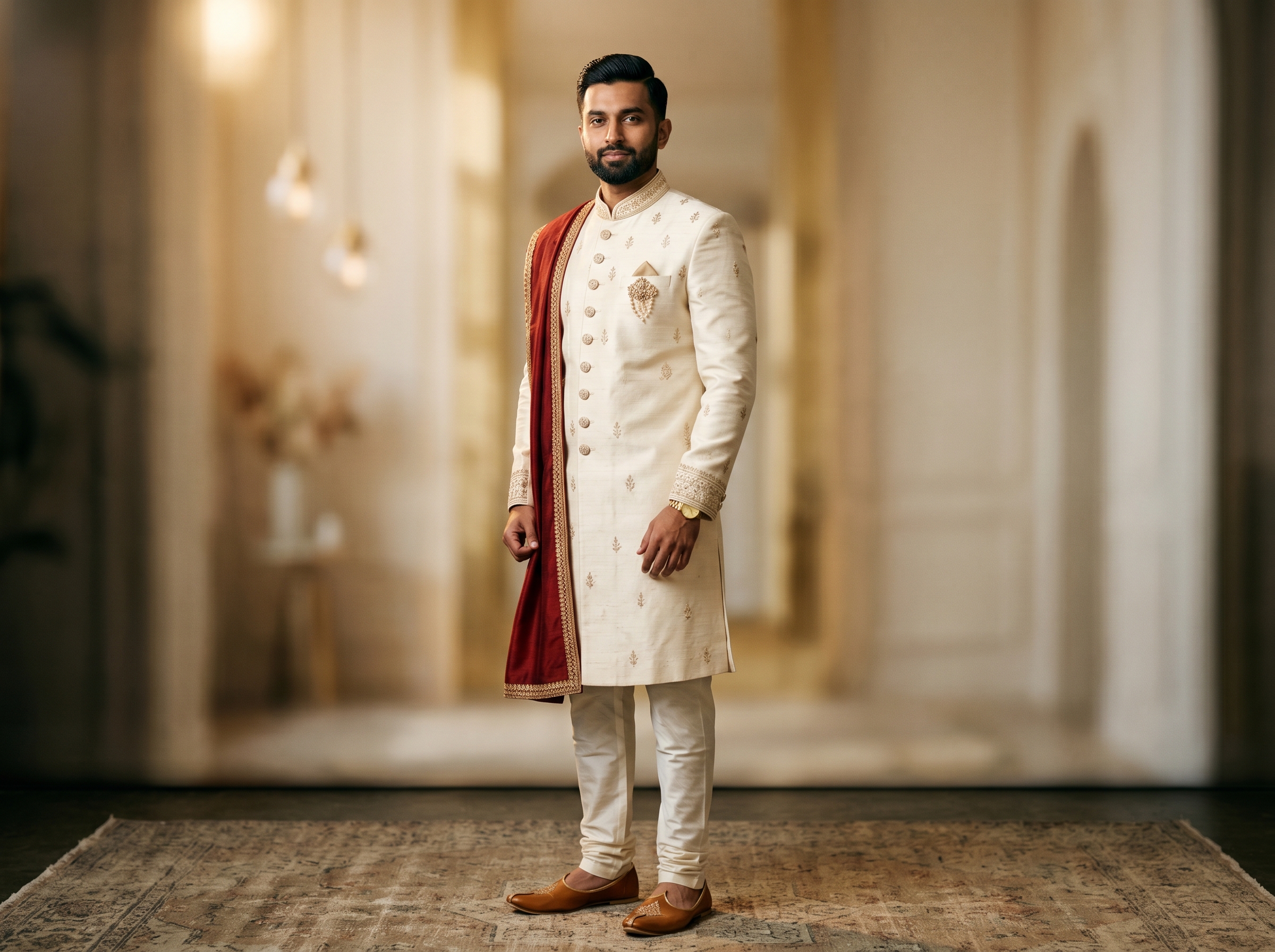
The men's bridal catalog runs in parallel — cream, ivory, gold and deep-jewel-tone sherwanis with subtle embroidery, churidar or dhoti pant pairing, and matching dupatta. Premium D2C bridal brands ship the bride + groom catalog together because visual continuity boosts couple-shopping conversion. Render the groom catalog at 2K hero, 4K detail for the embroidery.
Reception saree — 15–20% of SKUs
Reception sarees serve the post-wedding event styling. Ivory, gold, and pastel-on-gold silk sarees with heavy zari borders dominate. Render with the pallu drape over one shoulder showing the full border weave. Reception saree SKUs cross-sell into Karva Chauth and Diwali during the bridal-adjacent fall window.
Sangeet-look fusion — 10–15% of SKUs
Sangeet-night styling skews mid-tone, often pastel or jewel-toned, and runs more fusion than traditional. Drape skirts, cape-style anarkalis, structured kurta-saree hybrids — all serve the sangeet occasion. Sangeet SKUs cross-sell year-round into cocktail and engagement occasions, which is why brands keep this category in the bridal catalog even when it's not strictly bridal.
Wedding-guest anarkali and saree — 10–15% of SKUs
Wedding-guest SKUs are the volume garments of the mid-market and mass-market bridal catalog. Anarkali, lighter saree weaves, and ready-to-wear ethnic at ₹500–₹3,000 AOV ship through Meesho and Flipkart Fashion. The wedding-guest mix amortizes across multiple festivals and stretches the catalog's working window beyond the bridal season alone.
Mehendi-ceremony casual ethnic — 5–10% of SKUs
Yellow, orange and pastel mehendi-ceremony ethnic-wear rounds out the catalog. Lighter, more casual styling than the bridal lehenga hero — kurta sets, casual lehenga, fusion. The mehendi mix sells through the pre-wedding micro-occasions (mehendi ceremony, haldi, engagement). See the Karva Chauth bridal campaign shoot guide for the parallel mehendi-styling rules.
What is the bridal-jewelry crossover production cycle?
Bridal-jewelry crossover integrates the jewelry catalog production line into bridal apparel shoots — bridal jewelry sets (mathapatti, choker, kalire, bangles, kamarbandh) render as separate SKUs that compose into bridal hero shots. Brands shooting bridal apparel and bridal jewelry in one cycle ship two parallel catalogs with shared model identity; the crossover is a margin expander on the bridal pipeline.
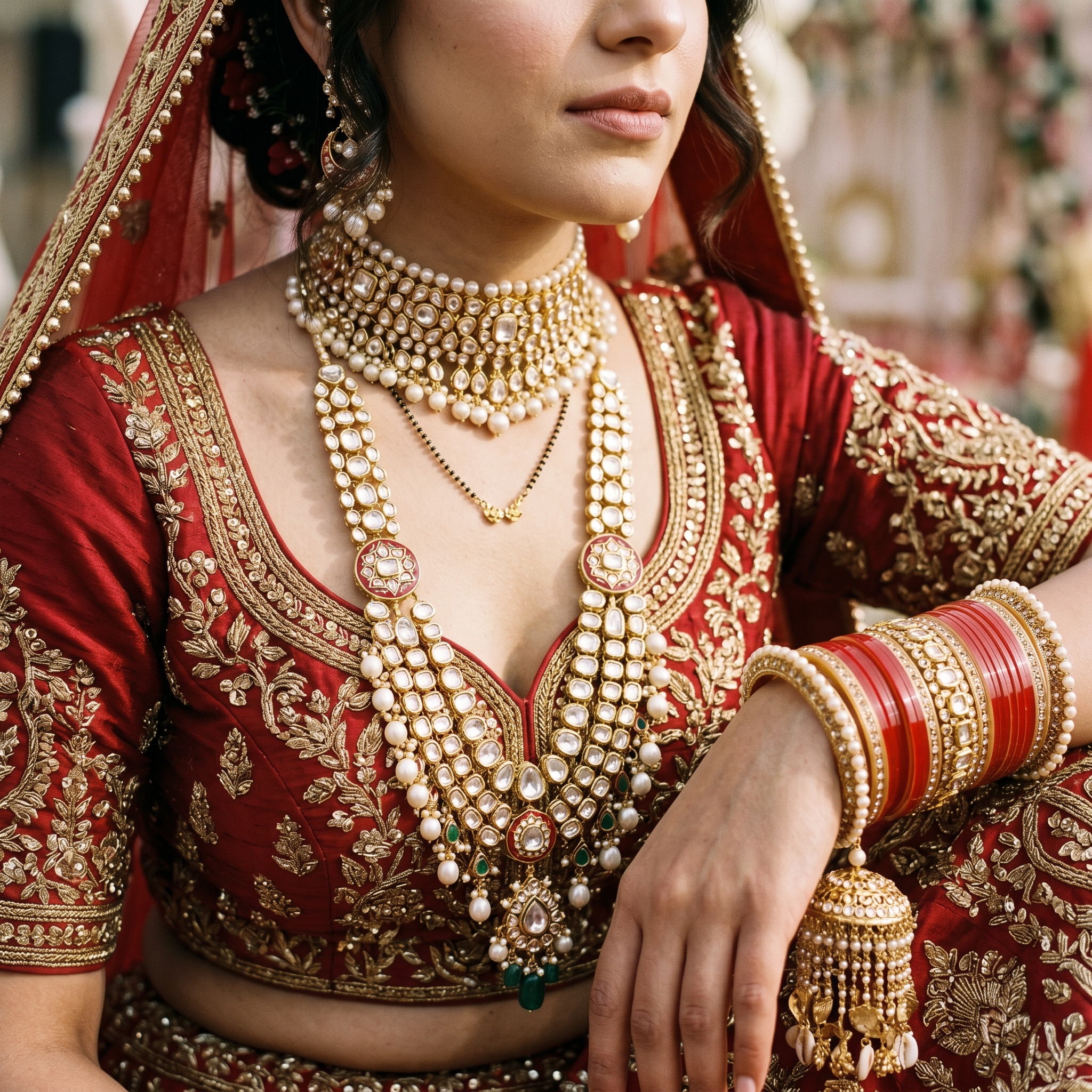
The mechanics work like this. Each piece of bridal jewelry — mathapatti, kundan choker, kalire, bridal bangle stack, kamarbandh — renders independently as its own SKU through the jewelry photography pipeline. Those renders feed back into the bridal apparel catalog as reference images that lock the jewelry's pixel-level fidelity across every shot of the chapter. The bridal hero shows the full set composed on the model; slot 4 (detail) shows the choker close-up; slot 5 (look-shot) shows the mathapatti drape.
The arithmetic is sharper than it looks. A 30-SKU bridal apparel catalog plus a 20-SKU bridal jewelry catalog ships together for less than the cost of two separate productions. The bridal jewelry SKUs continue selling year-round into Karva Chauth, Diwali, engagement occasions, and the next wedding season. Two catalogs, one production cycle, two seasons of revenue — that's the structural advantage of running the bridal-jewelry crossover through Kraftr (kraftr.studio).
What are the marketplace ad specs for bridal?
Bridal marketplace specs sit on the highest end of the spec hierarchy. Tata Cliq Luxe and Nykaa Fashion weight 4K editorial imagery in placements; Myntra weights 2K+ hero with 4K detail crops; AJIO Luxe and Flipkart Fashion run 2K standard; Meesho and mid-tier AJIO run 1K–2K. The render-tier mapping is non-negotiable for the premium tier — sub-2K hero on a Tata Cliq Luxe bridal lehenga gets bounced for editorial-fidelity reasons even when the spec field says 1,000 × 1,000 is the minimum. For the underlying Myntra primary-slot rules, see the Myntra image guidelines guide.
| Marketplace | Slot 1 (hero) | Aspect ratio | Min dimensions | Bridal-specific |
|---|---|---|---|---|
| Tata Cliq Luxe | Editorial bridal, white BG | 3:4 portrait | 4K hero required | Couture-tier editorial fidelity |
| Nykaa Fashion | 3:4 portrait on-model | 3:4 portrait | 4K hero for premium | Pink Friday premium-look bias |
| Myntra | Full-length on-model, white BG | 3:4 portrait | 1,500 × 2,000 (hero); 2,000+ for premium | 4K detail for zardosi |
| AJIO Luxe | 1:1 + 4:5 alternates | 1:1 + 4:5 | 2,000 × 2,000 | Mid-premium tier |
| Flipkart Fashion | 1:1 white BG + 4:5 alternates | 1:1 + portrait alternates | 1,000 × 1,000 (zoom); 2,000+ for HD | Big Billion Days HD-bias [VERIFY] |
| AJIO | 1:1 + 4:5 alternates | 1:1 + 4:5 | 1,200 × 1,200 (min) | Mid-mass tier [VERIFY] |
| Meesho | 1:1, garment fills 80%+ frame | 1:1 | 1,200 × 1,200 (min) | Wedding-guest volume |
For year-round cross-platform specs, see marketplace product photo specs 2026.
What are the rejection traps for bridal catalogs?
Bridal catalogs get rejected for predictable, heavy-embroidery and premium-tier-specific reasons. The dupatta-over-head trap is the most common — Myntra's gender-match and full-face rule conflicts with the bridal-signature dupatta drape unless the catalog handles it correctly. Run the pre-flight checklist below before each refresh cycle.
- Bridal lehenga cropped at skirt hem. Full-length 3:4 portrait required; head-to-knee crops lose the lehenga flare.
- Dupatta-over-head styling rejected as "no full face visible". Reserve dupatta-over-head for slot 5 (look-shot) only. Slot 1 needs full-face uncovered framing per Myntra spec.
- Heavy zardosi mis-read as blurry at 1,500 px. 4K renders required for premium-tier bridal SKUs on Myntra, Nykaa Fashion, and Tata Cliq Luxe.
- Bridal jewelry styled as standalone in slot 1. Each jewelry piece is its own SKU. In the apparel catalog, jewelry must compose with the model as an accessory.
- Pose with mehendi-hands obscuring the saree pallu. Pallu must remain the visual subject; mehendi crops belong in slot 4 only.
- SKU title contains "wedding" or "bridal 2026". Myntra deprioritizes time-bound bridal titles after Feb 28; use evergreen SKU titles and let bridal creative live in catalog slots.
- Couture-tier render at sub-2K hero on Tata Cliq Luxe. Couture spec demands 4K editorial; sub-spec submissions get bounced.
How does the bride + groom catalog production work?
Sherwani and groom catalogs are a parallel production line with a male model — but Kraftr's bridal pipeline runs the female bridal + male sherwani shoot in one cycle with shared backdrop, palette and styling continuity. Most premium bridal D2C brands ship the bride + groom catalog together; the visual continuity boosts couple-shopping conversion by an estimated 25–40% across the categories we've seen, where the same brand sells both lines.
Anchor → fan-out applies separately per model. The bride catalog has its own hero render that anchors the female chapter; the groom catalog has its own hero render that anchors the male chapter. The shared backdrop, palette, and editorial direction connect the two chapters visually without forcing one model identity onto two chapters. Brands shipping bride-and-groom couture catalogs run both chapters through Kraftr in parallel — same production cycle, two chapters, two render gallery sets.
How does the bridal cross-sell into year-round ethnic-wear work?
Bridal SKUs that aren't strictly bridal (reception saree, sangeet-look fusion, wedding-guest anarkali) cross-sell year-round into Diwali, Karva Chauth, Navratri and engagement / cocktail occasions. Pure bridal lehenga is wedding-season only — that's the 30–35% of the catalog that locks to Nov 15 – Feb 28. The remaining 65–70% amortizes across multiple festival windows.
Kraftr brands typically split the bridal catalog 60% wedding-season-only / 40% year-round-crossover to amortize the production cost. The 40% year-round mix continues earning paid-ad return through the off-season; the 60% wedding-season mix concentrates ROI in the 4-month window. The split is a margin decision, not a creative one — both sides of the catalog share the same model identity and brand aesthetic.
Frequently asked questions
When does the Indian bridal / wedding season run in 2026–27?
Bridal / wedding season 2026–27 runs Nov 15, 2026 through Feb 28, 2027 — the peak Indian wedding muhurat dates cluster in this window per Drik Panchang's annual panchang. D2C bridal brands ship season-opener catalogs by Sep 30, 2026, and refresh on a rolling 8–12-week cadence through end-Feb. Karva Chauth (Oct 29) is a bridal-adjacent crossover window.
Which marketplaces drive the most bridal GMV in India?
Bridal GMV concentrates on Myntra and Nykaa Fashion for premium D2C brands; Tata Cliq Luxe captures heavy-couture; AJIO Luxe covers mid-premium; Meesho captures mass-market wedding-guest inventory at ₹500–₹3,000 AOV. A balanced bridal catalog ships different SKU tiers to each marketplace's AOV band: bridal lehenga at premium tiers, wedding-guest saree at mass-market.
What garments lead a wedding-season catalog?
Bridal wedding-season catalogs lead with bridal lehenga (30–35% of SKUs), sherwani (15–20%), reception saree (15–20%), sangeet-look fusion (10–15%), wedding-guest anarkali / saree (10–15%), and mehendi-ceremony casual ethnic (5–10%). Premium brands skew bridal lehenga; mass-market brands skew wedding-guest saree volume.
How does the bridal-jewelry crossover work in catalog production?
Bridal jewelry crossover integrates the jewelry catalog production line into bridal apparel shoots — bridal jewelry sets (mathapatti, choker, kalire, bangles, kamarbandh) render as separate SKUs that compose into bridal hero shots. Brands shooting bridal apparel + bridal jewelry in one cycle ship two parallel catalogs with shared model identity; the crossover is a margin expander.
What's a typical bridal-season catalog budget for a 50-SKU premium brand?
Bridal premium 50-SKU shoots in traditional studios run ₹6,000–₹15,000 per image for couture lehengas — typically ₹8–25 lakh for a 50–100 SKU bridal catalog. Kraftr's per-SKU credit cost runs a fraction of that; bridal SKUs justify the highest render tier (4K) given the premium AOV. See Kraftr pricing for live INR rates.
How often should a bridal catalog refresh across the season?
Bridal catalogs refresh on a rolling 8–12-week cadence: season-opener by Sep 30, mid-season refresh Dec 1, late-season refresh Jan 15, end-season closer Feb 28. Each refresh updates hero creative and adds new SKUs while anchor → fan-out chaining preserves model identity and brand aesthetic from the season-opener. Brand recognition compounds across the 4–5-month season.
Does Kraftr render heavy bridal embroidery accurately?
Bridal embroidery — zardosi, brocade, gota patti, dabka thread — renders accurately through Kraftr's fidelity-first pipeline, which preserves thread color and density from the flat-lay reference. Bridal SKUs render best at 4K resolution to capture the embroidery detail; the hero anchor locks the embroidery aesthetic, then fan-out carries it across hero, back, side, detail and look-shot slots without drift.
What's the difference between bridal lehenga and bridal saree creative?
Bridal lehenga creative needs full-length 3:4 portrait to capture the skirt flare; the dupatta drape over head is the bridal-signature styling. Bridal saree creative emphasizes the pallu drape, traditional gold border, and the bride's pose with hands in suhag-jewelry styling. Both render at 4K hero for the embroidery detail; styling diverges but both share the bridal palette (red, maroon, gold, ivory).
Are sherwani / groom catalogs a separate production line?
Sherwani and groom catalogs are a parallel production line with a male model — but Kraftr's bridal pipeline runs the female bridal + male sherwani shoot in one cycle with shared backdrop, palette and styling continuity. Most premium bridal D2C brands ship the bride + groom catalog together; the visual continuity boosts couple-shopping conversion. Anchor → fan-out applies separately per model.
Can a bridal catalog cross-sell into year-round ethnic-wear?
Bridal SKUs that aren't strictly bridal (reception saree, sangeet-look fusion, wedding-guest anarkali) cross-sell year-round into Diwali, Karva Chauth, Navratri and engagement / cocktail occasions. Pure bridal lehenga is wedding-season only. Kraftr brands typically split the bridal catalog 60% wedding-season-only / 40% year-round-crossover to amortize the production cost.
Ship your full bridal season in one production cycle
Kraftr's fidelity-first pipeline produces full bridal catalogs — heavy-zardosi lehengas, ivory sherwanis, reception sarees, sangeet fusion, wedding-guest anarkali — on gender-matched models, at marketplace tiers from couture (Tata Cliq Luxe) through mass-market (Meesho), with bridal jewelry crossover, in days not weeks. Plan your bridal catalog with Kraftr →
Sources
- Drik Panchang — 2026 festivals list — bridal / wedding season 2026–27 window verified Nov 15, 2026 – Feb 28, 2027.
- Myntra image size & guidelines (2026) — primary-slot rules and premium-tier render specs.
- Marketplace product photo specs 2026 — cross-platform spec table.
- AI vs traditional fashion photoshoot cost — per-image production cost benchmarks behind the bridal budget estimates.
- Indian fashion seasonal drop calendar — the full 2026 drop calendar.
- Karva Chauth bridal campaign shoot guide — bridal-adjacent festival crossover playbook.
- Bridal catalog photography landing — production walk-through with render gallery.
- Lehenga photography for fashion catalogs — underlying garment-cluster specs.
- Jewelry photography pipeline — the bridal-jewelry crossover production line.
- Drik Panchang wedding-muhurat windows
[VERIFY]— specific muhurat-date cluster for the 2026–27 season.
About the author: the Kraftr team ships fidelity-first catalog production for D2C fashion brands selling on Indian marketplaces.
Last verified: 2026-05-22.
Frequently asked questions
- When does the Indian bridal / wedding season run in 2026–27?
- Bridal / wedding season 2026–27 runs Nov 15, 2026 through Feb 28, 2027 — the peak Indian wedding muhurat dates cluster in this window per Drik Panchang's annual panchang. D2C bridal brands ship season-opener catalogs by Sep 30, 2026, and refresh on a rolling 8–12-week cadence through end-Feb. Karva Chauth (Oct 29) is a bridal-adjacent crossover window.
- Which marketplaces drive the most bridal GMV in India?
- Bridal GMV concentrates on Myntra and Nykaa Fashion for premium D2C brands; Tata Cliq Luxe captures heavy-couture; AJIO Luxe covers mid-premium; Meesho captures mass-market wedding-guest inventory at ₹500–₹3,000 AOV. A balanced bridal catalog ships different SKU tiers to each marketplace's AOV band: bridal lehenga at premium tiers, wedding-guest saree at mass-market.
- What garments lead a wedding-season catalog?
- Bridal wedding-season catalogs lead with bridal lehenga (30–35% of SKUs), sherwani (15–20%), reception saree (15–20%), sangeet-look fusion (10–15%), wedding-guest anarkali / saree (10–15%), and mehendi-ceremony casual ethnic (5–10%). Premium brands skew bridal lehenga; mass-market brands skew wedding-guest saree volume.
- How does the bridal-jewelry crossover work in catalog production?
- Bridal jewelry crossover integrates the jewelry catalog production line into bridal apparel shoots — bridal jewelry sets (mathapatti, choker, kalire, bangles, kamarbandh) render as separate SKUs that compose into bridal hero shots. Brands shooting bridal apparel + bridal jewelry in one cycle ship two parallel catalogs with shared model identity; the crossover is a margin expander.
- What's a typical bridal-season catalog budget for a 50-SKU premium brand?
- Bridal premium 50-SKU shoots in traditional studios run ₹6,000–₹15,000 per image for couture lehengas — typically ₹8–25 lakh for a 50–100 SKU bridal catalog. Kraftr's per-SKU credit cost runs a fraction of that; bridal SKUs justify the highest render tier (4K) given the premium AOV. See /pricing for live INR rates.
- How often should a bridal catalog refresh across the season?
- Bridal catalogs refresh on a rolling 8–12-week cadence: season-opener by Sep 30, mid-season refresh Dec 1, late-season refresh Jan 15, end-season closer Feb 28. Each refresh updates hero creative and adds new SKUs while anchor → fan-out chaining preserves model identity and brand aesthetic from the season-opener. Brand recognition compounds across the 4–5-month season.
- Does Kraftr render heavy bridal embroidery accurately?
- Bridal embroidery — zardosi, brocade, gota patti, dabka thread — renders accurately through Kraftr's fidelity-first pipeline, which preserves thread color and density from the flat-lay reference. Bridal SKUs render best at 4K resolution to capture the embroidery detail; the hero anchor locks the embroidery aesthetic, then fan-out carries it across hero, back, side, detail and look-shot slots without drift.
- What's the difference between bridal lehenga and bridal saree creative?
- Bridal lehenga creative needs full-length 3:4 portrait to capture the skirt flare; the dupatta drape over head is the bridal-signature styling. Bridal saree creative emphasizes the pallu drape, traditional gold border, and the bride's pose with hands in suhag-jewelry styling. Both render at 4K hero for the embroidery detail; styling diverges but both share the bridal palette.
- Are sherwani / groom catalogs a separate production line?
- Sherwani and groom catalogs are a parallel production line with a male model — but Kraftr's bridal pipeline runs the female bridal + male sherwani shoot in one cycle with shared backdrop, palette and styling continuity. Most premium bridal D2C brands ship the bride + groom catalog together; the visual continuity boosts couple-shopping conversion. Anchor → fan-out applies separately per model.
- Can a bridal catalog cross-sell into year-round ethnic-wear?
- Bridal SKUs that aren't strictly bridal (reception saree, sangeet-look fusion, wedding-guest anarkali) cross-sell year-round into Diwali, Karva Chauth, Navratri and engagement / cocktail occasions. Pure bridal lehenga is wedding-season only. Kraftr brands typically split the bridal catalog 60% wedding-season-only / 40% year-round-crossover to amortize the production cost.
About the author
Kraftr is a fidelity-first AI catalog production tool for D2C fashion and jewelry brands selling on Indian marketplaces. We publish marketplace specs and production playbooks based on the rules our customers ship against every week.
More about Kraftr