
Karva Chauth Bridal Campaign Shoot Guide 2026 — Calendar & Specs
Karva Chauth 2026 (Oct 29) catalog shoot-by date is Sep 17. Bridal-leaning calendar, red saree + suhag jewelry specs, mehendi styling rules, and rejection traps.
Last verified:
TL;DR: Karva Chauth 2026 falls on Oct 29. The shoot-by date is Sep 17. This guide gives you the bridal-leaning shoot calendar, red saree + suhag jewelry specs across Myntra and Nykaa Fashion, mehendi-styling rules, and the rejection traps for bridal-adjacent festive catalogs.
Short answer
Karva Chauth bridal campaigns for 2026 follow a 10-week ramp: concept lock by Aug 6, references by Aug 20, hero render by Aug 27, full catalog by Sep 10, marketplace upload by Sep 17. Garment focus is red bridal saree, gold-and-red lehenga, suhag jewelry, and mehendi-themed styling. SKUs cross-sell into the Nov 15 – Feb 28 bridal / wedding season.
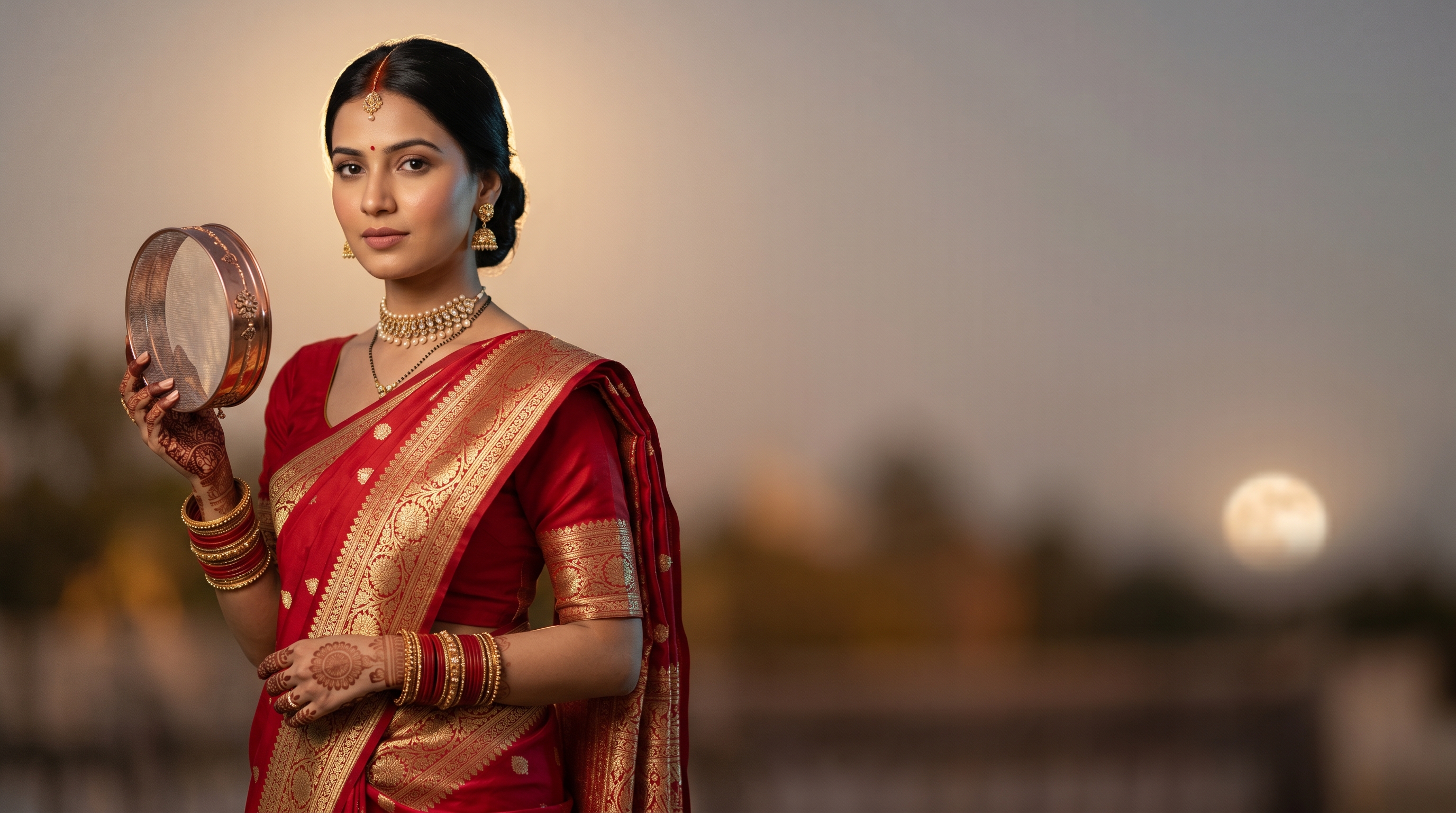
For the date-of-truth, we cross-check apps/web/src/content/festivals.ts against Drik Panchang's 2026 festival list. For the broader seasonal frame around Karva Chauth, see the Indian fashion seasonal drop calendar.
When is Karva Chauth 2026, and why does it sit on the bridal calendar?
Karva Chauth 2026 falls on Thursday, October 29 — verified against Drik Panchang's 2026 festival list and apps/web/src/content/festivals.ts. It sits between Navratri (Oct 11–19) and Diwali (Nov 8), which is why Karva Chauth catalogs cross-sell heavily into both adjacent festivals plus the Nov 15 wedding-season opener.
Karva Chauth is the only festival on the Indian calendar where bridal-leaning SKUs — red saree, gold-and-red lehenga, suhag jewelry — sell at peak volume without an actual wedding muhurat. The shoot-by date is Sep 17. The MOFU catalog window runs Sep 29 (T-30) through Nov 12 (T+14) — the validFrom and validThrough window we emit in JSON-LD for this post and the matching Karva Chauth landing.
The Karva Chauth shoot calendar — week by week
Karva Chauth campaigns ship live by Sep 17, 2026 — six weeks before the Oct 29 festival — to capture marketplace pre-festival ramp on Myntra and Nykaa Fashion, the two marketplaces that dominate Karva Chauth premium-SKU demand. The bridal-leaning palette runs red, maroon, gold and ivory; garment focus is red bridal saree, gold-and-red lehenga, suhag jewelry sets, and mehendi-themed styling. The countdown table below mirrors the Karva Chauth landing page.
| Phase | Recommended date | What to lock |
|---|---|---|
| T-12w | Aug 6 | Concept lock; bridal-leaning SKU shortlist |
| T-10w | Aug 20 | Flat-lay references; red saree + lehenga |
| T-9w | Aug 27 | Hero render approved (anchor) |
| T-7w | Sep 10 | Full catalog rendered |
| T-6w | Sep 17 | Marketplace upload (shoot-by) |
| T-30d | Sep 29 | Sitemap bumps changeFreq=weekly |
| T-day | Oct 29 | Festival peak |
| T+17d | Nov 15 | Bridal season opens; cross-sell window starts |
What is the bridal-leaning garment focus for Karva Chauth?
Karva Chauth catalogs lead with red bridal saree (35–40% of SKUs), gold-and-red lehenga (20–25%), suhag jewelry sets (15–20%), anarkali (10–15%), and Indo-western fusion (5–10%). The palette skews bridal — red, maroon, gold, ivory — and SKUs lean heavier on premium AOV than typical festive-wear catalogs. Premium brands shooting for Myntra and Nykaa Fashion run 4K hero renders to capture the zardosi and gold zari at the saree pallu.
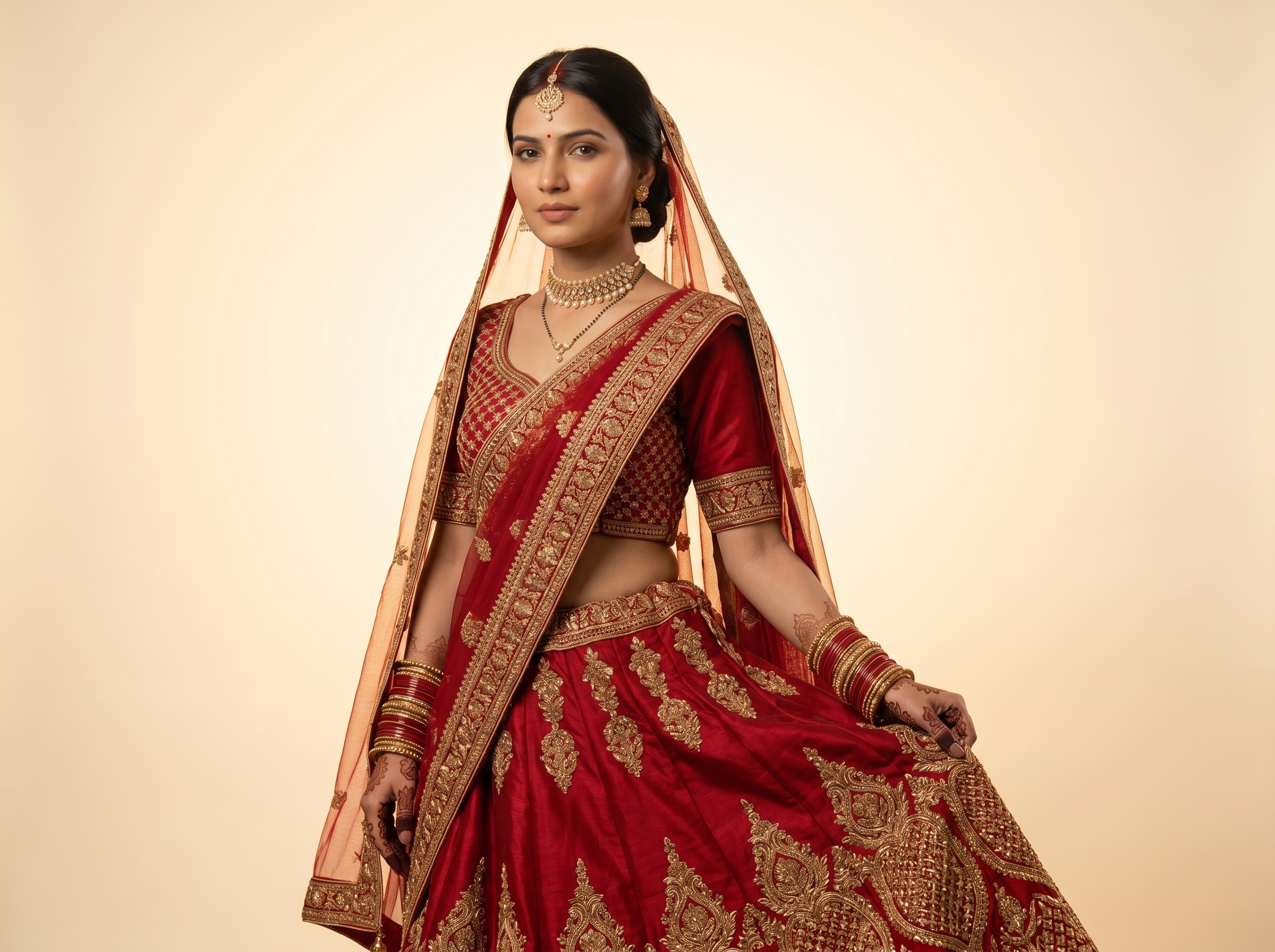
Red bridal saree — 35–40% of SKUs
The red bridal saree is the Karva Chauth signature SKU. Heavy banarasi, kanjivaram, and silk sarees with gold zari borders dominate the premium tier; mass-market brands ship lighter weaves at Meesho AOV. Render hero at full-length 3:4 portrait showing the pallu drape over one shoulder.
Gold-and-red lehenga — 20–25% of SKUs
Gold-and-red lehengas serve the brides-to-be and bridal-adjacent gift-givers. Render the dupatta drape over the head for the bridal-signature styling; reserve full-face uncovered framing for slot 2 (back) or slot 3 (side).
Suhag jewelry — 15–20% of SKUs
Suhag jewelry — bindi, sindoor, mangalsutra, kalire, bangles — is the cross-cluster garment-jewelry expansion line. Each piece renders as a separate SKU through the jewelry photography pipeline and composes back into the Karva Chauth hero shots through anchor → fan-out chaining. This is the post's info-gain moat — competitors treat suhag jewelry as styling; Kraftr treats it as a parallel SKU production line.
Anarkali and Indo-western fusion — 15–25% combined
The remaining mix balances traditional anarkali (often in the bridal red-and-gold palette) and Indo-western fusion (drape skirts, structured kurta-saree hybrids) for the cocktail / pre-Karva-Chauth-dinner occasion. These SKUs amortize across Diwali and the bridal-season opener too.
What are the Karva Chauth palette and styling rules?
Karva Chauth styling runs bridal-leaning: red, maroon, gold and ivory garments; mehendi-decorated hands composed at the model's sides; suhag jewelry styled as the model's accessories rather than as a separate visual subject; soft pre-dawn or moonlight cinematic backdrop reserved for slots 4–5 (detail / look-shot). Slot 1 still requires the white #FFFFFF primary background per Myntra spec — editorial styling never moves into the primary slot.
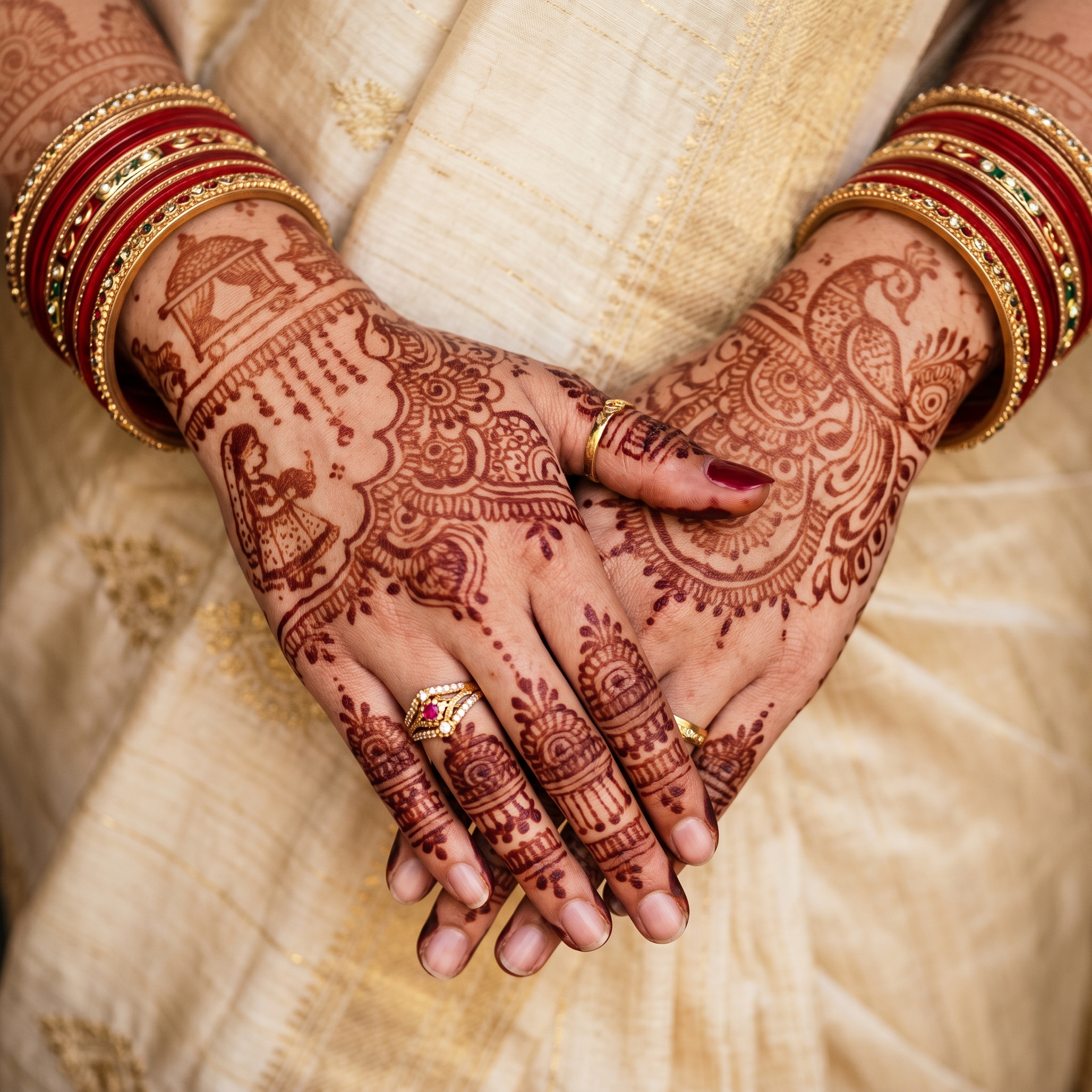
Mehendi-as-styling rule
Mehendi appears on the model's hands across slots 1–5, but never blocks the SKU. Slot 1 must show the full garment with the model — mehendi can be visible on the hands as long as the saree pallu, lehenga skirt, or anarkali silhouette is still the visual subject. Extreme mehendi close-ups belong in slot 4 (detail) only.
Moonlight backdrop rule
Moonlight-themed lifestyle backdrops are editorial gold for premium marketplaces (Myntra and Nykaa Fashion) where editorial-festival creative outranks utility shots in EORS placements. Reserve moonlight backdrops for slots 4–5 only; slot 1 stays on pure white #FFFFFF.
Suhag-jewelry crossover rule
Suhag jewelry is the cross-cluster crown jewel of Karva Chauth catalogs. Brands running the bridal-jewelry production line in parallel with the apparel catalog ship two parallel SKU lists — the jewelry SKUs sell independently year-round, but compose into the Karva Chauth hero shots via anchor → fan-out chaining. The bridal cross-sell amortizes both production lines across two seasons.
What are the marketplace ad specs for Karva Chauth?
Karva Chauth marketplace specs follow year-round primary-slot rules — Myntra 3:4 portrait, Nykaa Fashion 3:4 portrait, AJIO 1:1, Meesho 1:1 — with a sharper premium bias than Navratri or Diwali. Myntra and Nykaa Fashion capture the bulk of GMV, so the production budget concentrates on 2K+ hero renders that surface zardosi and gold zari at marketplace QC resolution. For the underlying Myntra primary-slot rules, see the Myntra image guidelines guide.
| Marketplace | Slot 1 (hero) | Aspect ratio | Min dimensions | Karva Chauth specific |
|---|---|---|---|---|
| Myntra | Full-length on-model, white BG | 3:4 portrait | 1,500 × 2,000 px (hero); 2,000 × 2,000+ for premium | Editorial festival lifestyle slot ranks higher when filled [VERIFY: Myntra Partner Portal] |
| Nykaa Fashion | 3:4 portrait on-model | 3:4 portrait | 1,500 × 2,000 (hero) | Pink Friday — premium-look bias is sharpest here |
| AJIO | 1:1 + 4:5 alternates | 1:1 + 4:5 | 1,200 × 1,200 (min) | Mid-market crossover [VERIFY: AJIO seller portal] |
| Meesho | 1:1, garment fills 80%+ frame | 1:1 | 1,200 × 1,200 (min) | Mass-market red saree volume |
| Flipkart Fashion | 1:1 white BG + 4:5 portrait alternates | 1:1 + portrait alternates | 1,000 × 1,000 (zoom threshold); 2,000+ for HD | Big Billion Days HD-bias [VERIFY: Flipkart Seller Hub] |
What are the rejection traps for bridal-adjacent festive catalogs?
Karva Chauth catalogs get rejected for predictable, bridal-adjacent reasons. The mehendi-hand trap is the most common — close-up mehendi-hand shots in slot 1 obscure the SKU and trigger off-SKU rejection. Run the pre-flight checklist below before the Sep 17 shoot-by date.
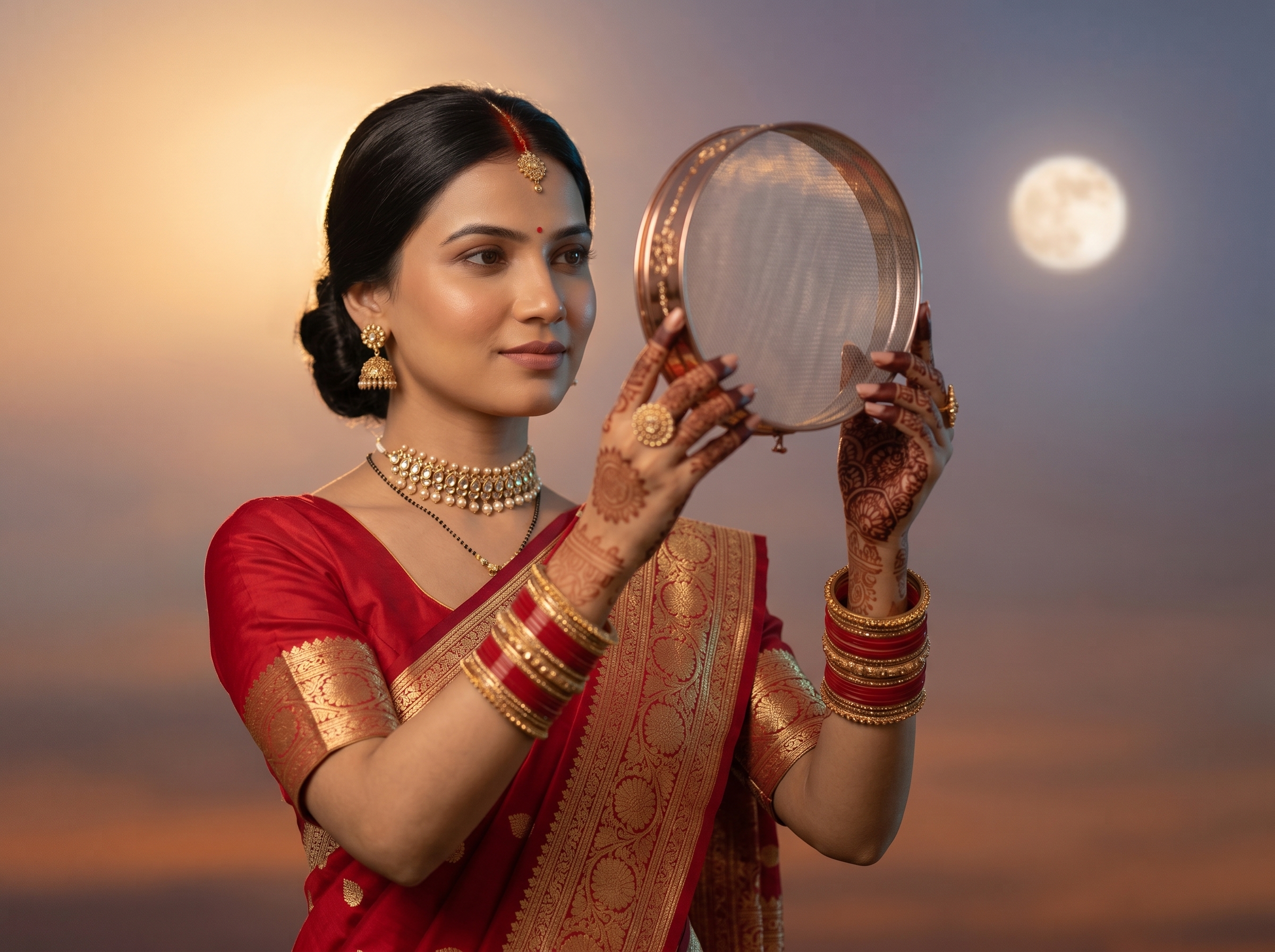
- Mehendi-hand close-up in slot 1 obscures the SKU. Move mehendi crops to slot 4 (detail) only. Slot 1 needs the full garment visible.
- Off-SKU suhag jewelry styled as standalone in slot 1. Jewelry must compose with the model as accessory, not stand alone in the primary slot.
- Saree drape mis-rendered at hem. Full-length 3:4 portrait required; head-to-knee crops lose the saree silhouette.
- Model hair covering the dupatta zardosi. Restyle hair away from the dupatta border, or shoot back-view in slot 2.
- SKU title contains "Karva Chauth" or year. Myntra deprioritizes time-bound titles after the festival; use evergreen titles in the SKU and let festival creative live in the catalog slots.
- Sindoor-and-bindi composition that crops the model's face. Faces stay visible in slot 1 — full-face framing required.
How does the suhag-jewelry crossover compress two campaigns into one cycle?
Karva Chauth is the only festival where the cross-cluster link goes deep into jewelry. Kraftr's jewelry photography pipeline renders bindi, sindoor, mangalsutra, kalire and bangles as separate SKUs that compose into the Karva Chauth catalog through anchor → fan-out chaining. The same model identity carries from the Karva Chauth hero render into the Nov 15 – Feb 28 bridal-season catalog's hero, locking model identity, hair, makeup and bridal styling continuity across two campaigns.
Brand recognition compounds when buyers see the same face across two adjacent campaigns. The production-cost arithmetic is sharper: brands amortize one shoot across Karva Chauth (Oct 29) plus the bridal season opener (Nov 15) plus the December–February wedding rolling refreshes. Two-to-five campaigns, one production cycle. See the bridal & wedding season catalog playbook for the downstream bridal-cycle continuation.
Frequently asked questions
When should D2C brands shoot their Karva Chauth 2026 catalog?
Karva Chauth shoots wrap by Sep 17, 2026 — six weeks before the Oct 29 festival — to ship the bridal-leaning catalog live before marketplaces ramp algorithmic boosts. Brands using Kraftr (kraftr.studio) compress the shoot window from four weeks to one to three days, and the catalog cross-sells directly into the Nov 15 – Feb 28 bridal / wedding season.
What garments lead a Karva Chauth catalog?
Karva Chauth catalogs lead with red bridal saree (35–40% of SKUs), gold-and-red lehenga (20–25%), suhag jewelry (15–20%), anarkali (10–15%), and Indo-western fusion (5–10%). The palette skews red, maroon, gold and ivory. SKUs lean premium AOV — Myntra and Nykaa Fashion capture the bulk of GMV; Meesho captures mass-market red saree volume.
How do you photograph mehendi without violating marketplace QC?
Karva Chauth mehendi-hand close-ups belong in slot 4 (detail), never slot 1 (primary). Marketplace QC rejects primary images where the model's mehendi obscures the SKU — the garment must be fully visible in slot 1. Mehendi can appear on the model's hands in slots 2–5 as long as the SKU isn't blocked. Kraftr's pipeline composes mehendi as styling, not subject.
Can a Karva Chauth catalog cross-sell into the bridal / wedding season?
Karva Chauth SKUs cross-sell directly into the Nov 15 – Feb 28 bridal / wedding season — red saree, bridal lehenga and suhag jewelry are core wedding-guest and bridal inventory. Kraftr's anchor → fan-out chaining reuses the Karva Chauth hero's model identity across the bridal catalog, compressing two campaigns into one production cycle.
What's the typical Karva Chauth catalog budget for a 50-SKU premium brand?
Karva Chauth premium 50-SKU shoots in traditional studios run ₹3,000–₹6,000 per image with bridal styling, suhag jewelry, and mehendi continuity — typically ₹2–5 lakh end-to-end. Kraftr's per-SKU credit cost runs a fraction of that; see Kraftr pricing for live INR rates. The bridal cross-sell into Nov–Feb amortizes the production cost across two seasons.
Which marketplaces capture the most Karva Chauth GMV?
Karva Chauth GMV concentrates on Myntra and Nykaa Fashion for premium D2C ethnic-wear brands in India. AJIO and Flipkart cover mid-market; Meesho captures mass-market red saree volume. The premium bias is sharper than Navratri or Diwali — Karva Chauth SKUs sell on AOV, not volume; render fidelity at 2,000+ px hero is non-negotiable for the premium tier.
How does Kraftr render suhag jewelry consistently across a catalog?
Karva Chauth suhag jewelry (bindi, sindoor, mangalsutra, kalire, bangles) renders consistently when each piece is passed as a reference image in the shoot pipeline. The anchor → fan-out pattern carries the suhag jewelry through every shot in a chapter — hero, back, side, detail, look-shot — preserving piece-by-piece fidelity.
Should the same model carry across Karva Chauth and bridal catalogs?
Karva Chauth and bridal catalogs work best with the same model identity by design. Kraftr's anchor → fan-out chaining uses the Karva Chauth hero render as a visual reference for the bridal season catalog's hero, locking model identity, hair, makeup and bridal styling continuity across two campaigns. Brand recognition compounds when buyers see the same face.
Is moonlight-backdrop styling worth shooting for Karva Chauth?
Karva Chauth moonlight-backdrop styling lifts catalog engagement on premium marketplaces (Myntra + Nykaa Fashion) where editorial-festival creative outranks utility shots in EORS placements. Reserve moonlight backdrops for slots 4–5 (detail / look-shot) — slot 1 still requires the white #FFFFFF primary background per Myntra spec.
What are the most common Karva Chauth catalog rejection reasons?
Karva Chauth catalogs get rejected most often for mehendi-hand close-ups in slot 1 obscuring the SKU, off-SKU suhag jewelry pieces in slot 1, saree drape mis-rendered at hem, model hair covering the dupatta zardosi, and SKU titles containing the year. Use detail crops in slots 4–5 only and keep slot 1 SKU-first.
Ship your Karva Chauth + bridal campaign in one production cycle
Kraftr's fidelity-first pipeline produces full Karva Chauth catalogs — red sarees, gold-and-red lehengas, suhag jewelry sets — on the same model identity that carries into the bridal season, at marketplace + D2C specs — in days, not weeks. Two campaigns, one shoot. Plan your Karva Chauth drop with Kraftr →
Sources
- Drik Panchang — 2026 festivals list — Karva Chauth 2026 date verified Oct 29.
- Myntra image size & guidelines (2026) — primary-slot rules and premium-tier render specs.
- Marketplace product photo specs 2026 — cross-platform spec table.
- AI vs traditional fashion photoshoot cost — per-image production cost benchmarks.
- Indian fashion seasonal drop calendar — the full 2026 drop calendar.
- Bridal & wedding season catalog playbook — downstream bridal-cycle continuation playbook.
- Karva Chauth catalog photography landing — production walk-through.
- Jewelry photography pipeline — the suhag-jewelry crossover production line.
About the author: the Kraftr team ships fidelity-first catalog production for D2C fashion brands selling on Indian marketplaces.
Last verified: 2026-05-22.
Frequently asked questions
- When should D2C brands shoot their Karva Chauth 2026 catalog?
- Karva Chauth shoots wrap by Sep 17, 2026 — six weeks before the Oct 29 festival — to ship the bridal-leaning catalog live before marketplaces ramp algorithmic boosts. Brands using Kraftr's fidelity-first pipeline compress the shoot window from four weeks to one to three days, and the catalog cross-sells directly into the Nov 15 – Feb 28 bridal / wedding season.
- What garments lead a Karva Chauth catalog?
- Karva Chauth catalogs lead with red bridal saree (35–40% of SKUs), gold-and-red lehenga (20–25%), suhag jewelry (15–20%), anarkali (10–15%), and Indo-western fusion (5–10%). The palette skews red, maroon, gold and ivory. SKUs lean premium AOV — Myntra and Nykaa Fashion capture the bulk of GMV; Meesho captures mass-market red saree volume.
- How do you photograph mehendi without violating marketplace QC?
- Karva Chauth mehendi-hand close-ups belong in slot 4 (detail), never slot 1 (primary). Marketplace QC rejects primary images where the model's mehendi obscures the SKU — the garment must be fully visible in slot 1. Mehendi can appear on the model's hands in slots 2–5 as long as the SKU isn't blocked. Kraftr's pipeline composes mehendi as styling, not subject.
- Can a Karva Chauth catalog cross-sell into the bridal / wedding season?
- Karva Chauth SKUs cross-sell directly into the Nov 15 – Feb 28 bridal / wedding season — red saree, bridal lehenga and suhag jewelry are core wedding-guest and bridal inventory. Kraftr's anchor → fan-out chaining reuses the Karva Chauth hero's model identity across the bridal catalog, compressing two campaigns into one production cycle.
- What's the typical Karva Chauth catalog budget for a 50-SKU premium brand?
- Karva Chauth premium 50-SKU shoots in traditional studios run ₹3,000–₹6,000 per image with bridal styling, suhag jewelry, and mehendi continuity — typically ₹2–5 lakh end-to-end. Kraftr's per-SKU credit cost runs a fraction of that; see /pricing for live INR rates. The bridal cross-sell into Nov–Feb amortizes the production cost across two seasons.
- Which marketplaces capture the most Karva Chauth GMV?
- Karva Chauth GMV concentrates on Myntra and Nykaa Fashion for premium D2C ethnic-wear brands in India. AJIO and Flipkart cover mid-market; Meesho captures mass-market red saree volume. The premium bias is sharper than Navratri or Diwali — Karva Chauth SKUs sell on AOV, not volume; render fidelity at 2,000+ px hero is non-negotiable for the premium tier.
- How does Kraftr render suhag jewelry consistently across a catalog?
- Karva Chauth suhag jewelry (bindi, sindoor, mangalsutra, kalire, bangles) renders consistently when each piece is passed as a reference image in the shoot pipeline. The anchor → fan-out pattern carries the suhag jewelry through every shot in a chapter — hero, back, side, detail, look-shot — preserving piece-by-piece fidelity. See the jewelry photography page for the underlying jewelry pipeline.
- Should the same model carry across Karva Chauth and bridal catalogs?
- Karva Chauth and bridal catalogs work best with the same model identity by design. Kraftr's anchor → fan-out chaining uses the Karva Chauth hero render as a visual reference for the bridal season catalog's hero, locking model identity, hair, makeup and bridal styling continuity across two campaigns. Brand recognition compounds when buyers see the same face.
- Is moonlight-backdrop styling worth shooting for Karva Chauth?
- Karva Chauth moonlight-backdrop styling lifts catalog engagement on premium marketplaces (Myntra + Nykaa Fashion) where editorial-festival creative outranks utility shots in EORS placements. Reserve moonlight backdrops for slots 4–5 (detail / look-shot) — slot 1 still requires the white #FFFFFF primary background per Myntra spec.
- What are the most common Karva Chauth catalog rejection reasons?
- Karva Chauth catalogs get rejected most often for mehendi-hand close-ups in slot 1 obscuring the SKU, off-SKU suhag jewelry pieces in slot 1, saree drape mis-rendered at hem, model hair covering the dupatta zardosi, and SKU titles containing the year. Use detail crops in slots 4–5 only and keep slot 1 SKU-first.
About the author
Kraftr is a fidelity-first AI catalog production tool for D2C fashion and jewelry brands selling on Indian marketplaces. We publish marketplace specs and production playbooks based on the rules our customers ship against every week.
More about Kraftr