
Navratri Lookbook Production Guide 2026: 9-Day Calendar & Specs
Navratri 2026 (Oct 11–19) catalog shoot-by date is Aug 30. Full 9-day color calendar, chaniya choli specs, marketplace rules, and the multi-look production playbook.
Last verified:
TL;DR: Navratri 2026 runs Oct 11 (Day 1) – Oct 19 (Day 9). The shoot-by date is Aug 30. This guide gives you the nine-day color calendar, chaniya choli specs across Myntra/Flipkart/AJIO/Meesho, the multi-look production playbook, and the eight rejection traps for festive multi-look catalogs.
Short answer
Navratri lookbook production for 2026 follows a 12-week ramp: concept lock by Jul 20, references by Aug 2, hero render (Day-1 palette) by Aug 9, full nine-day catalog by Aug 23, marketplace upload by Aug 30. The traditional Gujarati color sequence runs Day 1 yellow through Day 9 purple. Garment mix skews chaniya choli, ghaghra, kediyu and traditional jewelry.
For the date-of-truth, we cross-check apps/web/src/content/festivals.ts against Drik Panchang's 2026 festival list. For the broader seasonal frame around Navratri, see the Indian fashion seasonal drop calendar.
When is Navratri 2026, and why does the nine-day window change everything?
Navratri 2026 runs Sunday, October 11 (Day 1) through Monday, October 19 (Day 9) — verified against Drik Panchang's 2026 festival list and apps/web/src/content/festivals.ts. Unlike Diwali, Navratri is a nine-day commerce window, not a single peak day. That changes the catalog structure: a Navratri lookbook is nine looks, not one.
Marketplace algorithms ramp ~30 days before Day 1, meaning the catalog must be live by Sep 11 for the pre-festival paid-ad CPM efficiency window. The shoot-by date is Aug 30. Dussehra immediately follows on Oct 20, and most chaniya choli and ghaghra SKUs cross-sell into that tail, so the working window effectively runs Sep 11 through Nov 2 (Day-9 + 14 days).
The Navratri shoot calendar — week by week
Navratri shoots wrap by Aug 30, 2026 — six weeks before the Oct 11 Day-1 peak. The full 12-week ramp lets brands lock the concept by Jul 20, gather flat-lay references by Aug 2, render the Day-1 hero anchor by Aug 9, and complete the full nine-day catalog by Aug 23. The countdown table below mirrors the Navratri landing page; both pages keep the same dates so AI extraction stays consistent.
| Phase | Recommended date | What to lock |
|---|---|---|
| T-12w | Jul 20 | Concept lock; 9-look SKU shortlist |
| T-10w | Aug 2 | Flat-lay references; chaniya choli + ghaghra |
| T-9w | Aug 9 | Hero render (Day-1 yellow palette) — anchor |
| T-7w | Aug 23 | Full 9-day catalog rendered |
| T-6w | Aug 30 | Marketplace upload (shoot-by) |
| T-30d | Sep 11 | Sitemap bumps changeFreq=weekly |
| T-day | Oct 11 | Day 1 — Navratri peak begins |
| T-end | Oct 19 | Day 9 — final garba night |
| T+1d | Oct 20 | Dussehra; reuse Navratri SKUs |
What is the traditional 9-day Navratri color calendar?
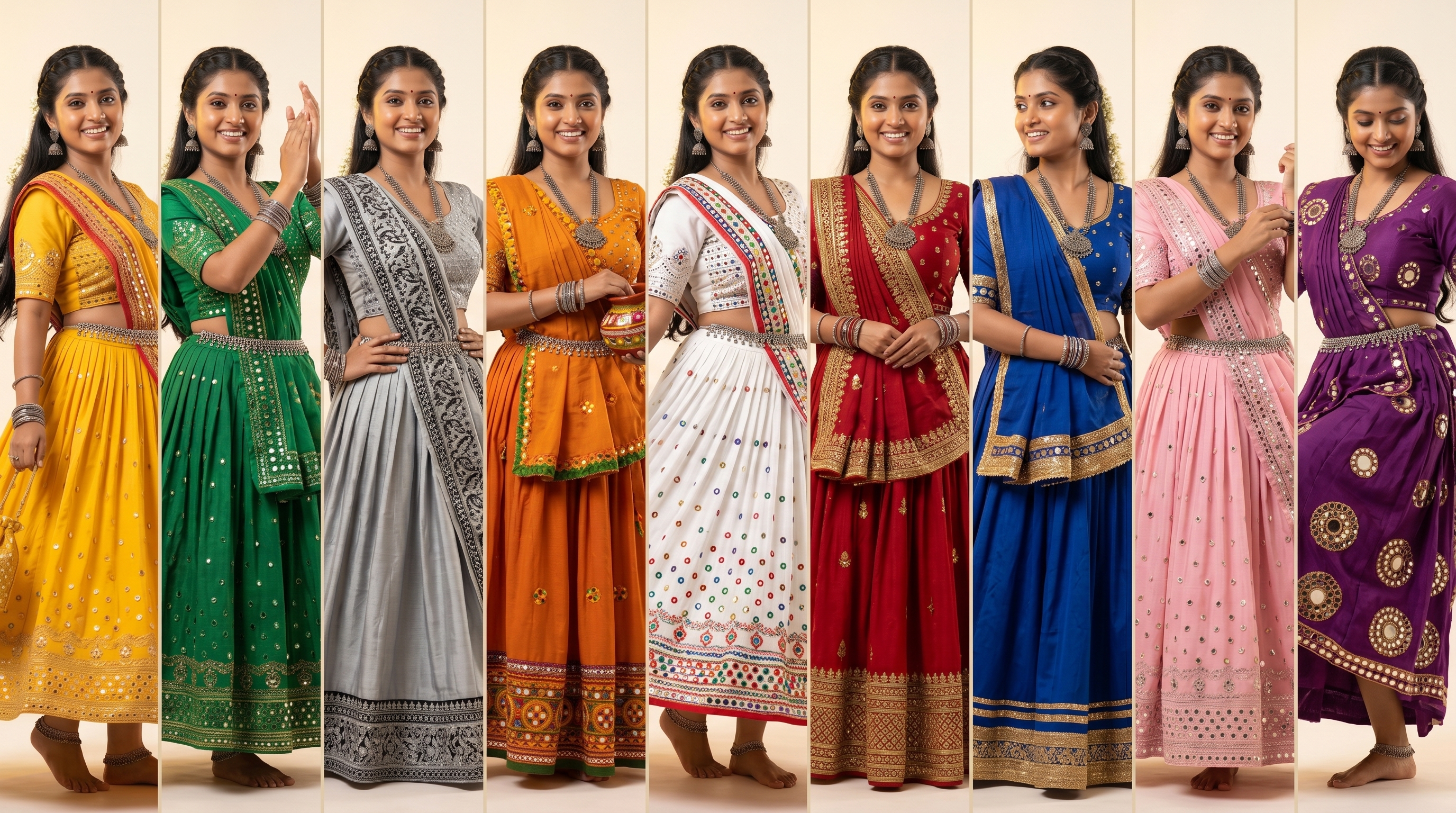
Navratri 2026 follows the traditional Gujarati color sequence: Day 1 yellow, Day 2 green, Day 3 grey, Day 4 orange, Day 5 white, Day 6 red, Day 7 royal blue, Day 8 pink, Day 9 purple. This is the post's info-gain moat — competitors describe Navratri generically; Kraftr publishes the color-per-day mapping aligned to the production calendar. Regional variations exist; cross-check the panchang for your target audience's tradition before publishing.
| Day | Date | Traditional color | Garment styling cue |
|---|---|---|---|
| Day 1 | Oct 11 (Sun) | Yellow / Pratipada | Bright sunny chaniya choli, yellow ghaghra |
| Day 2 | Oct 12 | Green | Emerald chaniya choli with green mirror-work |
| Day 3 | Oct 13 | Grey / Tritiya | Silver-grey ghaghra with monochrome dupatta |
| Day 4 | Oct 14 | Orange | Orange chaniya choli, festive jewelry |
| Day 5 | Oct 15 | White / Panchami | White ghaghra with multi-color mirror-work |
| Day 6 | Oct 16 | Red | Deep red chaniya choli (bridal-leaning) |
| Day 7 | Oct 17 | Royal blue | Royal blue ghaghra with traditional gold trim |
| Day 8 | Oct 18 | Pink | Pink chaniya choli, festive look |
| Day 9 | Oct 19 | Purple | Purple ghaghra (Navami) |
[VERIFY: regional Gujarati Navratri tradition source] — color-per-day mappings vary by region; the sequence above reflects the dominant Gujarati Navratri tradition. Cross-check before publish.
What garments lead a Navratri lookbook?
Navratri lookbooks lead with chaniya choli (60–70% of SKUs), ghaghra (15–20%), traditional mirror-work skirts (5–10%), and men's kediyu / dhoti sets (5–10%). Premium brands add ethnic jewelry crossover; mass-market brands skew chaniya choli volume with regional Gujarati color variants. Multi-day color drops outperform single-day drops by roughly 2× engagement [VERIFY: D2C operator data].
Chaniya choli — 60–70% of SKUs
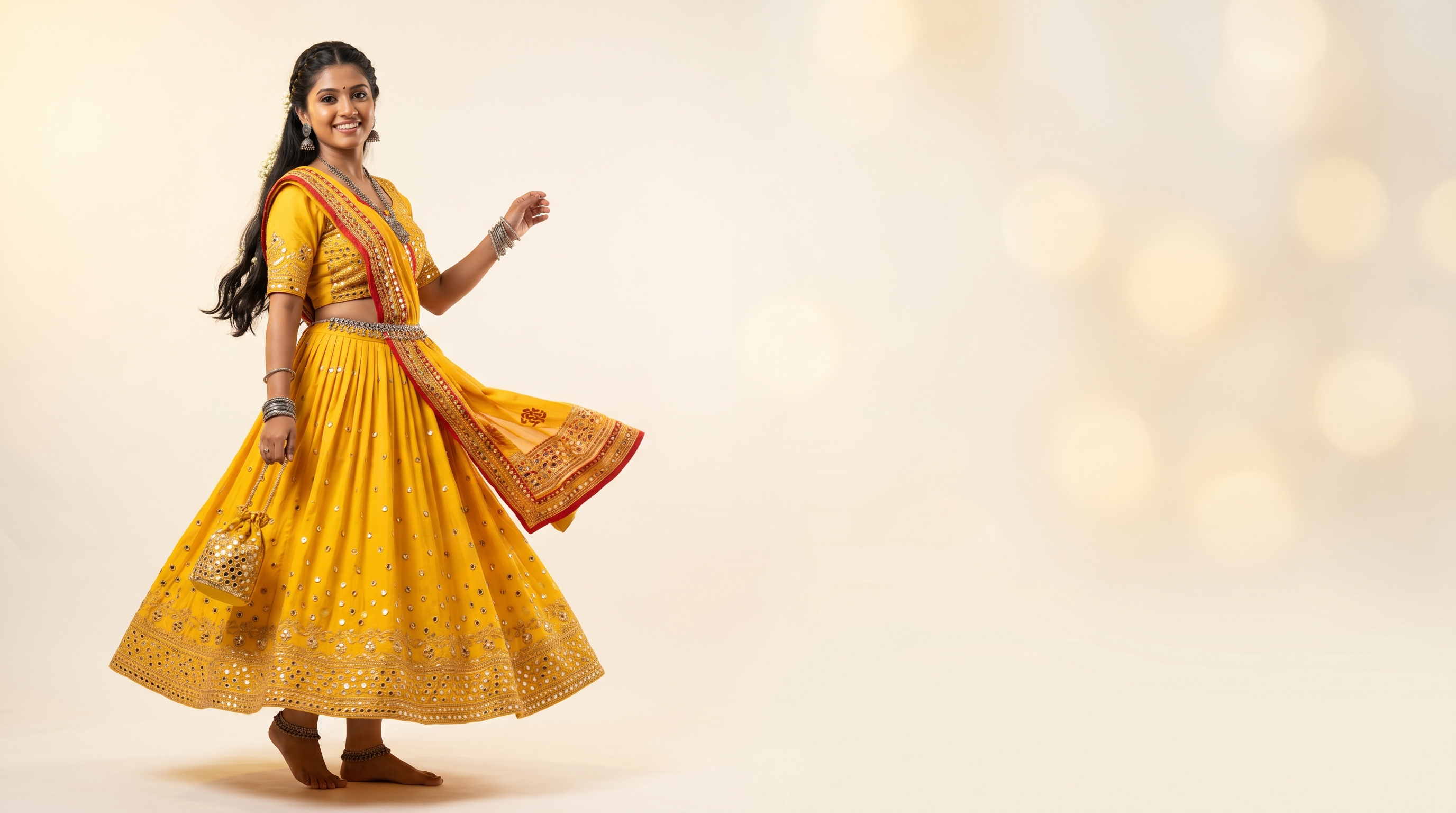
The chaniya choli is the Navratri volume garment. The flared skirt with mirror-work or gota patti detail anchors every look. Render at 3:4 portrait, full-length, with enough bottom-of-frame to show the skirt flare in motion. Square crops kill the silhouette — see the rejection-traps section.
Ghaghra — 15–20% of SKUs
Ghaghras span the heavier, fuller-flared traditional skirts often paired with embroidered cholis. They photograph best at full-length with the model in a slight twist pose, which catches the flare and the dupatta drape in one frame.
Kediyu (men's) — 5–10% of SKUs
The men's side of Navratri is small but consistent: white kediyu with churidar or dhoti, traditional Gujarati embroidery at the neckline, and a coordinating turban for the garba-night look. Brands shipping the bride + groom pre-wedding catalog often pair kediyu SKUs with women's chaniya choli at matching mirror-work palette.
Traditional jewelry crossover — 5–10% of SKUs
Oxidized silver, kundan and traditional Gujarati jewelry (haar, jhumka, kamarbandh) cross-sell into the Navratri look. The jewelry crossover is the margin expander on premium Navratri catalogs; see the Karva Chauth bridal campaign shoot guide for the parallel suhag-jewelry crossover playbook.
Multi-look production — how do you produce nine palette-distinct looks with one model?
Navratri's production challenge is producing nine palette-distinct looks that share a single model identity. The standard studio answer is nine shoot days, nine hair-and-makeup cycles, and one continuity supervisor. Kraftr's answer is anchor → fan-out chaining: the Day-1 hero render becomes the visual reference for Days 2–9, locking model identity while changing palette and garment per day. This is the post's production-side moat.
In practice, the brand renders the Day-1 yellow chaniya choli first — that's the anchor. Days 2 through 9 each reference that anchor's pixels for face, hair, makeup and skin tone, while the prompt swaps the chaniya choli flat-lay reference and color palette. The result is nine looks that share editorial coherence without nine shoot days. We've seen brands ship a full nine-day Navratri lookbook in 24–48 hours of active render time with Kraftr's fidelity-first pipeline.
What are the marketplace ad specs for Navratri?
Navratri marketplace specs match year-round specs for primary slots — Myntra 3:4 portrait, Flipkart 1:1 + portrait alternates, AJIO 1:1, Meesho 1:1, Nykaa Fashion 3:4 — but festive SKUs benefit from hero renders at 2,000+ px on the long edge so mirror-work and gota patti detail read cleanly at QC. Below is the per-marketplace spec table for Navratri uploads. For year-round cross-platform specs, see marketplace product photo specs 2026.
| Marketplace | Slot 1 (hero) | Aspect ratio | Min dimensions | Festival-specific |
|---|---|---|---|---|
| Myntra | Full-length on-model, white BG | 3:4 portrait | 1,500 × 2,000 px (hero); 2,000 × 2,000+ for EORS | Mirror-work fidelity at 2K+ [VERIFY: Myntra Partner Portal] |
| Flipkart Fashion | 1:1 white BG + 4:5 portrait alternates | 1:1 + portrait alternates | 1,000 × 1,000 (zoom threshold); 2,000+ for HD | Big Billion Days HD-bias [VERIFY: Flipkart Seller Hub] |
| AJIO | 1:1 + 4:5 alternates | 1:1 + 4:5 | 1,200 × 1,200 (min) | Big Bold Sale [VERIFY: AJIO seller portal] |
| Meesho | 1:1, garment fills 80%+ frame | 1:1 | 1,200 × 1,200 (min) | Mass-market volume — price emphasis over render fidelity |
| Nykaa Fashion | 3:4 portrait on-model | 3:4 portrait | 1,500 × 2,000 (hero) | Pink Friday — premium-look bias |
| Amazon India | 1:1 white BG, full product visible | 1:1 | 1,000 × 1,000 (min); 1,600 × 1,600 (recommended) | Great Indian Festival — main image white BG |
For the underlying Myntra primary-slot rules, see the Myntra image guidelines guide.
What are the rejection traps for chaniya choli catalogs?
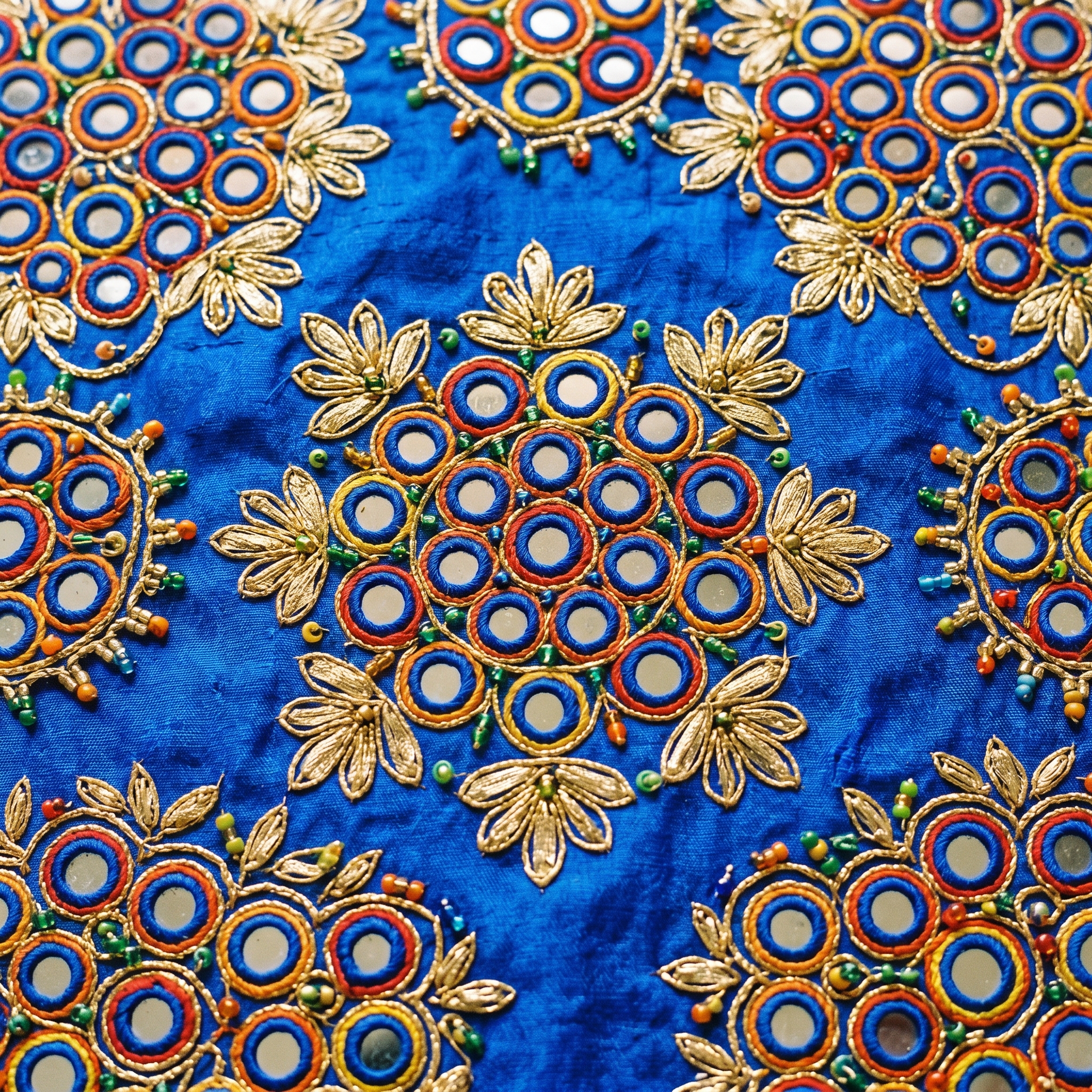
Navratri catalogs get rejected for predictable, garment-specific reasons. The mirror-work resolution trap is the single most common on Myntra and Flipkart — small mirror tiles look "blurry" to QC if the hero render is below 2K. Run the pre-flight checklist below before the Aug 30 shoot-by date.
- Mirror-work mis-read as blurry at 1,500 px. Render hero at 2,000+ px on the long edge. Small mirror tiles need the resolution to read.
- Chaniya choli cropped at the skirt hem. Full-length 3:4 portrait required; the skirt flare needs the bottom 30% of the frame.
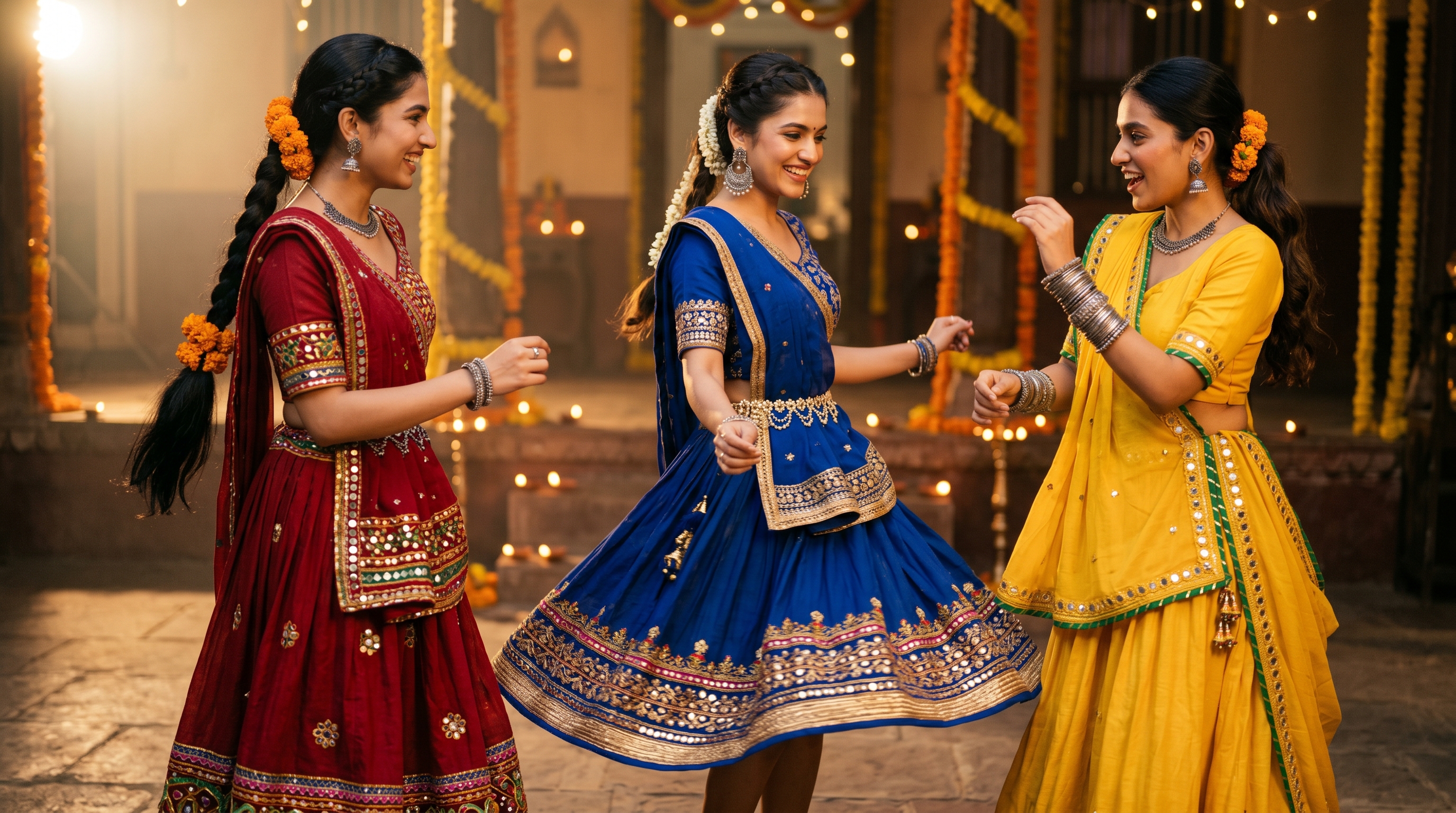
- Multi-look SKUs uploaded as a single SKU. Each day's chaniya choli is its own SKU. Group shots belong in slot 5 (lifestyle), not slot 1.
- Regional palette mismatch. Using a Bengali Durga Puja palette for a Gujarati audience triggers a creative miss; check the regional tradition first.
- Garba-night lifestyle props (dandiya sticks) blocking the SKU in slot 1. Dandiya stays in slot 5 (look-shot) only; the garment must be the visual subject of slot 1.
- Headless cropped above shoulder on slot 1. Myntra mandates real face, full silhouette in the primary slot. Move headless detail crops to slot 4.
- Off-white BG instead of #FFFFFF on Myntra primary. Pure white only on slot 1; light grey on slots 2–4.
- Mirror-work scale lost between hero and slot 4 close-up. Slot 4 (detail) must show the mirror-work at recognizable scale — same density as the flat-lay reference.
Frequently asked questions
When should D2C brands shoot their Navratri 2026 catalog?
Navratri shoots wrap by Aug 30, 2026 — six weeks before the Oct 11 Day-1 peak — to ship the nine-day multi-look catalog live before marketplaces ramp algorithmic boosts at T-30 days. Brands using Kraftr (kraftr.studio) compress the shoot window from four weeks to one to three days; lock dates can slide to mid-September on the recovery path.
What's the traditional color palette for Navratri 2026 by day?
Navratri 2026 follows the traditional Gujarati color sequence: Day 1 yellow, Day 2 green, Day 3 grey, Day 4 orange, Day 5 white, Day 6 red, Day 7 royal blue, Day 8 pink, Day 9 purple. Regional variations exist — cross-check the Drik Panchang panchang for your target audience's regional tradition before publishing.
Should a Navratri catalog show nine separate models or one?
Navratri catalogs work best with one model carried across all nine looks — the anchor identity creates editorial coherence and visual familiarity that boosts conversion on multi-look hubs. Kraftr's anchor → fan-out chaining locks the model identity, hair, and makeup across Days 1–9 while changing only the chaniya choli and palette per day.
Which marketplaces drive the most Navratri volume?
Navratri volume on Meesho leads the chaniya choli mass-market AOV (₹500–₹2,000); AJIO captures mid-premium (₹2,000–₹8,000); Myntra captures premium and bridal-leaning at ₹3,000–₹15,000+. A balanced multi-marketplace Navratri drop ships different SKUs at each marketplace's AOV band rather than the same SKUs across all three.
What's a typical Navratri shoot budget for a 9-look catalog?
Navratri shoots for nine looks in traditional studios run ₹1,000–₹6,000 per image (₹45,000–₹2,70,000 for a 9-day × 5-slot catalog) plus studio, stylist, and hair-and-makeup — typically ₹1.5–4 lakh end-to-end. Kraftr's per-SKU credit cost runs a fraction of that; see Kraftr pricing for live INR rates.
How do you handle chaniya choli flare or volume in a render?
Navratri chaniya choli flare and volume render best in 3:4 portrait at full-length — the skirt's flare needs the bottom 30% of the frame to read correctly. Submitting square crops loses the silhouette. Kraftr renders at 3:4 portrait by default for chaniya choli and ghaghra SKUs across Myntra, Flipkart Fashion, and Nykaa Fashion.
Does Navratri creative need to differ by region?
Navratri creative differs by region: Gujarat skews chaniya choli + garba-night styling; Bengal skews towards Durga Puja and saree; South India observes Golu / Bommai Golu with different ethnic-wear cues. For pan-India D2C brands, the Gujarati chaniya choli interpretation is the dominant marketplace search demand; regional variants ship as supplementary SKUs.
Are mirror-work details captured well in renders at marketplace QC resolution?
Navratri chaniya choli mirror-work details require hero renders at 2,000+ px on the long edge — Myntra and Flipkart QC mis-reads small mirror-work as 'blurry' at 1,500 px or below. Kraftr's fidelity-first pipeline preserves mirror-work density and scale from the flat-lay reference and renders at 2K resolution by default for festive SKUs.
Can you ship the same Navratri catalog to all marketplaces?
Navratri catalog rendering through Kraftr produces every marketplace's required aspect ratio from one reference set — Myntra 3:4 portrait, Flipkart 1:1 + portrait alternates, AJIO 1:1 + 4:5, Meesho 1:1, Nykaa Fashion 3:4. One Navratri shoot, every channel. Channel choice becomes a margin and audience decision rather than a re-shoot decision.
What happens to a Navratri catalog after Day 9?
Navratri catalogs reuse into the Dussehra (Oct 20) window — most chaniya choli + ghaghra SKUs work for both. Add men's kurta-pyjama and women's saree variants for Dussehra. The Navratri catalog's validThrough runs to Nov 2 (Day-9 + 14 days) in JSON-LD, giving the festival page two weeks of post-peak freshness signal.
Ship your 9-day Navratri lookbook by August 30
Kraftr's fidelity-first pipeline produces full Navratri catalogs — chaniya choli, ghaghra, kediyu — on gender-matched models, in all nine traditional color palettes, at marketplace + D2C specs — in days, not weeks. Plan your Navratri drop with Kraftr →
Sources
- Drik Panchang — 2026 festivals list — Navratri 2026 dates verified Oct 11 – Oct 19.
- Myntra image size & guidelines (2026) — primary-slot rules and EORS-tier specs.
- Marketplace product photo specs 2026 — cross-platform spec table.
- AI vs traditional fashion photoshoot cost — per-image production cost benchmarks.
- Indian fashion seasonal drop calendar — the full 2026 drop calendar.
- Navratri catalog photography landing — production walk-through with render gallery.
- AJIO seller portal (gated) — Big Bold Sale 2026 dates
[VERIFY]. - Regional Gujarati Navratri tradition source for color-per-day sequence
[VERIFY].
About the author: the Kraftr team ships fidelity-first catalog production for D2C fashion brands selling on Indian marketplaces.
Last verified: 2026-05-22.
Frequently asked questions
- When should D2C brands shoot their Navratri 2026 catalog?
- Navratri shoots wrap by Aug 30, 2026 — six weeks before the Oct 11 Day-1 peak — to ship the nine-day multi-look catalog live before marketplaces ramp algorithmic boosts at T-30 days. Brands using Kraftr's fidelity-first pipeline compress the shoot window from four weeks to one to three days; lock dates can slide to mid-September on the recovery path.
- What's the traditional color palette for Navratri 2026 by day?
- Navratri 2026 follows the traditional Gujarati color sequence: Day 1 yellow, Day 2 green, Day 3 grey, Day 4 orange, Day 5 white, Day 6 red, Day 7 royal blue, Day 8 pink, Day 9 purple. Regional variations exist — cross-check the Drik Panchang panchang for your target audience's regional tradition before publishing.
- Should a Navratri catalog show nine separate models or one?
- Navratri catalogs work best with one model carried across all nine looks — the anchor identity creates editorial coherence and visual familiarity that boosts conversion on multi-look hubs. Kraftr's anchor → fan-out chaining locks the model identity, hair, and makeup across Days 1–9 while changing only the chaniya choli and palette per day.
- Which marketplaces drive the most Navratri volume?
- Navratri volume on Meesho leads the chaniya choli mass-market AOV (₹500–₹2,000); AJIO captures mid-premium (₹2,000–₹8,000); Myntra captures premium and bridal-leaning at ₹3,000–₹15,000+. A balanced multi-marketplace Navratri drop ships different SKUs at each marketplace's AOV band rather than the same SKUs across all three.
- What's a typical Navratri shoot budget for a 9-look catalog?
- Navratri shoots for nine looks in traditional studios run ₹1,000–₹6,000 per image (₹45,000–₹2,70,000 for a 9-day × 5-slot catalog) plus studio, stylist, and hair-and-makeup — typically ₹1.5–4 lakh end-to-end. Kraftr's per-SKU credit cost runs a fraction of that; see /pricing for live INR rates.
- How do you handle chaniya choli flare or volume in a render?
- Navratri chaniya choli flare and volume render best in 3:4 portrait at full-length — the skirt's flare needs the bottom 30% of the frame to read correctly. Submitting square crops loses the silhouette. Kraftr renders at 3:4 portrait by default for chaniya choli and ghaghra SKUs across Myntra, Flipkart Fashion, and Nykaa Fashion.
- Does Navratri creative need to differ by region (Gujarat vs Bengal vs South)?
- Navratri creative differs by region: Gujarat skews chaniya choli + garba-night styling; Bengal skews towards Durga Puja and saree; South India observes Golu / Bommai Golu with different ethnic-wear cues. For pan-India D2C brands, the Gujarati chaniya choli interpretation is the dominant marketplace search demand; regional variants ship as supplementary SKUs.
- Are mirror-work details captured well in renders at marketplace QC resolution?
- Navratri chaniya choli mirror-work details require hero renders at 2,000+ px on the long edge — Myntra and Flipkart QC mis-reads small mirror-work as 'blurry' at 1,500 px or below. Kraftr's fidelity-first pipeline preserves mirror-work density and scale from the flat-lay reference and renders at 2K resolution by default for festive SKUs.
- Can you ship the same Navratri catalog to all marketplaces?
- Navratri catalog rendering through Kraftr produces every marketplace's required aspect ratio from one reference set — Myntra 3:4 portrait, Flipkart 1:1 + portrait alternates, AJIO 1:1 + 4:5, Meesho 1:1, Nykaa Fashion 3:4. One Navratri shoot, every channel. Channel choice becomes a margin and audience decision rather than a re-shoot decision.
- What happens to a Navratri catalog after Day 9?
- Navratri catalogs reuse into the Dussehra (Oct 20) window — most chaniya choli + ghaghra SKUs work for both. Add men's kurta-pyjama and women's saree variants for Dussehra. The Navratri catalog's validThrough runs to Nov 2 (Day-9 + 14 days) in JSON-LD, giving the festival page two weeks of post-peak freshness signal.
About the author
Kraftr is a fidelity-first AI catalog production tool for D2C fashion and jewelry brands selling on Indian marketplaces. We publish marketplace specs and production playbooks based on the rules our customers ship against every week.
More about Kraftr