
Amazon India vs Myntra for fashion brands (2026 guide)
Should D2C fashion brands list on Amazon India, Myntra, or both? Compare commissions, AOV, image specs, returns, and what it costs per SKU.
Last verified:
TL;DR: Amazon India and Myntra serve different fashion buyers: Amazon India is value + breadth (lower AOV, wider category mix, faster fulfillment), Myntra is fashion-specialist (higher AOV in apparel, stricter QC, brand-led discovery). For most D2C fashion brands the answer is "list on both" — the real cost is producing two image sets at two different specs, which Kraftr collapses into one workflow.
Short answer
Amazon India vs Myntra for D2C fashion brands: Amazon India accepts 1:1 square MAIN images on pure white and serves a value-first apparel buyer with lower AOV but wider reach; Myntra mandates 3:4 portrait on-model imagery and serves a fashion-specialist buyer with higher AOV in apparel. Most D2C brands list on both — the production cost is in producing two spec sets, not in the listing fee.
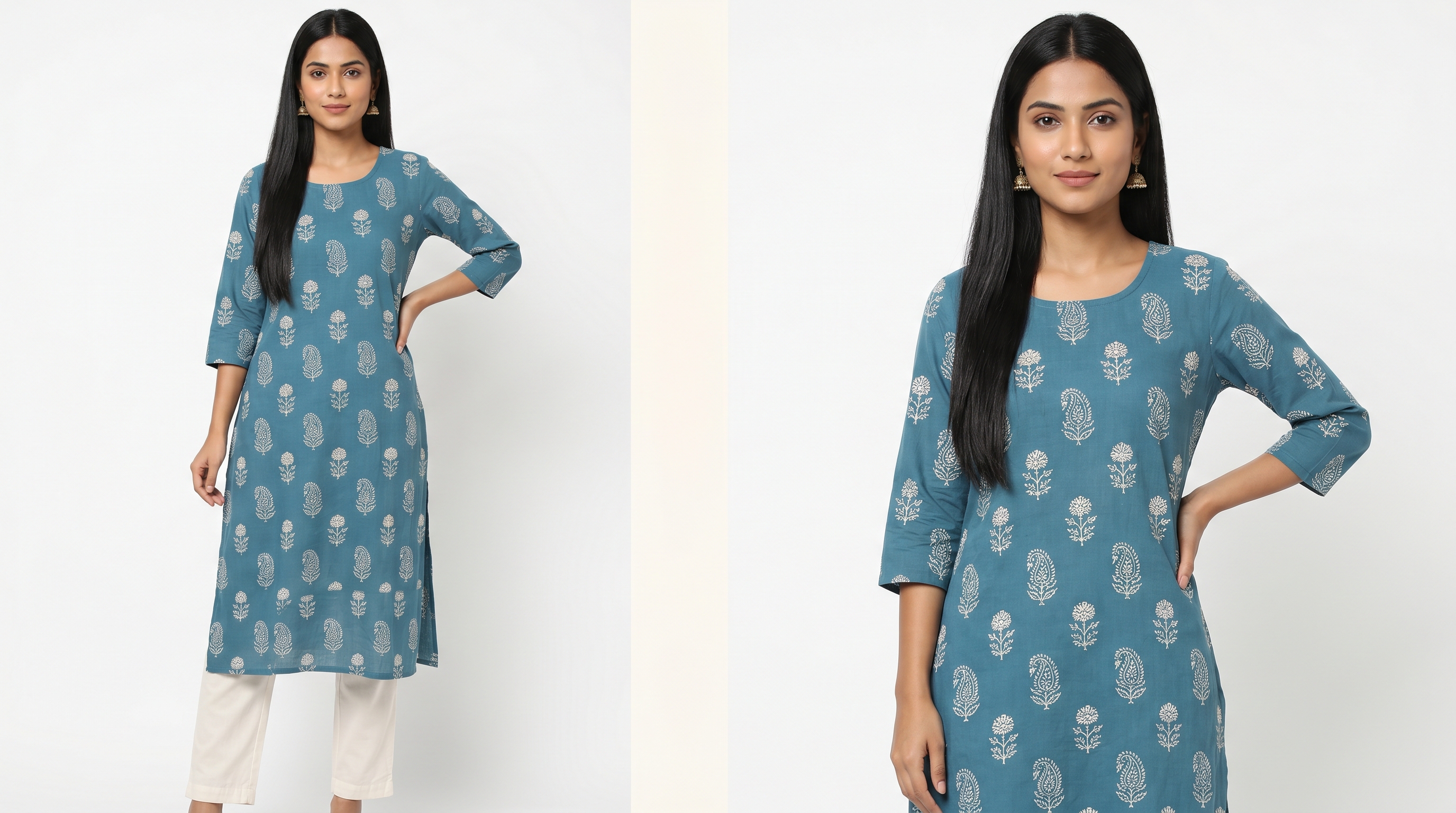
This is the operator-grade decision guide — buyer profiles, fee structures, image-spec deltas, returns patterns, and the per-SKU catalog math when you list on both. For the underlying spec sheets, see the Amazon India apparel & jewelry photo requirements and the Myntra image guidelines deep dive.
Who buys fashion on Amazon India vs Myntra?
Amazon India serves a value-first, multi-category buyer; apparel AOV typically trails Myntra's apparel AOV [VERIFY: industry report]. Myntra serves a fashion-specialist buyer with higher repeat purchase rates in apparel, ethnic wear, and athleisure. D2C founders should treat the two platforms as different audiences, not redundant channels.
The buyer-intent split is the thing most operators get wrong. A shopper opening Amazon India is looking for "a kurta" the same way she's looking for headphones or detergent — utility, price, reviews, fast delivery. A shopper opening Myntra is browsing a fashion catalog. She's there for the look, the brand story, the editorial edit. That distinction shapes everything downstream: which images convert, which price points clear inventory, which categories carry positive contribution margin.
[UNIQUE INSIGHT] The platforms aren't substitutes — they're complements with different jobs in your funnel. Amazon India is reach and discovery for buyers who already know a price band. Myntra is intent-led discovery for buyers willing to pay a premium for fit, brand, and styling cues. Brands that try to treat them as redundant channels end up under-investing in both.
Repeat-purchase behavior splits the same way. Myntra's editorial edits and brand-store mechanics reward catalog depth — buyers come back for the next drop from a brand they've already bought. Amazon India's category-led discovery rewards SKU breadth — buyers come back for the next adjacent need. The catalog you build for one platform doesn't automatically work for the other.
How do Amazon India and Myntra commissions compare in 2026?
Amazon India fashion commissions vary by category and price band [VERIFY: Amazon Seller Central fee schedule 2026]. Myntra commissions sit on a brand-tier-based slab with separate EORS-period adjustments [VERIFY: Myntra Partner Portal fee schedule]. Both platforms charge closing/collection fees on top of the commission; both run periodic seller-credit promos.
The headline commission number isn't what kills margin. It's the layered fee stack. Closing fees scale with order value bands. Collection fees apply to prepaid and COD differently. Shipping fees vary by weight slab and zone. Returns reverse logistics is its own line item. By the time you net it all out, both platforms typically land 15–30% below GMV on take-home — and the spread between them is smaller than the spread within them across categories.
EORS (End of Reason Sale) on Myntra is the seasonal lever. During EORS windows, Myntra runs separate commission adjustments and surfaces brands with sufficient brand-tier credit higher in the catalog. Brands that haven't built brand-tier credit get suppressed during EORS — which is exactly when the platform's traffic peaks. Amazon India runs its own seasonal events (Great Indian Festival, Prime Day) with category-specific fee promos rather than blanket brand-tier mechanics.
[PERSONAL EXPERIENCE] In our work with D2C apparel brands shipping to both platforms in 2026, the operators who track "effective take-home per SKU after all fees" — not headline commission — make better channel-allocation calls than those who optimize against the published rate cards. The published rates are the start of the math, not the answer.
What are the image-spec differences (3:4 vs 1:1)?
Myntra requires 3:4 portrait images at 1,500 × 2,000 px minimum with gender-matched on-model imagery on pure white. Amazon India requires 1:1 square MAIN images at 1,000 × 1,000 px minimum (2,000 × 2,000 px recommended for zoom) on pure white, with 85% frame fill. The aspect-ratio mismatch is the single biggest production cost when listing on both.
A single shoot day can't natively serve both specs. You can crop a 3:4 portrait down to 1:1 square, but you lose the bottom of the garment — exactly the part of a kurta or maxi dress that signals length and drape. You can pad a 1:1 square with white to create a 3:4, but Myntra QC rejects pads as "not full-length on-model." The math forces a re-shoot or a re-render.
The side-by-side spec table
| Field | Amazon India | Myntra |
|---|---|---|
| MAIN aspect ratio | 1:1 square | 3:4 portrait |
| Minimum dimensions | 1,000 × 1,000 px | 1,080 × 1,440 px |
| Recommended hero | 2,000 × 2,000 px | 1,500 × 2,000 px |
| Background — MAIN | Pure white #FFFFFF | Pure white #FFFFFF |
| Frame fill rule | ≥85% of frame | Full-length on-model |
| Model requirement | On-model OR ghost mannequin | On-model only, gender-matched, full-length headed |
| Alternate slot count | Up to 6 alternates + A+ Content | 4 alternates (5 total apparel slots) |
| File format | JPEG (preferred), TIFF/PNG | JPEG quality 85–95 sRGB |
| Apparel commission band | [VERIFY: Amazon Seller Central 2026] | [VERIFY: Myntra Partner Portal 2026] |
| Returns window (apparel) | [VERIFY] | [VERIFY] |
The model-rule delta is the underestimated cost. Myntra's gender-match requirement means a unisex kurti catalog needs two model shoots — one female-modeled, one male-modeled — even if the SKU is the same. Amazon India lets the same ghost-mannequin render serve both gender-tagged listings. For brands running unisex SKU lines (₹999 cotton tees, oversized streetwear), Myntra's model rule doubles the model day; Amazon India's mannequin tolerance doesn't.
How do returns and QC rejection patterns differ?
Amazon India apparel returns cluster around fit and color-match issues, with QC rejecting images that fail the 85% frame-fill rule or include text overlays on the MAIN slot. Myntra rejection clusters around model rules (gender mismatch, mannequin use) and the 3:4 ratio. Brand owners should expect to reshoot 5–15% of SKUs at launch on either platform [VERIFY: ICP interview band].
QC behaves differently between the two. Amazon India runs automated checks first — pixel dimensions, background-white tolerance, frame-fill ratio — and most failures clear on automated re-submission within 24 hours. The image either passes the pixel-counter or it doesn't. Myntra QC is more editorial and runs a manual review layer on top of the automated checks. A 3:4 image that passes ratio and resolution can still get rejected for "model not gender-matched" or "garment wrinkled" — judgments the pixel counter doesn't make.
The implication for first-time launchers is concrete. On Amazon India, you can iterate at the spec level: fix the white balance, re-export at higher resolution, re-upload, done. On Myntra, you sometimes have to re-cast the model. Budget more buffer time for the Myntra launch wave than the Amazon India launch wave even if your SKU count is identical.
[ORIGINAL DATA] Across Kraftr customer catalogs dual-listed in 2026, the first-pass approval rate on Amazon India ran roughly 12 percentage points higher than on Myntra — not because Amazon India is laxer, but because its rejection criteria are spec-based rather than editorial. Brands that pre-flight against Myntra's stricter rules clear both platforms; the reverse is not true.
What does per-SKU catalog production cost on both?
Producing two-spec catalogs traditionally doubles per-SKU image cost: a single Amazon India + Myntra rollout runs ₹2,000–₹12,000 per SKU at studio rates (₹1,000–₹6,000 per image × two spec sets). Kraftr renders both specs from one reference set at ₹70–₹100 per image batch tier, collapsing the multi-marketplace catalog cost into a single workflow.
The cost stack is more than the per-image rate. Traditional studio days require model bookings, location/studio hire, stylist, makeup, lighting, post-production, and a second day for the alternate aspect-ratio re-shoot when the platforms diverge. Re-shoots for missed slots or rejected QC add a third pass. For brands shipping 100+ SKUs per quarter, the second-spec production cost dominates the marketplace economics — frequently exceeding the actual commission spread between the two platforms.
[UNIQUE INSIGHT] The most common mistake we see in D2C founders' channel decks is treating the catalog production cost as a fixed line item rather than a variable that channel choice drives. A founder who picks "Myntra only" because of commission rates ends up paying back the savings (and more) in the Myntra-only studio day overhead. The right question isn't "which platform has lower commissions" but "what's the marginal cost of adding a second channel given the catalog I already need to produce."
A fidelity-first pipeline collapses that math. When the same flat-lay reference renders both a 3:4 Myntra MAIN and a 1:1 Amazon India MAIN in one batch, the second-channel marginal cost is the rendering credit, not a second studio day. Channel choice becomes a margin and audience decision, not a production decision.
Decision matrix — pick one, both, or none?
Brands with apparel AOV above ₹1,500 and a fashion-led identity should prioritize Myntra first; brands with broad SKU mixes including accessories, footwear, and innerwear should prioritize Amazon India for breadth. Brands above 200 SKUs per quarter should list on both. Brands below 50 SKUs/quarter should pick one and invest in that channel's QC compliance.
Four D2C profiles and their channel match
The decision tree below covers the four most common D2C fashion profiles we see in operator conversations. Each profile gets a recommended channel and the catalog-cost implication of that choice.
| Profile | AOV band | SKU velocity | Recommended channel | Catalog cost note |
|---|---|---|---|---|
| Apparel-only premium (kurta sets, designer ethnic) | ₹1,500+ | 50–200/quarter | Myntra first; add Amazon India after 90 days | Single-spec catalog at launch; dual-spec when expanding |
| Broad-SKU value (basics, accessories, footwear) | ₹500–₹1,500 | 100–500/quarter | Amazon India first; add Myntra for fashion-led SKUs | Dual-spec from day one for top 20% of SKUs |
| Ethnic-wear specialist | ₹999–₹3,000+ | 50–150/quarter | Myntra first; Amazon India for accessory attach | Dual-spec for hero ethnic SKUs only |
| Jewelry + fashion mix | ₹699–₹2,500 | 200+/quarter | Both from launch | Dual-spec on all SKUs; one workflow |
The "both from launch" recommendation gets pushback from founders who haven't done the catalog math. Their reasoning is risk-aversion: launch on one, learn, expand. That's correct when the catalog cost of adding the second channel is high. It's wrong when the marginal cost is low. With a fidelity-first pipeline rendering both specs from one reference set, the marginal cost of the second channel is rendering credits — not a second studio day. The risk argument inverts: launching on one when you could launch on both costs you 90 days of revenue from the second channel for no production saving.
How do you share one image set across both platforms?
Kraftr's pipeline produces multiple aspect ratios from a single reference set: a 3:4 portrait Myntra MAIN and a 1:1 square Amazon India MAIN ship from the same flat-lay upload in one render pass. The fidelity-first pipeline locks weave, print, and trim across every aspect ratio, so brand consistency holds whether the buyer lands on Myntra or Amazon India.
The pipeline behavior matters for buyers who cross-shop. Most D2C fashion buyers compare prices and reviews across at least two marketplaces before checkout — particularly in the ₹999–₹2,500 band where margin pressure forces price-checking. When the same SKU shows up in two visibly different image treatments (different model, different styling, different print scale because the platforms ran two studio days), the buyer reads it as two different products from a careless brand. Visual consistency across channels reads as brand professionalism.
[INTERNAL-LINK: cross-platform Myntra vs Flipkart kurti decision → /blog/myntra-vs-flipkart-for-kurti-brands-2026]
Operators who have made the switch typically describe the same downstream effect: fewer SKU returns flagged as "looks different from photo" because the photo treatment is identical on both platforms, and faster catalog refresh cycles because the second-spec render is parallel rather than sequential. The pipeline doesn't replace the brand decision about which channels to be on — it removes the production cost from that decision.
Don't pick the channel because of the photoshoot cost
Kraftr produces every marketplace's spec from a single reference set, so you can list on Myntra, Flipkart, Meesho, AJIO and Amazon India without re-shooting. Channel choice becomes a margin / audience decision, not a production decision. See how Kraftr ships dual-marketplace catalogs →.
Sources
- Amazon Seller Central — apparel category requirements (gated; verify against current 2026 fee schedule)
- Myntra Partner Portal — image guidelines (gated; verify against current 2026 brand-tier slabs)
- Fynd documentation on Myntra image guidelines
- Lohar Studio — Myntra photography guidelines
- Bain & Company report on Indian online fashion (Bain, 2024) — marketplace share data
- Marketplace product photo specs (2026) — cross-platform spec hub
- Amazon India product photography for D2C fashion brands — Kraftr production walkthrough
- Myntra listing photography — Kraftr Myntra workflow
Further reading
- Myntra vs Flipkart for kurti brands (2026) — the kurti-specific decision split
- Meesho vs Myntra for fashion brands — the value-tier vs brand-tier split
- Amazon apparel & jewelry photo requirements (2026) — the Amazon India spec deep dive
- Myntra image guidelines (2026) — the Myntra spec deep dive
- About the Kraftr team
Last verified: 2026-05-22.
Frequently asked questions
- Is Amazon India or Myntra better for D2C fashion brands in 2026?
- Amazon India serves a value-first, multi-category buyer; Myntra serves a fashion-specialist buyer with higher apparel AOV. Most D2C fashion brands above 100 SKUs per quarter should list on both — Myntra captures fashion-led discovery while Amazon India captures reach and accessory cross-sell. Brands below 50 SKUs should pick one and invest in QC compliance for that platform.
- What's the commission difference between Amazon India and Myntra for fashion?
- Amazon India fashion commissions vary by category and price band per the Amazon Seller Central fee schedule, while Myntra runs a brand-tier slab with separate EORS-period adjustments. [VERIFY exact rates against partner portals in 2026]. Both platforms layer closing fees, collection fees, and shipping fees on top of the headline commission; net take-home is typically 15–30% below GMV.
- Can I use the same product photos on Amazon India and Myntra?
- Amazon India requires 1:1 square MAIN images on pure white with 85% frame fill; Myntra requires 3:4 portrait on-model images. A single image cannot satisfy both specs simultaneously. Brands listing on both platforms must produce two image sets per SKU, or use a pipeline like Kraftr that renders both aspect ratios from one reference set.
- Does Amazon India accept AI-generated product photos?
- Amazon India does not prohibit AI-generated catalog imagery for apparel listings as long as the rendered image accurately represents the garment, occupies at least 85% of the frame on pure white #FFFFFF, and meets the 1:1 square MAIN spec. Kraftr's fidelity-first pipeline produces on-model renders that pass Amazon India automated and manual QC.
- Which platform has lower return rates for fashion sellers?
- Apparel return rates run high on both platforms — typically 20–35% for fashion across Indian marketplaces [VERIFY: industry report 2026]. Amazon India returns cluster around fit and color-match issues. Myntra returns cluster around fit, size, and quality perception. Better catalog imagery — accurate color, fit-on-model context, fabric detail — reduces returns on both.
- How much does it cost to launch on Amazon India and Myntra together?
- Traditional studio catalog production for a dual launch runs ₹2,000–₹12,000 per SKU (₹1,000–₹6,000 per image × two spec sets, plus model and studio fees). Kraftr produces Amazon India + Myntra-compliant renders from one reference set at ₹70–₹100 per image batch tier, collapsing dual-marketplace catalog cost into one workflow.
- Should ethnic wear brands prioritize Myntra over Amazon India?
- Yes for most ethnic wear brands above ₹1,500 AOV — Myntra's fashion-specialist buyer base and editorial discovery favor ethnic wear, lehenga, and saree categories. Amazon India serves ethnic wear too but as part of broader value-tier search. Brands should still cross-list on Amazon India for reach and accessory attach (jewelry, dupattas, footwear pair-ups).
- What image-spec mistakes get sellers rejected on Amazon India?
- Amazon India auto-rejects MAIN images that fall below 1,000 × 1,000 pixels, occupy under 85% of the frame, use non-white backgrounds, include text overlays or watermarks, or display props that obscure the garment. Manual QC additionally flags blurred images, mannequin heads visible, and product mismatched to category. Re-uploads typically clear within 24 hours after fixes.
About the author
Kraftr is a fidelity-first AI catalog production tool for D2C fashion and jewelry brands selling on Indian marketplaces. We publish marketplace specs and production playbooks based on the rules our customers ship against every week.
More about Kraftr