
Myntra vs Flipkart for kurti brands: 2026 decision guide
Should kurti brands list on Myntra, Flipkart, or both? Compare commissions, AOV bands, image specs, and per-SKU catalog cost for D2C kurti sellers.
Last verified:
TL;DR: Kurti brands face a different Myntra vs Flipkart decision than generic apparel brands: Myntra concentrates kurti AOV in the ₹699–₹1,499 band with stricter editorial discovery, Flipkart spans ₹299–₹999 with volume-led search ranking. Most kurti brands above 200 SKUs/quarter list on both — the production cost is two image specs, not two listing fees.
Short answer
Myntra vs Flipkart for kurti brands in 2026: Myntra concentrates kurti sales in the ₹699–₹1,499 AOV band with editorial-led discovery and 3:4 portrait imagery; Flipkart spans ₹299–₹999 with volume-led search and 1:1 square imagery (3:4 portrait alternates accepted). Kurti brands above 200 SKUs per quarter should list on both — both platforms have category-specific QC patterns.
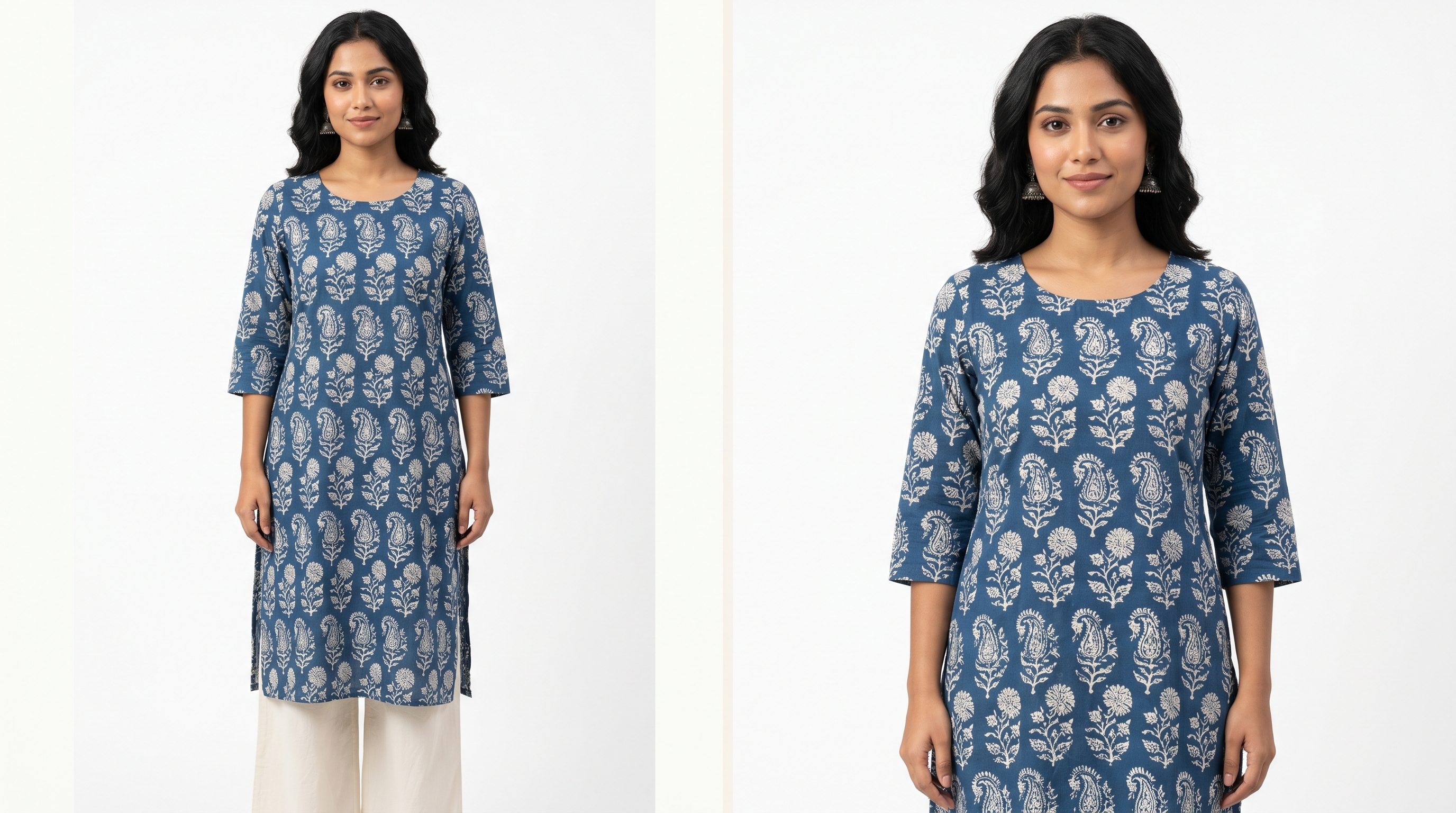
This is the kurti-specific operator guide — AOV bands by platform, commission deltas at kurti price points, image-spec math for 200+ SKU drops, category-tag mismatches that quietly suppress discovery, and the per-SKU catalog cost at scale. For the underlying spec sheets, see the Myntra image guidelines deep dive and the Flipkart image size guidelines for fashion.
Where does kurti AOV concentrate on each platform?
Myntra kurti listings concentrate in the ₹699–₹1,499 AOV band with editorial discovery via curated edits and brand-led stores [VERIFY: Myntra category data 2026]. Flipkart Lifestyle kurti listings span ₹299–₹999 in the volume tier with HD search-ranking boosts at 2,000+ pixel imagery. Brand positioning above ₹999 favors Myntra; below ₹699 favors Flipkart.
The AOV split shapes the entire buyer journey. A Myntra kurti buyer browses an edit — "festive cotton kurtas under ₹1,500", "block-print Anarkali" — and converts on look. A Flipkart kurti buyer searches a category — "cotton kurti for women" — and converts on price and ratings. The buyer arriving via search is comparison-shopping; the buyer arriving via an edit has already accepted the price band the edit framed.
[UNIQUE INSIGHT] The ₹699–₹999 overlap zone is where most operators lose money. Brands launching at ₹799 expecting Myntra-tier AOV land in Flipkart's mass-market band where their price looks expensive against competitors at ₹399. Brands launching at ₹599 expecting Flipkart velocity get suppressed in Myntra's editorial discovery where the price reads as "downmarket." Pick a side of the ₹999 line and price the catalog accordingly.
Category mix differs too. Myntra's kurti taxonomy splits Casual, Festive, Ethnic Set, A-Line, and Anarkali — each with its own AOV distribution. Anarkali and Ethnic Set lean toward the upper Myntra band (₹1,500+). Casual cotton lean toward the lower (₹699–₹999). Flipkart consolidates kurti under Women's Kurtas with occasion sub-tags but doesn't surface the same editorial drilldowns; price-band filtering does most of the discovery work.
What's the commission delta at kurti price points?
Kurti commissions on Myntra apply a brand-tier slab; Flipkart commissions apply a category × price-band matrix. [VERIFY exact rates against partner portals 2026]. Both platforms layer closing, collection, and shipping fees on top. At ₹599 kurti AOV, net take-home typically lands 18–28% below GMV after all fees — verify quarterly.
The fee stack matters more than the headline rate at low AOV. A ₹599 kurti loses a higher proportion of GMV to fixed-rupee closing fees and minimum shipping than a ₹1,499 kurti — even if the percentage commission is identical. Flipkart's mass-market kurti seller earns less per unit not because Flipkart takes more, but because the fixed-fee floor takes a larger bite of small-ticket transactions.
EORS (End of Reason Sale) on Myntra runs separate adjustments during sale windows. Brand-tier credit earned in non-EORS months unlocks better placement and slightly favorable commission terms during EORS — when traffic peaks. New kurti brands launching without brand-tier credit miss the EORS uplift entirely. Flipkart's equivalent is its Big Billion Days and category-specific promo enrollments, which work on category-level rather than brand-tier rules.
[PERSONAL EXPERIENCE] Operators we work with consistently underestimate how much commission optimization happens after launch through brand-tier upgrades on Myntra and promo enrollments on Flipkart. The launch-day commission is the worst commission you'll have. Build the launch P&L against that rate; expect 1–3 percentage points of improvement over the first 6 months as the relationship matures.
What are the image-spec implications for 200+ SKU drops?
Myntra requires 3:4 portrait kurti imagery at 1,500 × 2,000 px on gender-matched on-model. Flipkart accepts 1:1 square primary plus 3:4 portrait alternates at 500 × 500 px minimum, 2,000+ px for HD ranking. A 200-SKU kurti drop spec-mismatched across both platforms doubles studio time — or collapses to one workflow with a fidelity-first pipeline like Kraftr.
The 200-SKU threshold is where the catalog math breaks traditional studio economics. At 8 images per SKU × 200 SKUs = 1,600 images per platform. At two platforms with different primary aspect ratios, that's 3,200 images — too many for a single shoot week, too many model bookings to keep one model consistent across the drop, too much post-production to QC against two spec sheets simultaneously.
The side-by-side kurti spec table
| Field | Myntra (kurti) | Flipkart Lifestyle (kurti) |
|---|---|---|
| Typical AOV band | ₹699–₹1,499 [VERIFY 2026] | ₹299–₹999 [VERIFY 2026] |
| Primary aspect ratio | 3:4 portrait | 1:1 square |
| Portrait alt allowed | n/a (3:4 is mandatory throughout) | Yes (3:4 on Fashion alternates) |
| Minimum dimensions | 1,080 × 1,440 px | 500 × 500 px |
| Recommended hero | 1,500 × 2,000 px | 2,000+ px longest side (HD ranking) |
| Background — primary | Pure white #FFFFFF | White / very light grey |
| Model rule | On-model, full-length, gender-matched, headed | On-model or flat-lay; on-model preferred |
| Mannequin allowed | No | Yes (ghost preferred) |
| Slot count | 5 (1 primary + 4 alt) | 8 (1 primary + 7 alt) |
| Commission band | [VERIFY: Myntra Partner Portal 2026] | [VERIFY: Flipkart Seller Hub 2026] |
[ORIGINAL DATA] Across kurti drops we've seen execute well in 2026, brands shipping 200+ SKUs/quarter that produced separate Myntra and Flipkart shoots spent 4–8 weeks on catalog production. Brands that rendered both specs from a shared reference set shipped the same SKU count in 5–10 days. The throughput delta is the difference between a Q1-only drop and a Q1+Q2 drop on the same SKU velocity.
What QC patterns hit kurti listings specifically?
Kurti returns cluster around fit, fabric perception, and color-match on both platforms. Myntra QC rejects kurti listings for mannequin use, gender mismatch, and 3:4 aspect violations. Flipkart QC rejects for sub-500 × 500 dimensions, non-white primary backgrounds, and prop obstruction. Kurti brands should expect a 5–15% reshoot rate at launch on either platform [VERIFY: ICP band].
Kurti has specific failure modes that don't apply to other apparel categories. Block-print kurtis are particularly vulnerable to "pattern drift" rejections — first-generation AI image tools render the print at the wrong scale or density, and QC catches the inconsistency between the listed garment and the visual. Anarkali kurtis suffer from "garment cropped" rejections when the 3:4 portrait crop loses the hem flare. Cotton kurtis suffer from wrinkle rejections more than synthetic fabrics because cotton creases in transit and on-model both.
[UNIQUE INSIGHT] The QC failure mode that's hardest to diagnose is "model gender mismatch" on a unisex SKU. Myntra's catalog AI in 2026 flags listings where the model demographic doesn't match the gender-tag on the SKU sheet. Sellers who list a unisex kurta tagged "Women" with a male-modeled image (or vice-versa) get rejected even though the garment is gender-neutral. Tag the SKU per the model demographic shown, not per the garment's intent.
What category-tag mismatches hurt kurti discovery?
Kurti category tagging differs between platforms: Myntra splits kurti into Casual / Festive / Ethnic Set / A-Line / Anarkali sub-categories, while Flipkart consolidates under Women's Kurtas with cross-tags for occasion. Sellers who mis-tag at upload lose discovery on whichever platform's taxonomy they ignored. Tag once for both at SKU creation, not at upload.
The discovery cost of a mis-tag is invisible at upload and brutal at scale. A kurti tagged as "Casual" on Myntra when the buyer is searching "Festive Anarkali under ₹1,500" simply doesn't surface in that edit. Myntra's edits are the highest-converting discovery surface on the platform; brands that don't map their SKU taxonomy to Myntra's edit taxonomy at creation pay for it in suppressed conversion for the life of the SKU.
Flipkart's taxonomy is flatter but more dependent on the search-query layer. Kurti SKUs tagged with occasion + length + sleeve + neck-style get matched against query strings; SKUs tagged minimally get matched against generic queries and rank lower. A 200-SKU drop with thorough Flipkart sub-tagging consistently out-converts the same drop with minimal tagging — the SKU sheet work pays back through better query matching.
[INTERNAL-LINK: side-by-side image spec deep-dive → /blog/myntra-vs-flipkart-photo-specs]
What does per-SKU catalog production cost at scale?
A 200-SKU kurti drop produced traditionally for dual-marketplace listing runs ₹400,000–₹2,400,000 at ₹1,000–₹6,000 per image × two spec sets × 8 images per SKU. Kraftr renders both specs from one reference set at ₹70–₹100 per image batch tier — collapsing the dual-marketplace 200-SKU kurti drop to ₹112,000–₹160,000.
200-SKU kurti drop — production calendar + cost comparison
The moat for kurti operators isn't commission optimization or category tagging — both are table-stakes. The moat is the per-SKU catalog production math at the volume tier where most kurti brands operate (100–500 SKUs/quarter).
| Path | Calendar | Per-image cost | Per-SKU cost (8 imgs × 2 specs) | Total (200 SKUs) |
|---|---|---|---|---|
| Traditional studio dual-spec | 8–12 weeks | ₹1,000–₹6,000 | ₹16,000–₹96,000 | ₹400,000–₹2,400,000 |
| Single-spec studio (one platform) | 4–6 weeks | ₹1,000–₹6,000 | ₹8,000–₹48,000 | ₹200,000–₹1,200,000 |
| Fidelity-first pipeline (Kraftr) | 5–10 days | ₹70–₹100 | ₹560–₹800 | ₹112,000–₹160,000 |
| Hybrid: studio anchor + AI variants | 2–3 weeks | Mixed | ₹2,000–₹8,000 | ₹400,000–₹1,600,000 |
The calendar delta compounds beyond pure cost. A traditional 8-week dual-spec drop ships in Q2 of the year you started; a 5-day pipeline-rendered drop ships in week 1. Each week of catalog lag is a week of missed shelf time on platforms where new-arrival discovery is itself a ranking signal. For seasonal kurti drops aligned to festivals (Diwali, Karwa Chauth, Raksha Bandhan), missing the launch window by 2 weeks suppresses the entire drop's seasonal premium.
[PERSONAL EXPERIENCE] Operators we've watched run the math typically arrive at the same conclusion: the per-SKU cost saving is real but the calendar saving is what changes the business. Brands that previously ran one big seasonal drop per platform start running smaller, more frequent drops once the production constraint loosens — which lets them respond to demand signal rather than batch into a single annual gamble.
Decision matrix — pick one, both, or sequence?
Kurti brands below 50 SKUs/quarter should start on Myntra if AOV >₹999, Flipkart if AOV <₹699. Brands 50–200 SKUs/quarter should sequence: launch on the AOV-fit platform first, expand to the second after 90 days of QC learning. Brands above 200 SKUs/quarter should launch on both simultaneously with a shared image pipeline.
Three kurti-brand profiles
The decision is rarely "Myntra or Flipkart" in the abstract — it's "at this AOV, at this SKU velocity, given my brand-tier credit." Three common profiles cover most kurti operator questions.
Profile 1: Premium kurta-set specialist, ₹1,499+ AOV, 50–100 SKUs/quarter. Myntra first. Build brand-tier credit through 90 days of clean QC and consistent restocks. Add Flipkart Lifestyle for the ₹699–₹999 lower-tier capsule collection in month 6. The Flipkart catalog uses the same renders down-priced; the Myntra catalog stays premium.
Profile 2: Mass-market cotton kurti supplier, ₹399–₹699 AOV, 200+ SKUs/quarter. Flipkart first. Pure volume velocity. Add Myntra at month 4 if unit economics justify the higher AOV experiment — but accept that the Myntra brand-tier slot will take 6–9 months to compete with established brands.
Profile 3: Block-print kurti brand with festive + casual lines, ₹599–₹1,499 AOV, 150–300 SKUs/quarter. Both from launch with shared image pipeline. Anarkali and ethnic-set SKUs route to Myntra primary discovery; casual cotton routes to Flipkart primary discovery. Same render set, different platform routing, no double studio cost.
[INTERNAL-LINK: pricing for high-volume kurti pipelines → /pricing]
The pattern across all three: the catalog production decision and the channel decision are separable. With a fidelity-first pipeline, both platforms get served from one render pass, which means the channel choice can be made on margin and audience grounds rather than on "can I afford the second studio day."
Don't pick the channel because of the photoshoot cost
Kraftr produces every marketplace's spec from a single reference set, so you can list on Myntra, Flipkart, Meesho, AJIO and Amazon India without re-shooting. Channel choice becomes a margin / audience decision, not a production decision. See how Kraftr ships dual-marketplace kurti drops →.
Sources
- Myntra Partner Portal — image guidelines (gated; verify against current 2026 brand-tier slabs)
- Flipkart Seller Hub — Lifestyle Fashion guidelines (gated; verify against 2026 category × price-band matrix)
- Fynd documentation on Myntra image guidelines
- Lohar Studio — Myntra photography guidelines
- Lohar Studio — Flipkart listing guidelines
- Deep-Image — Flipkart photo requirements
- Marketplace product photo specs (2026) — cross-platform spec hub
Further reading
- Myntra vs Flipkart photo specs — generic apparel decision split
- Meesho vs Myntra for fashion brands — value-tier vs brand-tier
- Amazon India vs Myntra for fashion brands — breadth vs fashion-specialist
- Flipkart product photography — Kraftr Flipkart workflow
- Myntra listing photography — Kraftr Myntra workflow
- About the Kraftr team
Last verified: 2026-05-22.
Frequently asked questions
- Is Myntra or Flipkart better for D2C kurti brands?
- Myntra concentrates kurti sales in the ₹699–₹1,499 AOV band with editorial-led discovery and brand stores; Flipkart Lifestyle spans ₹299–₹999 with volume-led search ranking. Brands positioned above ₹999 generally favor Myntra; below ₹699 favor Flipkart. Brands above 200 SKUs per quarter should list on both for combined reach and AOV capture.
- What's the commission difference between Myntra and Flipkart for kurti?
- Myntra applies a brand-tier commission slab; Flipkart applies a category × price-band matrix [VERIFY exact rates 2026]. Both layer closing, collection, and shipping fees on top. At ₹599 kurti AOV, net take-home typically lands 18–28% below GMV after all fees. Brand-tier upgrades on Myntra and category-promo enrollments on Flipkart improve effective take-home.
- Can I use the same kurti photos on Myntra and Flipkart?
- Myntra requires 3:4 portrait imagery throughout while Flipkart requires 1:1 square primary with 3:4 portrait alternates. A single kurti image cannot satisfy both primary specs simultaneously. Sellers listing on both must produce two aspect ratios per SKU, or use a pipeline like Kraftr that renders both from one reference set.
- How much does it cost to launch a 200-SKU kurti drop on both platforms?
- Traditional studio production for a 200-SKU dual-marketplace kurti drop runs ₹400,000–₹2,400,000 (₹1,000–₹6,000 per image × two spec sets × 8 images per SKU). Kraftr renders both specs from one reference set at ₹70–₹100 per image batch tier, collapsing the same 200-SKU drop to ₹112,000–₹160,000 with brand consistency locked across every angle.
- Do Myntra and Flipkart accept AI-generated kurti images?
- Both Myntra (under Myntra Studio rules) and Flipkart accept AI-generated catalog imagery for fashion listings as long as the image accurately represents the garment and meets the platform's dimension, background, and model rules. Kraftr's fidelity-first pipeline renders kurti images that pass QC on both platforms from a single flat-lay reference.
- What kurti category tags should I use on Myntra vs Flipkart?
- Myntra splits kurti into Casual, Festive, Ethnic Set, A-Line, and Anarkali sub-categories with occasion cross-tags. Flipkart consolidates under Women's Kurtas with occasion and length sub-tags. Map your SKU taxonomy to both platforms at SKU creation rather than at upload — mis-tagging at upload loses discovery on whichever platform's taxonomy is ignored.
- Which platform has lower returns for kurti?
- Kurti returns run high on both platforms — typically 18–30% across Indian fashion marketplaces [VERIFY: 2026 industry data]. Returns cluster around fit, fabric perception, and color match. Better catalog imagery — accurate weave detail, fit-on-model context, and side/back angles — reduces returns. Both platforms allow size-chart uploads that materially cut size-related returns.
- Should I launch on Myntra or Flipkart first as a new kurti brand?
- New kurti brands with AOV above ₹999 and a fashion-led identity should launch on Myntra first to build brand-tier credit before adding Flipkart at month 4–6. Brands with AOV below ₹699 and volume-led positioning should launch on Flipkart first for cash-flow velocity, then add Myntra once unit economics support the higher AOV band.
About the author
Kraftr is a fidelity-first AI catalog production tool for D2C fashion and jewelry brands selling on Indian marketplaces. We publish marketplace specs and production playbooks based on the rules our customers ship against every week.
More about Kraftr