
Meesho vs Myntra for fashion brands: 2026 decision guide
Meesho or Myntra for your D2C fashion brand? Compare AOV, commissions, image specs, reseller economics, and per-SKU catalog cost in 2026.
Last verified:
TL;DR: Meesho serves a price-sensitive, reseller-driven volume buyer (₹199–₹699 AOV); Myntra serves a brand-aware fashion buyer (₹699–₹3,000+ AOV). The two rarely compete for the same customer. Most brands should pick one based on positioning — but brands running supplier-tier private labels alongside a flagship brand often run both, with separate SKU sets and image pipelines.
Short answer
Meesho vs Myntra for fashion brands: Meesho is reseller-driven volume at ₹199–₹699 AOV with 1:1 square imagery and on-model or flat-lay options; Myntra is brand-discovery fashion at ₹699–₹3,000+ AOV with 3:4 portrait gender-matched on-model imagery. Brands typically pick one based on positioning — Meesho for volume-tier private labels, Myntra for brand-led fashion identities.
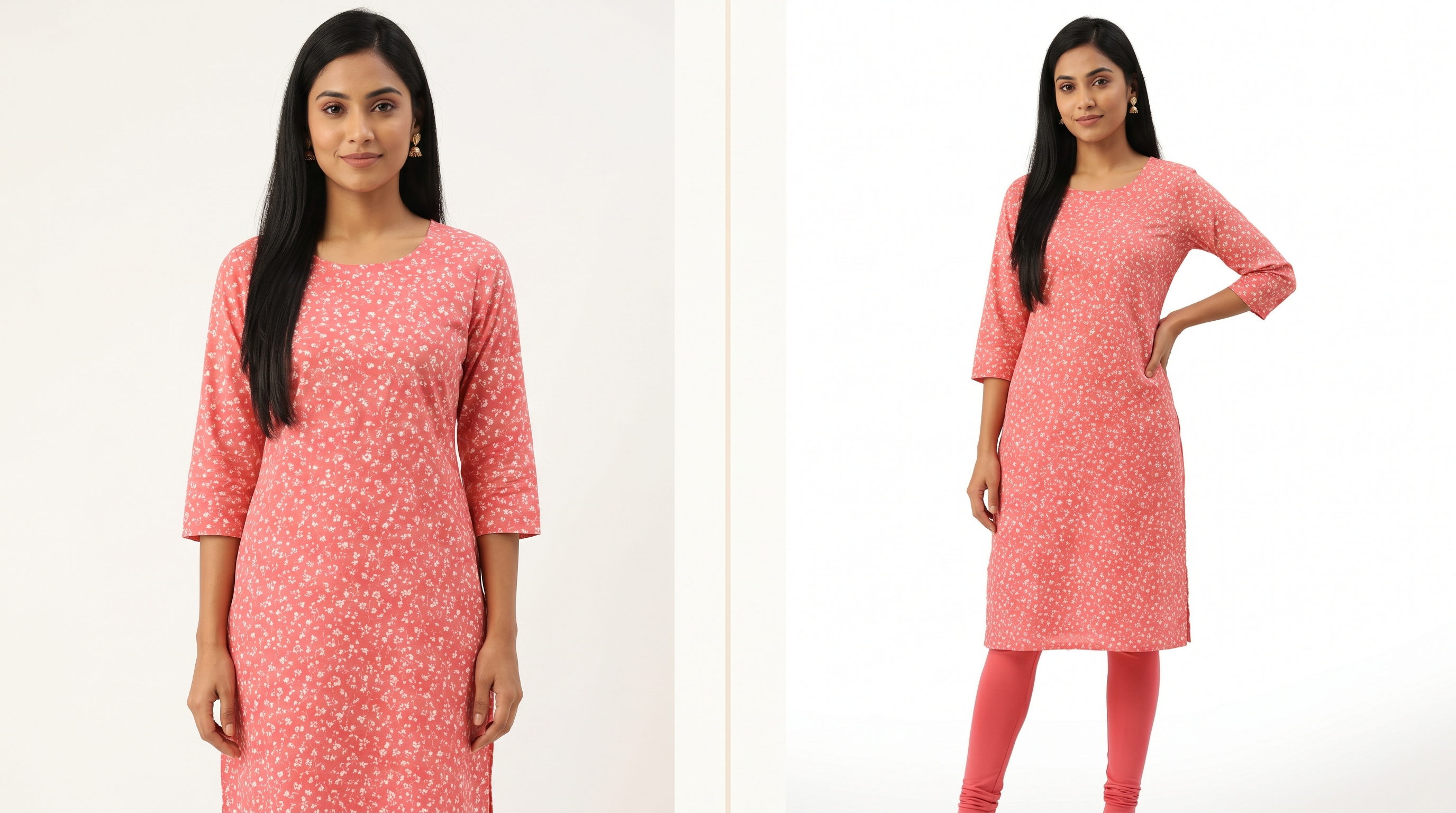
This is the positioning-tier decision guide — buyer adjacency, AOV bands, reseller economics, image-spec deltas, and the per-SKU catalog math when a brand family runs both. For the underlying spec sheets, see the Meesho product image guidelines and the Myntra image guidelines deep dive.
Who buys fashion on Meesho vs Myntra?
Meesho serves a price-sensitive volume buyer routed through a reseller-share funnel; many transactions originate as a reseller's WhatsApp share to an end customer. Myntra serves a fashion-specialist brand-aware buyer with editorial discovery via curated edits and brand stores. The two rarely overlap — a brand chasing Meesho buyers signals positioning that suppresses Myntra conversion, and vice versa.
The reseller-share funnel is the structural difference most operators underweight. A Meesho transaction often isn't direct buyer-to-supplier — it's reseller-to-end-customer, with the reseller picking the SKU from Meesho's catalog and forwarding the product images via WhatsApp. The catalog imagery is doing two jobs: convincing the reseller to share it, and convincing the end customer to buy. On-model imagery converts better at both steps because resellers prefer "catalog-grade" visuals that signal legitimacy to their downstream customers.
Myntra has no equivalent reseller layer. The buyer arrives at the catalog directly through editorial discovery — curated edits, brand stores, category drilldowns — and buys at the AOV the edit framed. The Myntra catalog has to convince one person (the end buyer), not two (the reseller and the buyer). That shapes both the imagery (editorial framing, full-length on-model) and the price tolerance (₹699–₹3,000+ band).
[UNIQUE INSIGHT] The most consequential signal both platforms read is brand positioning consistency. A brand that lists the same SKU at ₹399 on Meesho and ₹999 on Myntra creates a discoverable price-arbitrage that suppresses conversion on both platforms once a buyer cross-checks. Run two distinct SKU sets — different product, different branding, different pricing — or accept one platform's positioning fully.
What AOV bands and category mix do they support?
Meesho fashion AOV concentrates in the ₹199–₹699 band with private-label apparel, ethnic-wear, and basics dominating. Myntra fashion AOV concentrates in the ₹699–₹3,000+ band with branded apparel, ethnic-wear-with-name-recognition, and athleisure dominating. Category mix on Meesho skews toward kurti, sari, and women's basics; on Myntra it spans every fashion vertical with editorial weight on ethnic and athleisure.
The AOV bands don't overlap by accident. Meesho's reseller-share model relies on small-ticket impulse purchases that resellers can share confidently — buyers who balk at ₹699 won't balk at ₹299. The platform's economics depend on volume velocity at the low band. Myntra's brand-store and editorial-edit model relies on considered purchases at ₹999+ where the buyer is treating the marketplace as a fashion destination, not a value channel.
Category mix follows. Meesho's strongest fashion verticals — women's kurti, sari, basics — are categories where buyers are willing to trade brand recognition for price. Myntra's strongest verticals — branded athleisure, designer ethnic, premium streetwear — are categories where brand recognition is the entire point. A premium athleisure brand on Meesho competes against unbranded basics and loses; an unbranded basics line on Myntra competes against branded athleisure and loses.
[PERSONAL EXPERIENCE] We watch operators try to "test Meesho" with their Myntra catalog and conclude that "Meesho doesn't convert for us." The conclusion is correct; the test was wrong. Meesho doesn't convert at the Myntra price point because the Meesho buyer isn't shopping at the Myntra price point. The fair test is: launch a separate private-label SKU set at Meesho-tier pricing, and judge that experiment on its own.
How do commissions and reseller economics compare?
Meesho commissions apply at a category-tier level with low or zero listing fees and a separate reseller-share margin that ships to the resellers, not the supplier [VERIFY: Meesho Supplier Panel 2026]. Myntra commissions apply a brand-tier slab. Effective Meesho take-home is set after reseller margin and platform commission; effective Myntra take-home is set after brand-tier slab plus closing/collection fees.
The reseller-share margin is what most newcomers miss. On a ₹399 Meesho kurti, the supplier doesn't pocket ₹399 minus commission — the reseller takes a margin first, then platform commission applies, then the supplier gets the residual. Effective take-home as a percentage of GMV runs materially lower than the headline commission rate suggests, because the reseller layer is paid before the supplier sees the receipt.
Myntra's brand-tier slab works the opposite way: take-home improves as brand-tier credit accumulates. New brands launch at the highest commission rate; established brands negotiate downward through brand-tier upgrades. EORS-period adjustments add a seasonal layer. Both platforms layer closing, collection, and shipping fees on top of the headline commission — net take-home typically lands 18–35% below GMV after all deductions.
[ORIGINAL DATA] Effective take-home is rarely the headline rate. Across the Meesho and Myntra fashion catalogs we've observed in 2026, the average per-SKU effective take-home was 11–18 percentage points below the platform's published commission rate once closing, collection, shipping, and (on Meesho) reseller-share margins were netted out. Operators who plan launch P&Ls against the headline rate consistently come up short on unit margin.
What are the image-spec differences and shared specs?
Meesho requires 1:1 square at 1,200 × 1,200 pixels minimum on white, with on-model or flat-lay accepted. Myntra requires 3:4 portrait at 1,080 × 1,440 minimum and 1,500 × 2,000 recommended, gender-matched on-model only. The aspect-ratio mismatch is the central production cost when running both — Meesho's 1:1 cannot serve as a Myntra 3:4 without re-rendering.
The side-by-side spec table
| Field | Meesho | Myntra |
|---|---|---|
| Typical AOV band | ₹199–₹699 [VERIFY 2026] | ₹699–₹3,000+ [VERIFY 2026] |
| Primary aspect ratio | 1:1 square | 3:4 portrait |
| Minimum dimensions | 1,200 × 1,200 px | 1,080 × 1,440 px |
| Recommended hero | 1,500 × 1,500 px | 1,500 × 2,000 px |
| Background — primary | White or very light neutral | Pure white #FFFFFF |
| Model requirement | On-model OR flat-lay | On-model only, gender-matched, full-length headed |
| Mannequin allowed | Yes (ghost preferred; visible head OK if cropped) | No |
| Slot count | 6 (1 primary + 5 alt) | 5 (1 primary + 4 alt) |
| Buyer type | Reseller-routed volume buyer | Fashion-specialist brand-aware buyer |
| Commission structure | Category-tier + reseller-share [VERIFY 2026] | Brand-tier slab [VERIFY 2026] |
The model-rule delta carries a real production cost beyond aspect ratio. Meesho's flat-lay tolerance lets suppliers ship 500+ SKU catalogs without model bookings; Myntra's gender-matched on-model requirement forces model days. A supplier running both gets the worst of both worlds at traditional studio rates — the Meesho-only operator's cost advantage disappears when the Myntra catalog requires real models.
How do returns, refunds, and after-sale economics work?
Meesho applies a category-level returns policy with reseller-mediated returns adding friction for the supplier. Myntra applies a 30-day returns window for most apparel categories with platform-handled logistics [VERIFY: Myntra 2026 policy]. Apparel return rates run 18–30% on both platforms; Meesho's reseller-funnel structure shifts some return friction onto the reseller rather than the supplier.
The reseller-mediated return on Meesho is a double-edged sword. Resellers absorb some return-handling friction — they're the customer-facing layer when an end buyer wants to return — which reduces the supplier's direct returns workload. But the supplier still bears the reverse-logistics cost when the return reaches them, and reseller relationships sour when returns spike, which suppresses future sharing. The net effect: a supplier with high returns on Meesho loses reseller pickup faster than they'd lose direct buyer trust on Myntra.
Myntra's platform-handled returns process is more predictable but more expensive per unit. The platform absorbs first-touch customer service and reverse logistics, then debits the supplier. Returns at ₹999 AOV burn more rupee per return than ₹399 AOV returns — but the percentage rate is comparable. Better catalog imagery (accurate fit-on-model, fabric detail, side/back angles) reduces return rates on both platforms.
[UNIQUE INSIGHT] On Meesho specifically, the catalog imagery has a second-order effect on returns: better imagery improves reseller pickup, which improves end-customer-share quality, which lowers expectation mismatch and lowers returns. A supplier optimizing only against the upload-QC pass rate is missing the bigger lever — reseller share rate. Catalog-grade on-model imagery beats compliant-but-thin flat-lay on lifetime supplier economics even when both pass QC.
When does running both private-label + brand make sense?
Brand families operating a flagship D2C identity often run a separate private-label SKU set on Meesho to capture the volume tier without diluting the flagship's positioning. The two SKU sets stay strictly disjoint at product, branding, and pricing — only the back-office production pipeline overlaps. Kraftr renders both 1:1 Meesho and 3:4 Myntra outputs from one reference set when the underlying garment is shared.
The brand-family pattern works when three conditions hold. First, the operator has supply-chain capacity to run two SKU lines without cannibalizing each other (different fabric grades, different cut complexity). Second, the back-office pipeline can produce both image specs without doubling production cost. Third, the brand names and customer-facing positioning stay airtight — no shared name, no shared social presence, no shared influencer roster. Sloppy separation tanks the flagship.
The pattern that doesn't work: listing the flagship brand's SKUs on Meesho at lower prices to "capture volume." That arbitrages the brand's own positioning, gets caught by cross-shopping buyers, and suppresses conversion on the flagship's Myntra storefront. Brand-tier credit on Myntra is built over quarters and lost in weeks; the Meesho experiment isn't worth what it costs the Myntra channel.
[INTERNAL-LINK: Meesho-only catalog production walkthrough → /use-cases/meesho-listings]
Decision matrix — which one (and which first)?
Brands positioned at ₹999+ AOV with fashion-specialist identity → Myntra only or Myntra first. Brands positioned below ₹699 AOV with volume-tier private labels → Meesho only or Meesho first. Brands running both flagship and private-label SKU sets → both platforms, with strict SKU and brand separation. New brands below 50 SKUs → pick one; don't split focus across both at launch.
The positioning-tier 2×2
The cleanest decision frame plots two axes: AOV band (above or below ₹699) and brand identity strength (brand-led vs supplier-led). Each quadrant routes to a different channel strategy. This is the question every D2C founder asks at the catalog-planning stage, and the answer is rarely "either/or."
| AOV band | Brand-led identity | Supplier-led identity |
|---|---|---|
| Above ₹699 | Myntra only (or Myntra first, add Amazon India for breadth) | Re-evaluate positioning — supplier-led at >₹699 typically loses to brand-led at the same price |
| Below ₹699 | Re-evaluate AOV — brand-led at <₹699 suppresses Myntra brand-tier credit | Meesho only (or Meesho first; add Myntra only when launching a separate flagship SKU set) |
The diagonal cells are the trap zones. Brand-led identities priced below ₹699 fight their own positioning every day; the price reads as a downmarket signal that suppresses Myntra discovery without lifting Meesho velocity (because Meesho buyers don't pay extra for brand). Supplier-led identities priced above ₹699 lose to brand-led identities at the same price band — buyers paying ₹999+ are buying brand, not just garment.
The off-diagonal cells are where most successful D2C brands operate. A brand-led, ₹999+ kurti label belongs on Myntra. A supplier-led, ₹299–₹599 kurti label belongs on Meesho. Brands operating in both quadrants run two SKU sets with strict separation — same back-office pipeline, different storefronts.
[INTERNAL-LINK: pricing for high-volume Meesho catalogs → /pricing]
Don't pick the channel because of the photoshoot cost
Kraftr produces every marketplace's spec from a single reference set, so you can list on Myntra, Flipkart, Meesho, AJIO and Amazon India without re-shooting. Channel choice becomes a margin / audience decision, not a production decision. See how Kraftr ships Meesho-scale catalogs →.
Sources
- Meesho Supplier Panel — image and listing guidelines (gated; verify against 2026 category-tier commissions and reseller-share margin)
- Myntra Partner Portal — image guidelines (gated; verify against 2026 brand-tier slabs)
- Fynd documentation on Myntra image guidelines
- Lohar Studio — Myntra photography guidelines
- Marketplace product photo specs (2026) — cross-platform spec hub
- Meesho product image guidelines (2026) — Meesho spec deep dive
Further reading
- Myntra vs Flipkart for kurti brands (2026) — kurti-specific decision
- Amazon India vs Myntra for fashion brands — breadth vs fashion-specialist
- Nykaa Fashion vs Myntra for premium brands — premium-tier decision
- Meesho product photography — Kraftr Meesho workflow
- Myntra listing photography — Kraftr Myntra workflow
- About the Kraftr team
Last verified: 2026-05-22.
Frequently asked questions
- Is Meesho or Myntra better for D2C fashion brands?
- Meesho serves a price-sensitive volume buyer at ₹199–₹699 AOV through a reseller-share funnel; Myntra serves a fashion-specialist brand buyer at ₹699–₹3,000+ AOV through editorial discovery. The two rarely target the same customer. Brand-led D2C identities should default to Myntra; supplier-tier or private-label catalogs should default to Meesho. Few brands should compete on both fronts simultaneously.
- Can a brand sell on both Meesho and Myntra without hurting positioning?
- Brands can sell on both with strict SKU and brand separation. Brand families running a flagship D2C identity often spin a separate private-label SKU set for Meesho to capture the volume tier without diluting flagship positioning. The two SKU sets stay disjoint at product, branding, and pricing — only the back-office production pipeline can overlap if a fidelity-first pipeline renders both specs from one reference.
- What's the commission difference between Meesho and Myntra for fashion?
- Meesho applies a category-tier commission with low or zero listing fees and a separate reseller-share margin shipped to resellers, not suppliers. Myntra applies a brand-tier commission slab with closing and collection fees on top. [VERIFY exact rates against partner portals 2026]. Effective take-home after all deductions sits 18–35% below GMV on both platforms.
- Can I use the same product photos on Meesho and Myntra?
- Meesho requires 1:1 square imagery at 1,200 × 1,200 pixels minimum while Myntra requires 3:4 portrait at 1,500 × 2,000 pixels recommended. A single image cannot satisfy both primary specs. Sellers listing on both platforms must produce two aspect ratios per SKU, or use a pipeline like Kraftr that renders both from one reference set.
- Should I start on Meesho or Myntra as a new D2C fashion brand?
- Start where your positioning fits. Brand-led identities with AOV above ₹999 should start on Myntra to build brand credit. Supplier-tier private labels with AOV below ₹699 should start on Meesho for volume velocity. Don't split focus across both at launch — pick one, hit 100+ SKUs of QC compliance there, then evaluate adding the second.
- Do Meesho and Myntra accept AI-generated product images?
- Both platforms accept AI-generated catalog imagery as long as the rendered image accurately represents the product and meets the platform's dimension, background, and model rules. Myntra requires compliance with Myntra Studio rules (gender-match, full-length, 3:4). Meesho requires 1:1 at 1,200 × 1,200 pixel minimum. Kraftr renders both specs from a single flat-lay reference.
- Does Meesho require on-model photos or are flat-lays acceptable?
- Meesho accepts both on-model and flat-lay imagery at the seller's choice. On-model imagery correlates with higher reseller-share conversion because resellers prefer catalog-grade visuals for their downstream WhatsApp share to end customers. High-volume Meesho suppliers often mix on-model primaries with flat-lay alternates to balance reseller pickup against production throughput.
- What's the per-SKU catalog cost difference between Meesho and Myntra at scale?
- Traditional studio production runs ₹400,000–₹2,400,000 per platform spec set at 500-SKU catalog scale (₹1,000–₹6,000 per image × 4–8 images per SKU). Kraftr produces both Meesho 1:1 and Myntra 3:4 specs from one reference set at ₹70–₹100 per image batch tier — a 500-SKU dual-platform catalog typically lands at ₹140,000–₹400,000 total.
About the author
Kraftr is a fidelity-first AI catalog production tool for D2C fashion and jewelry brands selling on Indian marketplaces. We publish marketplace specs and production playbooks based on the rules our customers ship against every week.
More about Kraftr