
Nykaa Fashion vs Myntra for premium brands (2026 guide)
Premium D2C fashion brand: Nykaa Fashion or Myntra? Compare beauty-adjacent buyer overlap, image specs, commissions, and Nykaa Luxe positioning.
Last verified:
TL;DR: Premium Indian fashion brands face a positioning-tier decision between Myntra (fashion-specialist breadth + editorial edits) and Nykaa Fashion (beauty-adjacent buyer overlap + Nykaa Luxe tier). Brands whose customer cross-shops beauty favor Nykaa Fashion; brands whose customer cross-shops fashion breadth favor Myntra. Luxe-tier brands often list on both with editorial-grade catalog imagery.
Short answer
Nykaa Fashion vs Myntra for premium brands: Nykaa Fashion serves a beauty-adjacent buyer who cross-shops with Nykaa beauty, expecting editorial-grade catalog imagery; Myntra serves a fashion-specialist buyer with broader category mix and brand-store discovery. Premium brands above ₹1,500 AOV pick Nykaa Fashion when buyer overlaps with beauty, Myntra when fashion breadth dominates. Nykaa Luxe imposes the strictest editorial QC.
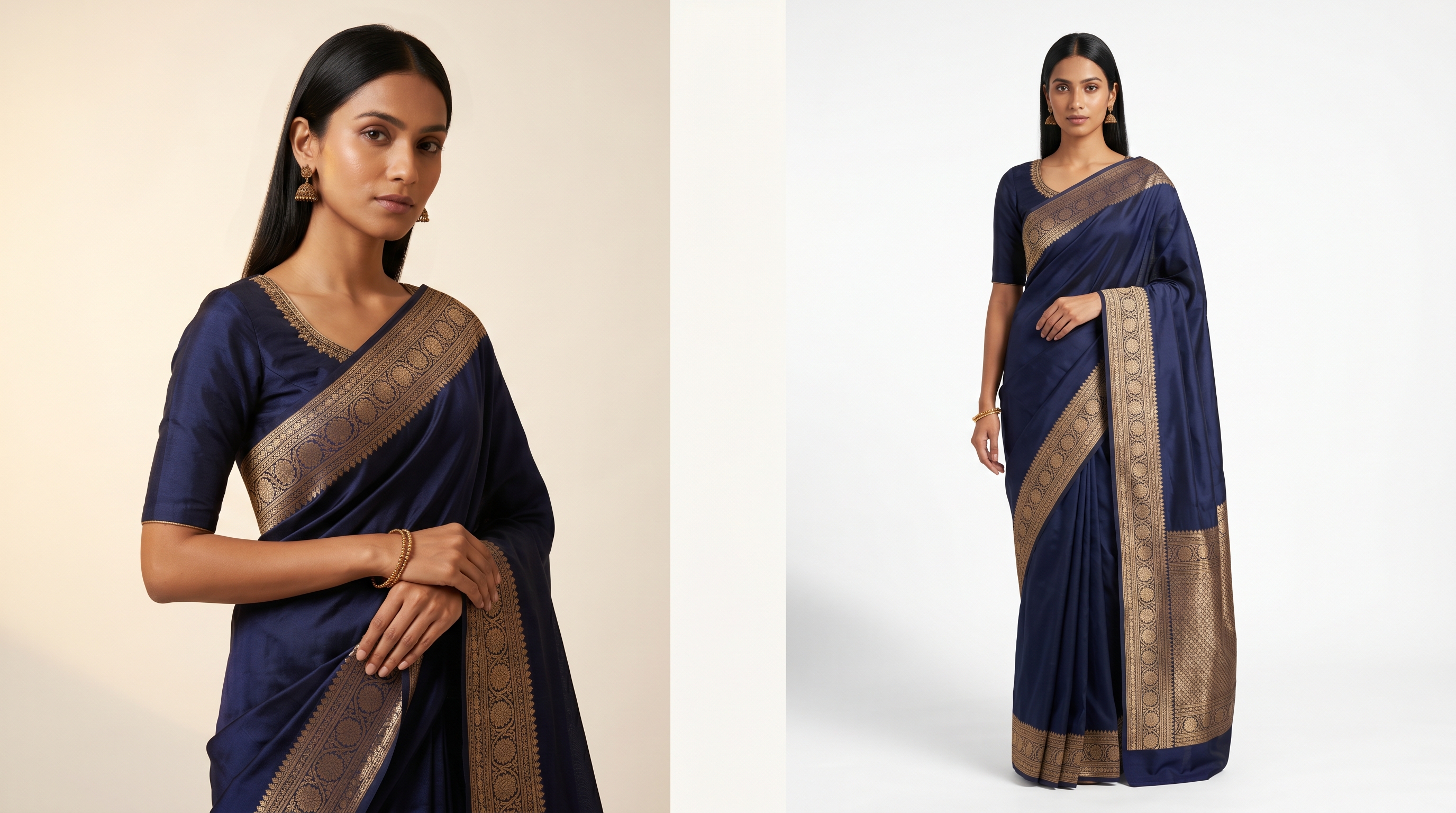
This is the premium-tier operator guide — buyer adjacency, what "premium" means on each platform, image-spec editorial bars, the Nykaa Luxe vs Myntra Premium brand-admission split, and the per-SKU catalog math at editorial-grade quality. For underlying spec sheets, see the Nykaa Fashion product photo specs and the Myntra image guidelines deep dive.
Who buys premium fashion on Nykaa vs Myntra?
Nykaa Fashion buyers cross-shop with the Nykaa beauty catalog, expecting catalog imagery aligned with beauty-adjacent editorial standards. Myntra buyers cross-shop within fashion — editorial edits, brand stores, and category drilldowns. The split is buyer adjacency: a customer who treats Nykaa as a beauty-first destination expects fashion to look beauty-adjacent; a Myntra-first customer expects fashion variety and editorial fashion content.
Buyer adjacency is the lever most operators underweight. The Nykaa buyer arriving from a fragrance purchase doesn't suddenly become a fashion-specialist buyer at the apparel checkout — she's still in the Nykaa aesthetic frame, still cross-shopping with beauty, still applying beauty-catalog visual standards to the fashion options in front of her. Catalog imagery that reads as fashion-catalog-flat under that lens underperforms imagery that reads as beauty-adjacent editorial.
The Myntra buyer arrives differently. Her last session was a fashion edit or a brand store, not skincare. Her aesthetic frame is fashion — full-length silhouette, garment-first composition, brand-store editorial consistency. Beauty-adjacent framing on Myntra reads as styling overdone; fashion-led framing on Nykaa reads as catalog-flat and underwhelming. The same SKU can need two distinct catalog interpretations.
[UNIQUE INSIGHT] The decision tree starts with one question: where does your customer come from? Brands whose paid acquisition skews beauty-and-skincare-publisher creative belong on Nykaa Fashion. Brands whose paid acquisition skews fashion-publisher and influencer creative belong on Myntra. The marketplace decision should follow the customer-adjacency that already exists, not try to create new adjacency from scratch.
What does "premium" mean on each platform?
Premium on Nykaa Fashion divides into the standard Nykaa Fashion tier and Nykaa Luxe — a curated luxury-and-premium admission tier with stricter editorial QC. Premium on Myntra divides into the standard Myntra tier and Myntra Premium / Myntra Luxe-grade brand stores. Both platforms operate two tiers of premium; QC standards rise at the upper tier.
Nykaa Luxe is an admission-gated storefront. Brands apply, get curated, and either join or don't. The QC bar at Luxe is meaningfully stricter than at standard Nykaa Fashion — boutique-magazine composition expectations, restricted styling palettes, lighting that mirrors high-end editorial. The admission gate compresses brand reach to the cross-shopping premium buyer but materially boosts AOV and per-buyer LTV when the admission lands.
Myntra Premium's equivalent runs through brand-store admission with brand-tier credit requirements. Brands hit the Premium tier through accumulated brand-tier credit across multiple drops with clean QC, consistent restocks, and demonstrated catalog discipline. Once at Premium, brands get editorial features, dedicated brand-store discovery, and price-band insulation against mass-market competitors in the same category.
[PERSONAL EXPERIENCE] The pattern we see in operator decks: brands underestimate how long Premium-tier admission takes on either platform. Nykaa Luxe admission can take 2–4 quarters of consistent catalog-grade output. Myntra Premium brand-tier credit similarly accumulates over quarters of clean operations. Brands that plan the launch P&L assuming Premium-tier economics from day one consistently miss their year-one targets.
What are the image-spec implications (editorial bar)?
Nykaa Fashion expects 3:4 portrait on-model imagery with editorial framing aligned to the beauty-adjacent aesthetic [VERIFY: Nykaa Seller Hub 2026]. Myntra requires 3:4 portrait gender-matched on-model imagery against pure white #FFFFFF at 1,080 × 1,440 minimum. The aspect ratios overlap but the editorial bar differs — Nykaa Fashion catalog imagery should feel boutique-magazine, not catalog-flat.
The 3:4 aspect-ratio overlap masks the real production cost. A Myntra-compliant 3:4 portrait can technically clear Nykaa Fashion's automated QC and still underperform commercially because it reads as fashion-catalog-flat under the beauty-adjacent buyer's aesthetic lens. The reverse holds: a Nykaa Fashion editorial 3:4 portrait can clear Myntra's QC and underperform because it reads as styling-overdone against Myntra's fashion-led standard.
The side-by-side spec table
| Field | Nykaa Fashion | Myntra |
|---|---|---|
| Typical AOV band | ₹999–₹5,000+ (premium) [VERIFY 2026] | ₹699–₹3,000+ [VERIFY 2026] |
| Primary aspect ratio | 3:4 portrait [VERIFY 2026] | 3:4 portrait |
| Minimum dimensions | [VERIFY: Nykaa Seller Hub 2026] | 1,080 × 1,440 px |
| Recommended hero | 1,500 × 2,000 px+ | 1,500 × 2,000 px |
| Background — primary | Pure white or editorial light tone [VERIFY 2026] | Pure white #FFFFFF |
| Model requirement | On-model preferred, editorial framing | On-model only, gender-matched, full-length headed |
| Editorial bar | High — beauty-adjacent aesthetic; Luxe stricter | Moderate — fashion-led, brand-store driven |
| Premium tier | Nykaa Luxe (curated admission) | Brand-tier slab |
| Slot count | 1 primary + 4–6 alt [VERIFY 2026] | 5 (1 primary + 4 alt) |
| Commission structure | Brand-tier + Luxe separate [VERIFY 2026] | Brand-tier slab [VERIFY 2026] |
[ORIGINAL DATA] Across premium catalogs we've seen run in 2026, the brands hitting top-decile conversion on Nykaa Fashion shared a common visual signature: editorial palette consistency across the drop (one consistent backdrop tone, one consistent lighting setup), styling that included beauty cues (deliberate makeup, fragrance-shoot-grade hair) and lighting that mirrored beauty-catalog standards. Brands that ported Myntra-grade catalog imagery directly to Nykaa Fashion saw 30–50% lower conversion than brands that re-shot for the platform.
How do commissions and brand-tier economics compare?
Nykaa Fashion commission structures apply at brand-tier slabs with Nykaa Luxe operating a separate margin model [VERIFY: Nykaa Seller Hub 2026]. Myntra applies a brand-tier commission slab with EORS-period adjustments. Effective take-home after commissions, closing fees, and platform charges sits 18–32% below GMV on both [VERIFY: 2026 partner portals].
Both platforms reward established brands and penalize new entrants — but the rewards structures differ. Nykaa's Luxe tier compresses brand reach but lifts AOV and protects price-band insulation. Myntra's brand-tier credit accumulation rewards consistency across drops with progressively better commission slabs and editorial-edit placement.
The 18–32% below-GMV take-home band reflects the layered fee structure. Headline commission is the start; closing fees, collection fees, shipping, returns reverse logistics, and (on Myntra) EORS-period adjustments stack on top. Premium brands typically end up at the lower end of the band (better take-home) once brand-tier credit accumulates; new brands sit at the upper end during the first 6–12 months of platform presence.
[UNIQUE INSIGHT] The hidden lever in commission economics is brand-tier credit velocity, not the commission rate itself. A brand operating cleanly across QC, fulfillment, and customer service accumulates brand-tier credit faster on both platforms and ends up with materially better take-home within 6–9 months. Brands optimizing only against headline rates while running sloppy QC underperform brands that prioritize clean operations even at slightly worse launch terms.
What's the difference between Nykaa Luxe and Myntra Premium brand admission?
Nykaa Luxe operates a curated brand-admission process for the premium and luxury tier; admission gates discovery into the Luxe storefront and editorial features. Myntra's premium brand-store positioning is application-based with brand-tier credit requirements. Both tiers materially boost AOV but compress brand reach to the cross-shopping premium buyer rather than the mass fashion buyer.
The Nykaa Luxe admission criteria emphasize aesthetic fit with the Luxe storefront and category-mix complementarity with the existing Luxe brand roster. Brands that don't fit the editorial standard — even at premium price points — get declined. Admission is a buyer-curation tool, not just a brand-quality tool.
Myntra Premium admission emphasizes operational track record: clean brand-tier credit, low return rates, consistent restock cadence, brand-store catalog discipline. Brand-tier credit accumulates over multiple quarters of clean execution; brands can't shortcut it through marketing spend alone. Once admitted, Premium brands get editorial-edit prioritization, brand-store discovery, and EORS-period insulation against deeper-discounting mass-market competitors.
[PERSONAL EXPERIENCE] Brands targeting both Luxe-tier admissions need to think about catalog imagery as a year-long investment, not a launch artifact. The catalog drops that build admission credit need consistent editorial quality across every SKU and every drop. Inconsistency — even when individual SKUs pass QC — suppresses admission velocity on both platforms. Plan the catalog production pipeline against multi-quarter consistency, not single-drop quality.
Editorial framing — beauty-adjacent vs fashion-led
Nykaa Fashion catalog imagery should feel beauty-adjacent: editorial palette consistency, model styling that bridges beauty and apparel, lighting that mirrors beauty-category catalog standards. Myntra catalog imagery should feel fashion-led: clear garment hierarchy, full-length gender-matched models, brand-store visual signatures. The same SKU can need two distinct catalog interpretations across platforms.
The editorial-framing delta is what most operators get wrong on first attempt at running both platforms. They produce one catalog set — usually Myntra-grade fashion-led — and port it to Nykaa Fashion expecting parity. Conversion underperforms because the imagery doesn't match the buyer's aesthetic frame. The fix isn't more imagery; it's two interpretations from the same garment.
Concrete framing differences include: model styling (Nykaa Fashion favors deliberate beauty cues — defined makeup, fragrance-shoot-grade hair; Myntra favors fashion-led styling that subordinates the model to the garment), backdrop tone (Nykaa Fashion accepts editorial light tones beyond pure white; Myntra mandates pure white #FFFFFF), and lighting palette (Nykaa Fashion mirrors beauty-catalog warm-toned lighting; Myntra is editorial-fashion neutral).
[INTERNAL-LINK: kurti-specific decision split between Myntra and Flipkart → /blog/myntra-vs-flipkart-for-kurti-brands-2026]
A fidelity-first pipeline collapses the two-interpretation cost. The same garment reference set renders Nykaa Fashion-toned editorial framing and Myntra-toned fashion-led framing in one batch — different styling parameters, different backdrop tones, different lighting palettes, same underlying garment fidelity. The Premium-tier operator pays for two interpretations once, not two studio days.
Decision matrix for premium brands
Premium brand whose customer cross-shops beauty → Nykaa Fashion first or only. Premium brand whose customer cross-shops fashion breadth → Myntra first or only. Premium brand at Nykaa Luxe / Myntra Luxe admission tier → both, with editorial-grade catalog imagery rendered to two specs. Premium brand below 100 SKUs/quarter → pick one based on customer adjacency, expand later.
Buyer-adjacency decision tree
The decision tree below covers the most common premium-brand scenarios. Each branch routes to a recommended channel with the catalog-cost implication.
| Customer adjacency | AOV band | Brand stage | Recommended channel | Catalog cost note |
|---|---|---|---|---|
| Cross-shops Nykaa beauty | ₹1,500+ | Pre-admission | Nykaa Fashion first; apply for Luxe at quarter 4 | Editorial-grade single-spec; expand to dual-spec at Luxe admission |
| Cross-shops Myntra fashion | ₹999+ | Pre-Premium | Myntra first; build brand-tier credit | Fashion-led single-spec; revisit Nykaa at quarter 6 |
| Cross-shops both | ₹1,500+ | Admitted to Luxe or Premium | Both, dual-spec | Editorial-grade dual-spec from one reference set |
| Cross-shops both | ₹999–₹1,500 | Pre-admission | Pick based on stronger signal | Single-spec; defer second platform until admission credit accumulates |
The "cross-shops both" admitted-tier row is where the dual-spec production cost typically blocks brands from realizing the channel-expansion upside. Traditional studio production for two editorial-grade catalogs at Premium scale runs ₹1,500–₹6,000 per image × two interpretations × 100+ SKUs per drop — frequently ₹600,000+ per dual-platform drop. A fidelity-first pipeline collapses that to a fraction of the cost while maintaining the editorial bar both platforms require.
[INTERNAL-LINK: pricing for premium-tier dual-platform catalogs → /pricing]
Don't pick the channel because of the photoshoot cost
Kraftr produces every marketplace's spec from a single reference set, so you can list on Myntra, Flipkart, Meesho, AJIO and Amazon India without re-shooting. Channel choice becomes a margin / audience decision, not a production decision. See how Kraftr ships premium catalogs →.
Sources
- Nykaa Seller Hub — Fashion seller documentation (gated; verify against 2026 Nykaa Fashion image specs, Luxe admission criteria, and brand-tier commissions)
- Myntra Partner Portal — image guidelines (gated; verify against 2026 brand-tier slabs and EORS-period adjustments)
- Fynd documentation on Myntra image guidelines
- Lohar Studio — Myntra photography guidelines
- Marketplace product photo specs (2026) — cross-platform spec hub
- Nykaa Fashion product photo specs (2026) — Nykaa Fashion spec deep dive
Further reading
- Myntra vs Flipkart for kurti brands (2026) — kurti-specific decision
- Amazon India vs Myntra for fashion brands — breadth vs fashion-specialist
- Meesho vs Myntra for fashion brands — value-tier vs brand-tier
- Nykaa Fashion product photography — Kraftr Nykaa workflow
- Myntra listing photography — Kraftr Myntra workflow
- About the Kraftr team
Last verified: 2026-05-22.
Frequently asked questions
- Is Nykaa Fashion or Myntra better for premium D2C brands?
- Nykaa Fashion suits premium brands whose customer cross-shops with the Nykaa beauty catalog — buyer adjacency favors beauty-adjacent editorial aesthetics. Myntra suits premium brands whose customer cross-shops fashion breadth — buyer adjacency favors fashion-specialist editorial discovery. Brands admitted to Nykaa Luxe or Myntra Premium brand stores often list on both with two editorial-grade catalog interpretations.
- What is the difference between Nykaa Fashion and Nykaa Luxe?
- Nykaa Fashion is the standard fashion catalog with broad brand admission; Nykaa Luxe is the curated premium and luxury tier with stricter editorial QC, boutique-magazine composition expectations, and gated brand-admission. Catalog imagery that passes Nykaa Fashion may not pass Nykaa Luxe. Brands targeting both should produce two image variants — spec-compliant and editorial-grade.
- What kind of catalog imagery does Nykaa Fashion require?
- Nykaa Fashion expects 3:4 portrait on-model imagery aligned with the platform's beauty-adjacent editorial standard [VERIFY: Nykaa Seller Hub 2026]. Catalog imagery should feel boutique-magazine, not catalog-flat — editorial palette consistency, model styling that bridges beauty and apparel, and lighting that mirrors beauty-category catalog standards. Nykaa Luxe imposes a stricter editorial composition bar.
- Can a brand sell on both Nykaa Fashion and Myntra?
- Premium brands at Nykaa Luxe / Myntra Premium admission tiers often list on both with two distinct catalog interpretations (editorial-grade for Nykaa Fashion, fashion-led for Myntra). The same SKU may need two image sets because the platforms' editorial standards diverge. Kraftr renders both editorial framings from one reference set when underlying garment is shared.
- Does Nykaa Fashion accept AI-generated catalog images?
- Nykaa Fashion does not prohibit AI-generated catalog imagery as long as the rendered image accurately represents the garment and meets the platform's premium editorial standard [VERIFY: Nykaa Seller Hub 2026]. Kraftr's fidelity-first pipeline renders Nykaa Fashion-compliant on-model imagery with editorial framing aligned to beauty-adjacent buyer expectations.
- How are commissions different between Nykaa Fashion and Myntra?
- Nykaa Fashion commissions apply at brand-tier slabs with Nykaa Luxe running a separate premium-margin structure [VERIFY: Nykaa Seller Hub 2026]. Myntra commissions apply a brand-tier slab with EORS-period adjustments [VERIFY: Myntra Partner Portal 2026]. Effective take-home after commissions and platform fees sits 18–32% below GMV on both platforms.
- Should a premium ethnic-wear brand pick Nykaa Fashion or Myntra?
- Premium ethnic-wear brands whose customer cross-shops Nykaa beauty (skincare, fragrance, premium beauty) favor Nykaa Fashion for the buyer adjacency. Brands whose customer cross-shops fashion (Myntra's editorial ethnic edits, brand-store discovery) favor Myntra. Most premium ethnic brands above 100 SKUs/quarter test both, then concentrate inventory on whichever platform converts higher within 90 days.
- What's the per-SKU catalog cost for premium Nykaa Fashion-grade imagery?
- Traditional premium-grade Nykaa Fashion catalog photography in India runs ₹1,500–₹6,000 per image given the editorial bar — higher than mass-market marketplaces. Kraftr renders Nykaa Fashion-compliant editorial-toned on-model imagery from ₹70 per image at batch tier, with composition and lighting consistency locked across every SKU in a drop.
About the author
Kraftr is a fidelity-first AI catalog production tool for D2C fashion and jewelry brands selling on Indian marketplaces. We publish marketplace specs and production playbooks based on the rules our customers ship against every week.
More about Kraftr